TEST 1 — HOUSEHOLD
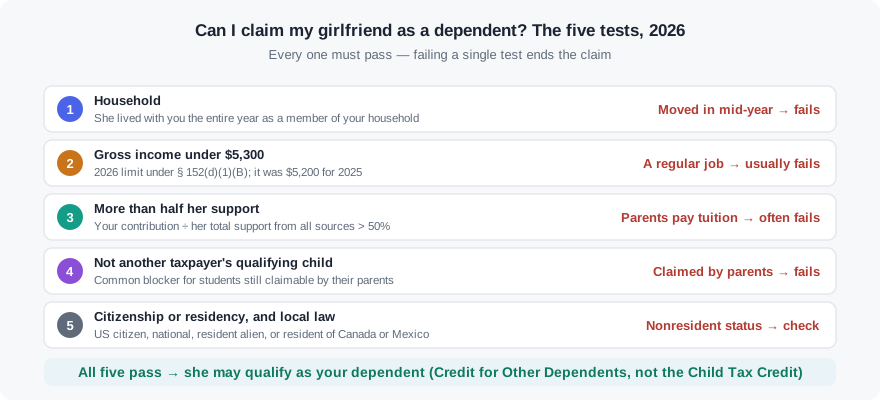
Test 1: Your Girlfriend Must Live With You All Year
This is the biggest difference between claiming a girlfriend and claiming family. Parents, children, siblings, grandparents and certain in-laws satisfy the relationship requirement without living with you. A girlfriend is not on that list, so your home has to have been her household for the full year.
Moved in on 1 January and stayed through 31 December? That part of the test may be met. Moved in during June? Even if you paid every one of her expenses from that day on, the full-year requirement fails for that tax year. Certain temporary absences — education, illness, business, vacation, military service — can be treated differently from permanently living elsewhere.
The question is not whether she spent a lot of time at your place. It is whether your home was her household for the required period.
TEST 2 — INCOME
Test 2: Her Gross Income Must Be Under $5,300
For 2026, a qualifying relative's gross income must be less than $5,300. The limit was $5,200 for 2025 — it is indexed for inflation and moves most years, so check the figure for the return you are actually filing.
| Her gross income | Income test |
|---|
| $0 — she does not work | Passes |
| $3,000 from occasional part-time work | Passes |
| $5,299 | Passes, barely |
| $5,300 | Fails — the limit is “less than” |
| $15,000 from a regular job | Fails |
This is the test that ends most cases. A girlfriend earning $15,000 cannot be your dependent even if you pay the rent, utilities, groceries and insurance — her income is simply over the line.
One detail that trips people up: gross income is not what lands in her bank account. The IRS means income in the form of money, property and services that is not exempt from tax. If you want to see the gap between the two for your own pay, the paycheck calculator breaks gross down to net line by line, and how much tax is taken from a paycheck explains each deduction.
TEST 3 — SUPPORT
Test 3: You Must Provide More Than Half Her Support
Clearing the income test does not finish the job. You generally have to provide more than 50% of her total support for the calendar year. Support includes housing, food, clothing, medical and dental costs, transportation, education, recreation and other basic living expenses.
Housing carries a lot of weight. If she lives in a home you pay for, the value of that lodging counts toward the support you provide. The arithmetic is simply support you provided ÷ total support she received, and the result has to clear 50%.
| What you paid | Amount |
|---|
| Housing | $7,000 |
| Food | $3,000 |
| Transportation | $1,500 |
| Medical and other | $1,000 |
| Your total | $12,500 |
| Her total support from all sources | $20,000 |
| Your share | 62.5% — passes |
Contribute $9,000 of that same $20,000 instead and your share is 45% — the test fails. Note that the denominator is her total support from every source, not just what the two of you spent, which is why parental contributions so often break this test.
TESTS 4 AND 5
Tests 4 and 5: The Dependent Rules People Forget
She cannot be someone else's qualifying child
If your girlfriend is the qualifying child of another taxpayer, you cannot claim her as your qualifying relative instead. This comes up most with younger adults: a 21-year-old full-time student may still meet the requirements to be her parents' qualifying child, depending on her living situation. Who pays the bills is not the whole question.
Citizenship, residency, and local law
A dependent generally must be a U.S. citizen, U.S. national, U.S. resident alien, or a resident of Canada or Mexico, subject to the applicable exceptions. This matters if one partner recently moved to the United States, is an international student, or has nonresident status.
There is also a rule that gets almost no attention: for an unrelated person to qualify by living in your household, the relationship must not violate local law. Publication 501 gives the example of a partner who lived with the taxpayer all year but was married to someone else — the relationship violated state law, so the household test failed.
WHAT IT IS WORTH
What Claiming a Girlfriend as a Dependent Is Worth
A girlfriend who qualifies as your dependent does not make you eligible for the Child Tax Credit. A qualifying relative may make you eligible for the Credit for Other Dependents, assuming the credit's own requirements are met. Credit amounts and income limits change, so check the rules for the year you are filing.
Claiming her also does not make you Head of Household by itself — those are separate tests, and an unrelated partner is not a qualifying person for that status.
Whether the claim changes your bottom line depends on your income, filing status and other credits. Run your numbers before and after with the take-home pay calculator, and if the answer changes your withholding, what a tax write-off actually does explains why a deduction and a credit move your bill by different amounts.
Being claimed does not stop her filing her own return, either. She may still need to file — or want to, to recover withholding — as long as the return reflects her dependent status correctly.
FREQUENTLY ASKED QUESTIONS
Can I Claim My Girlfriend as a Dependent? FAQ
Can I claim my girlfriend as a dependent if she has no income?+
Potentially. Having no income satisfies the gross income part of the test, and it is the easiest test to clear. She still has to live with you for the entire year as a member of your household, receive more than half her support from you, not be another taxpayer's qualifying child, and meet the citizenship or residency rule.
Can I claim my girlfriend as a dependent if she works?+
Only if her gross income stays under the limit — $5,300 for 2026. A job does not disqualify her by itself, but anything close to full-time work almost certainly pushes her over. For most working couples the income test settles the question before the support calculation even matters.
Can I claim my girlfriend if we don't live together?+
Generally no. A girlfriend is not one of the relatives who can meet the relationship test without living with you, so she has to live in your household for the whole year. Paying her rent somewhere else does not substitute for that, no matter how much of her support you provide.
Can I claim my girlfriend if she lived with me for six months?+
Generally no. The "more than half the year" rule people remember belongs to the qualifying child test, not this one. An unrelated partner has to live with you all year. Moving in during February or June breaks it for that tax year, though certain temporary absences — school, illness, military service, vacation — may be treated differently.
Can I claim my girlfriend and her child?+
They are evaluated separately, and one can qualify while the other does not. The common blocker is that her child is her own qualifying child, which prevents you from claiming the child as your qualifying relative. Do not assume that clearing the tests for her clears them for the child.
Does claiming my girlfriend make me Head of Household?+
Usually not on its own. Dependent status and Head of Household are different tests. IRS Publication 501 gives the example directly: a friend who lives with you all year may be your qualifying relative, but is not a qualifying person for Head of Household because they are not related to you in one of the required ways.
How much can my girlfriend make and still be my dependent?+
Under $5,300 of gross income for 2026, up from $5,200 for 2025. The figure is indexed and changes most years, so check the limit for the specific return you are filing. Gross income here means income in money, property and services that is not exempt from tax — not the amount that lands in her bank account after withholding.
Can I claim my boyfriend as a dependent?+
The same rules apply. Nothing in the qualifying relative test turns on gender: an unmarried boyfriend, partner or unrelated housemate can qualify on exactly the same five conditions.
BOTTOM LINE
Bottom Line: Can You Claim Your Girlfriend as a Dependent?
You can potentially claim your girlfriend as a dependent, but only if she meets the qualifying relative requirements. In practice the full-year household test, the $5,300 income test and the support test decide almost every case. A partner who lived with you all year, earned very little and received more than half her support from you has a real chance; one with a regular full-time income or her own place does not.
Before filing, add up the support you actually provided and confirm her gross income for the year. The IRS's Whom May I Claim as a Dependent? interactive assistant gives a situation-specific answer, and Publication 501 is the underlying source for every rule on this page. The $5,300 figure comes from IRS Revenue Procedure 2025-32, which sets the § 152(d)(1)(B) exemption amount for 2026.
Disclaimer: general information, not individualised tax advice. Thresholds change between years — always verify the limit for the tax year you are filing.
Reviewed by: Paycheck Calculator Editorial Team
Limits current for tax year 2026