How Much Taxes Deducted From Paycheck Texas: 2026 Breakdown
If you are asking how much taxes deducted from paycheck Texas employers actually withhold, the 2026 answer is short: federal income tax plus 7.65% for Social Security and Medicare, and nothing at all for state income tax.
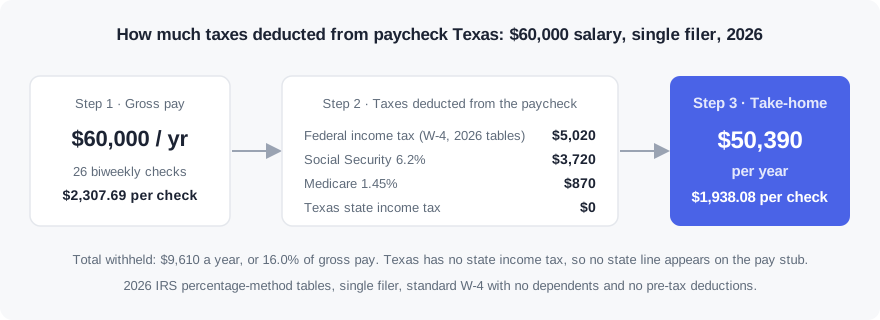
A single filer earning $60,000 in Texas has $9,610 withheld over the year — 16.0% of gross pay — which works out to $369.62 out of every biweekly paycheck and $1,938.08 landing in the bank.
This guide walks the exact dollar amounts by salary, by pay frequency and by filing status, then shows which Form W-4 entries change the number on your stub. Run your own figures in the Texas paycheck calculator when you are done.
THE SHORT ANSWER
How Much Taxes Deducted From Paycheck Texas Workers See in 2026
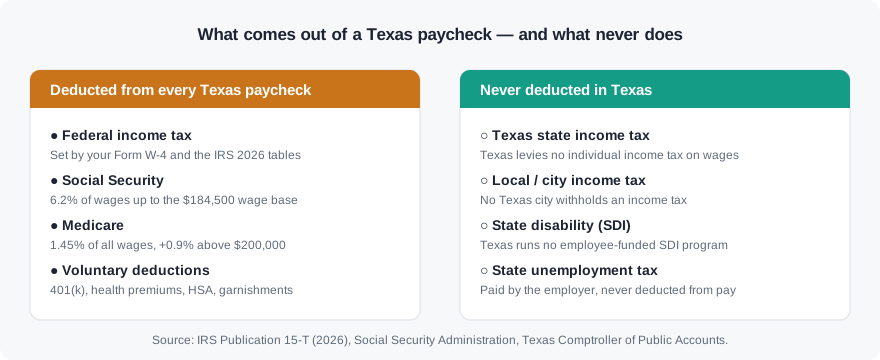
Three federal taxes come out of a Texas paycheck, and that is the whole list. Texas levies no individual income tax on wages, so the state line on a Texas pay stub reads $0.00 no matter how much you earn or where in the state you work.
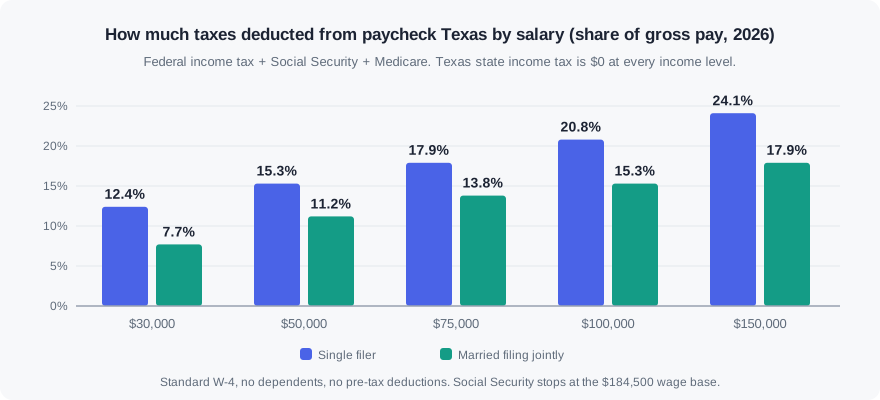
The percentage deducted rises with income because federal withholding is progressive, while Social Security and Medicare stay flat at 6.2% and 1.45%. That is why a Texas paycheck loses roughly 12% of gross at $30,000 but close to 24% at $150,000.
EVERY LINE ON THE STUB
The Four Tax Lines on a Texas Paycheck
Payroll systems label these differently — OASDI, FICA-MED, FIT — but every tax deducted from a Texas paycheck falls into one of the four buckets below.
1. Federal Income Tax Withheld From Texas Wages
Federal income tax is the largest and the only variable deduction. Your employer annualizes the wages on each check, applies the IRS percentage-method tables for 2026, and subtracts a standard adjustment of $8,600 for single filers or $12,900 for married filing jointly before the brackets apply. Everything you enter on Form W-4 feeds this calculation.
2. Social Security: 6.2% of Texas Paycheck Wages
Social Security tax is a flat 6.2% of wages up to the $184,500 wage base for 2026. Once year-to-date wages pass that ceiling the deduction stops for the rest of the year, which is why high earners in Texas see their December paychecks grow. Your employer pays a matching 6.2% that never appears on your stub.
3. Medicare: 1.45% of Every Texas Paycheck
Medicare tax is 1.45% of all wages with no ceiling. Wages above $200,000 in a calendar year pick up an extra 0.9% Additional Medicare Tax, which employers must start withholding as soon as you cross that threshold regardless of filing status.
4. Texas State Income Tax: $0.00 Deducted
Texas is one of the states with no individual income tax on wages, and the Texas Constitution requires a statewide vote before one could be introduced. No Texas city withholds a local income tax, and Texas runs no employee-funded disability program, so there is no SDI deduction either. State unemployment tax exists in Texas, but employers pay it — it is never deducted from your pay.
DOLLAR AMOUNTS
How Much Taxes Deducted From Paycheck Texas by Salary (2026 Table)
Every row below is a single filer claiming no dependents, with a standard Form W-4 and no pre-tax deductions. Federal income tax uses the 2026 percentage-method tables; Social Security and Medicare use the statutory 6.2% and 1.45% rates.
| Gross salary | Federal income tax | Social Security | Medicare | Total deducted | Share of gross | Take-home per year | Biweekly take-home |
|---|---|---|---|---|---|---|---|
| $30,000 | $1,420 | $1,860 | $435 | $3,715 | 12.4% | $26,285 | $1,010.96 |
| $40,000 | $2,620 | $2,480 | $580 | $5,680 | 14.2% | $34,320 | $1,320.00 |
| $50,000 | $3,820 | $3,100 | $725 | $7,645 | 15.3% | $42,355 | $1,629.04 |
| $60,000 | $5,020 | $3,720 | $870 | $9,610 | 16.0% | $50,390 | $1,938.08 |
| $75,000 | $7,670 | $4,650 | $1,087.50 | $13,407.50 | 17.9% | $61,592.50 | $2,368.94 |
| $100,000 | $13,170 | $6,200 | $1,450 | $20,820 | 20.8% | $79,180 | $3,045.38 |
| $150,000 | $24,734 | $9,300 | $2,175 | $36,209 | 24.1% | $113,791 | $4,376.58 |
Filing status moves these numbers more than anything else on the list. The same $60,000 Texas salary filed as married filing jointly is taxed $2,840 in federal withholding instead of $5,020, so total deductions fall to $7,430 — 12.4% of gross — and biweekly take-home rises to $2,021.92. At $100,000 the married filer keeps $84,710 against the single filer's $79,180.
PER PAYCHECK
Taxes Deducted From a Texas Paycheck by Pay Frequency
Pay frequency does not change what you owe over a year — it only changes how the same $9,610 is split. The table below takes the $60,000 single-filer example and divides it four ways.
| Pay frequency | Checks per year | Gross per check | Taxes deducted per check | Take-home per check |
|---|---|---|---|---|
| Weekly | 52 | $1,153.85 | $184.81 | $969.04 |
| Biweekly | 26 | $2,307.69 | $369.62 | $1,938.08 |
| Semimonthly | 24 | $2,500.00 | $400.42 | $2,099.58 |
| Monthly | 12 | $5,000.00 | $800.83 | $4,199.17 |
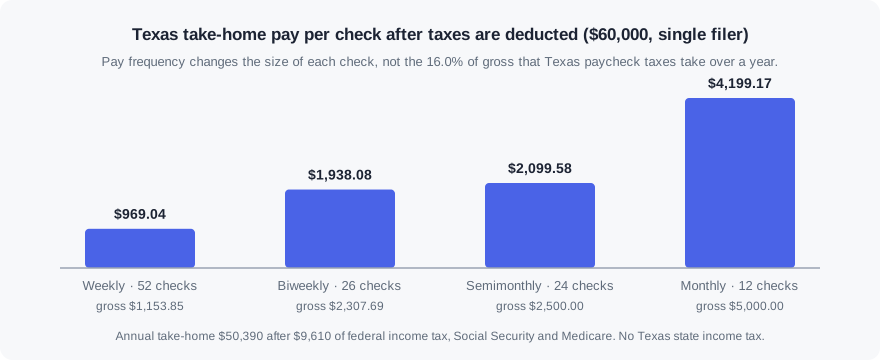
Biweekly pay adds one wrinkle. Two months a year contain three biweekly paydays, and because federal withholding annualizes each check on its own, that third check is taxed at the same rate as the others rather than pushing you into a higher bracket. Compare schedules side by side with the Texas biweekly paycheck calculator.
ONE CHECK, LINE BY LINE
Where Each Dollar of a Texas Paycheck Goes
On a $2,307.69 biweekly check, 84.0% of gross reaches your account. Federal income tax takes 8.4%, Social Security 6.2% and Medicare 1.45% — and the state takes nothing.
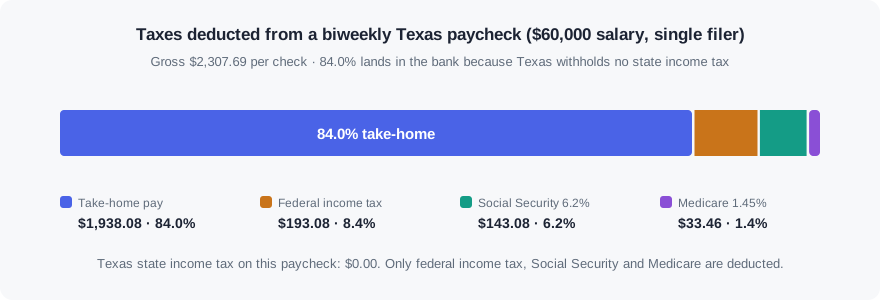
That 84.0% is the number worth remembering when you compare a Texas job offer against one in a state that withholds income tax. The federal and FICA lines follow you anywhere in the country; the missing state line is what makes Texas different.
WHEN THE NUMBER MOVES
Why the Taxes Deducted From Your Texas Paycheck Changed
Because Texas has no state withholding form, Form W-4 is the only document that changes the tax line on your stub. Six inputs account for nearly every surprise.
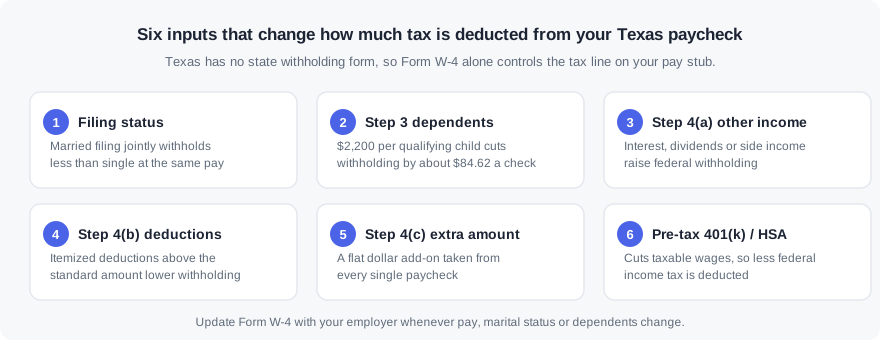
- Overtime, bonuses and commissions. A supplemental payment can be withheld at the flat 22% federal rate, or lumped into a regular check and annualized, which makes that one paycheck look heavily taxed.
- A filing status change. Switching from single to married filing jointly on Form W-4 drops federal withholding by about $2,180 a year on a $60,000 Texas salary.
- Dependents in Step 3. Each qualifying child removes $2,200 of annual withholding — roughly $84.62 from every biweekly Texas paycheck.
- Extra withholding in Step 4(c). This is a flat dollar add-on taken from every check, and it is the most common reason a Texas paycheck is smaller than the tables predict.
- Pre-tax benefits starting or stopping. A 401(k), HSA or Section 125 health premium lowers taxable wages, so pausing one raises the tax deducted from your Texas paycheck.
- Crossing a wage threshold. Social Security stops at $184,500 of year-to-date wages; Additional Medicare Tax of 0.9% starts at $200,000.
DO IT YOURSELF
How to Calculate How Much Taxes Deducted From Paycheck Texas Employers Withhold
Five steps reproduce what a Texas payroll system does on every pay date.
Annualize Texas Gross Pay
Multiply gross pay on the check by the number of pay periods: $2,307.69 × 26 = $60,000.
Subtract Pre-Tax Deductions
Remove 401(k), HSA and Section 125 health premiums to get taxable wages for federal income tax.
Apply the Federal W-4 Tables
Subtract $8,600 (single) or $12,900 (married), run the 2026 brackets, then divide by the number of pay periods.
Add Social Security and Medicare
6.2% of wages up to $184,500 plus 1.45% of all wages — 7.65% combined for most Texas employees.
Skip the Texas State Line
Enter $0 for state income tax, then subtract every deduction from gross to get Texas take-home pay.
If you would rather not run the tables by hand, the Texas take-home pay calculator applies the same 2026 methods to your salary, filing status and deductions in one pass.
RUN YOUR OWN NUMBERS
Texas Paycheck Tax Calculators and Related Guides
Each tool below applies the same 2026 federal withholding engine used for the figures on this page.
QUESTIONS
Texas Paycheck Tax FAQs
How much taxes deducted from paycheck Texas employers withhold in 2026?
Texas employers withhold federal income tax plus 7.65% FICA (6.2% Social Security and 1.45% Medicare). There is no Texas state income tax withholding. A single filer earning $60,000 has about $9,610 withheld a year, or 16.0% of gross pay, which is $369.62 out of each biweekly paycheck.
Does Texas take state income tax out of your paycheck?
No. Texas does not levy an individual income tax on wages, so no state income tax line appears on a Texas pay stub. No Texas city withholds a local income tax either, and Texas has no employee-funded disability insurance deduction.
What percentage is taken out of a Texas paycheck for taxes?
For a single filer with a standard Form W-4 and no pre-tax deductions, total 2026 withholding runs about 12.4% of gross pay at $30,000, 16.0% at $60,000, 20.8% at $100,000 and 24.1% at $150,000. Married filing jointly is roughly three to five points lower at the same salary.
How much is taken out of a $60,000 salary in Texas?
A $60,000 Texas salary for a single filer loses $5,020 in federal income tax, $3,720 in Social Security and $870 in Medicare — $9,610 total. Annual take-home is $50,390, which is $1,938.08 per biweekly paycheck.
Why did more tax come out of my Texas paycheck this month?
Federal withholding is calculated per pay period, so overtime, a bonus, a commission or an extra pay period pushes that single check into a higher annualized bracket. Changing your Form W-4, dropping a pre-tax 401(k) contribution, or crossing the $200,000 additional Medicare threshold also raises the amount deducted.
How can I reduce the taxes deducted from my Texas paycheck?
Contribute to a pre-tax 401(k), HSA or FSA to lower taxable wages, claim dependents in Step 3 of Form W-4, and remove any extra withholding you entered in Step 4(c). Because Texas has no state income tax, Form W-4 is the only lever that changes the tax line on your stub.
METHODOLOGY
Sources Behind These Texas Paycheck Tax Figures
Every dollar amount on this page comes from the same 2026 withholding engine that powers the calculators on this site, documented in our paycheck calculation methodology. Primary sources:
- IRS Publication 15-T — federal income tax withholding methods and the percentage-method tables.
- IRS Form W-4 — the employee entries that drive federal withholding on a Texas paycheck.
- Social Security Administration contribution and benefit base — the annual Social Security wage cap.
- Texas Comptroller of Public Accounts — confirmation that Texas levies no individual income tax on wages.
Disclaimer on Texas Paycheck Tax Estimates
These Texas paycheck figures are educational estimates, not tax advice. Actual withholding depends on your employer's payroll system, year-to-date wages, benefit elections, bonus treatment and the Form W-4 on file. Consult a qualified tax professional for guidance on your own situation.