Oklahoma combines graduated state taxation with a paycheck calculation that rounds withholding to whole dollars. This Oklahoma paycheck calculator follows the 2026 percentage method, making the state's rounding convention visible in every example.
Enter your salary information above to estimate your Oklahoma paycheck based on your pay frequency, deductions, and payroll factors. The same tool doubles as a Oklahoma salary calculator for annual pay, a Oklahoma pay calculator for hourly wages, and a Oklahoma payroll estimator for any pay schedule.
2026 IRS MethodSource-Backed CalculationsFree to Use
OK PAYCHECK BREAKDOWN
What This Oklahoma Paycheck Calculator Includes
Federal income tax
Social Security tax (6.2%)
Medicare tax (1.45%)
Oklahoma state income tax
Pre-tax deductions
Retirement contributions
Employee benefits
Pay frequency adjustments
OK SALARY & PAY CALCULATOR
Oklahoma Salary Calculator, Pay Calculator, and Payroll Estimator
People look for this tool under several names — a Oklahoma paycheck calculator, a Oklahoma salary calculator, a Oklahoma pay calculator, a Oklahoma payroll calculator, a Oklahoma income calculator, or simply a Oklahoma paycheck estimator. All of them describe the same job: turning a gross wage into the amount that actually reaches your bank account.
One engine covers every case. Enter an annual figure and it behaves as a Oklahoma salary calculator, dividing the year into weekly, biweekly, semimonthly, or monthly paychecks. Enter an hourly rate and your usual hours and it behaves as a OK wage calculator — a Oklahoma wage calculator — instead. Either way the output is identical: gross pay, every tax line, every deduction, and net pay.
The same page answers a search for an income calculator Oklahoma, a Oklahoma income tax calculator, a Oklahoma salary calculator, or a Oklahoma paycheck tax calculator — all of them describe withholding on Oklahoma wages, which is what the tool above computes.
Leading the state name or its abbreviation reads the same to us: a OK salary calculator, a OK paycheck tax calculator, a OK payroll tax calculator, a OK take home pay calculator, and the question people type most often — how much taxes deducted from paycheck OK — are all answered by the figures above.
The abbreviated forms work the same way: a salary calculator OK, a payroll calculator OK, a pay stub calculator OK, a take home salary calculator Oklahoma, a payroll check calculator Oklahoma, or a Oklahoma salary tax calculator all describe this page.
Word order does not change the tool either. A search for a wage calculator OK, a payroll calculator Oklahoma, a salary calculator Oklahoma, an income calculator OK, or a paycheck estimator Oklahoma lands on this same page and the same 2026 figures — the name people reach for usually depends on whether they are thinking in hourly wages, annual salary, or what an employer's payroll system reports.
Used as a OK tax calculator — or a Oklahoma tax calculator, the same thing — it separates the Oklahoma state income tax line from federal tax and FICA, so you can see exactly how much Oklahoma withholding costs you each pay period. Keep in mind that paycheck withholding follows the 2026 payroll method your employer applies, which can land slightly above or below the tax you finally owe on an annual return.
OK TAX INFORMATION
How Does Oklahoma State Income Tax Work?
Oklahoma uses graduated income-tax brackets from 0.25% to 4.5%, administered by the Oklahoma Tax Commission. Employees use Form OK-W-4 for state withholding elections, while payroll applies Oklahoma's state-specific withholding method. The calculator uses the "Oklahoma 2026 percentage method (whole-dollar paycheck rounding)." That rounding convention is why each example shows Oklahoma income tax as a whole-dollar amount. Because the tax system is graduated, the effective state percentage can also change with income and filing circumstances.
OK 2026 WITHHOLDING METHOD
How the Oklahoma paycheck estimate works
What the Oklahoma paycheck calculator estimates
Oklahoma uses graduated individual income-tax rules and state-specific withholding tables. The calculator applies the published 2026 state method in addition to IRS federal withholding and FICA. State payroll premiums are displayed separately from state income tax where applicable.
Oklahoma 2026 withholding brackets and OK-W-4 allowances
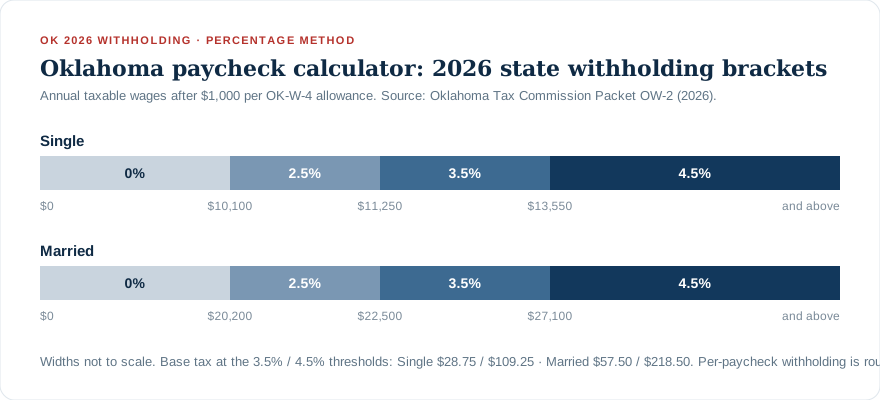
The engine follows the Oklahoma Tax Commission 2026 percentage method (Packet OW-2). Annual wages are reduced by $1,000 for each OK-W-4 allowance, then taxed at 0% up to $10,100, 2.5% to $11,250, 3.5% to $13,550, and 4.5% above that for single employees; married thresholds are exactly double ($20,200, $22,500, and $27,100). Oklahoma HB 2764 lowered the top rate from 4.75% to 4.5% starting with tax year 2026, and the withholding tables reflect that change.
Oklahoma 2026 annual withholding brackets as applied by this paycheck calculator. Source: Oklahoma Tax Commission Packet OW-2.
Oklahoma paycheck withholding for married employees
A married employee who checks the OK-W-4 box to withhold at the higher Single rate is taxed on the single table, which reaches 4.5% at $13,550 instead of $27,100. Use that toggle when both spouses work and want extra state withholding. Any additional Oklahoma dollar amount entered per paycheck is added after the table calculation, and the final per-paycheck figure is rounded to the whole dollar the way the OTC tables are published.
Why Oklahoma withholding is rounded to whole dollars
Oklahoma's 2026 percentage method uses whole-dollar paycheck rounding, which is immediately visible in the state deductions. The four examples show $59.00, $93.00, $117.00, and $187.00 of Oklahoma income tax. Other deductions in the same paychecks still contain cents, so the rounding is a feature of the Oklahoma withholding method rather than a rule applied to every payroll line. If a hand calculation lands close to the calculator result but differs by cents, check whether the state amount has been processed using the whole-dollar convention. Preserving this mechanic is important when comparing Oklahoma payroll calculations because skipping the rounding step can create a small mismatch even when the underlying wages and elections agree.
How Form OK-W-4 feeds Oklahoma's graduated calculation
Form OK-W-4 supplies Oklahoma-specific withholding elections for the state payroll calculation. Oklahoma's brackets range from 0.25% to 4.5%, so those elections operate within a graduated system rather than one flat tax percentage. The calculator applies the 2026 percentage method and then reflects the state's whole-dollar paycheck rounding. At $45,000 single with no allowances, the effective state rate is 3.41%; at $65,000 single, it becomes 3.72%. If your OK-W-4 information changes, recalculate the Oklahoma deduction rather than reusing the effective percentage from an earlier paycheck. The form and the graduated method together determine the state amount shown during payroll.
Oklahoma's $45,000 single paycheck from gross to net
At $45,000 single, the biweekly paycheck starts at $1,730.77. Federal income tax is $123.85, Social Security is $107.31, and Medicare is $25.10. Oklahoma state income tax is $59.00 after application of the 2026 percentage method and whole-dollar rounding. The final paycheck is $1,415.52, equivalent to $36,803.50/year, with an effective state rate of 3.41%. At $65,000 single, Oklahoma withholding becomes $93.00 and net pay is $1,999.60 from $2,500.00 gross. The comparison shows both the graduated behavior of the state tax and the whole-dollar format produced by Oklahoma's withholding mechanics.
Why Oklahoma's married effective rate can dip before rising
The effective state percentages do not rise in a straight line across the four examples because filing circumstances change. The $65,000 single case has a 3.72% effective state rate, while the higher-income $90,000 married filing jointly example shows 3.38% and $117.00 of Oklahoma withholding. At $130,000 married filing jointly, the effective rate rises to 3.74% and withholding reaches $187.00. Oklahoma's graduated system therefore cannot be summarized by assigning one effective percentage to every salary. Filing status and the state percentage method affect the result, while whole-dollar rounding determines how the final paycheck withholding amount is displayed.
Oklahoma hourly wages can produce different rounded deductions
Hourly workers can begin with the wages for the current period using the hourly paycheck calculator and then apply the Oklahoma withholding setup. The four salary examples use biweekly payroll across 26 periods, giving them fixed gross amounts. Variable hours can instead change the wages entering Oklahoma's graduated percentage method from one payday to the next. Because the final state withholding uses whole-dollar paycheck rounding, a different gross amount can also produce a different rounded Oklahoma deduction. Avoid dividing one of the salary examples' state amounts into an hourly rate or assuming the same effective percentage applies to every check. Calculate each payroll scenario from the wages actually being modeled.
What the paycheck estimate excludes
Reciprocity, nonresident rules, multiple jobs, credits, garnishments, and year-to-date wage history are not modeled; the methodology page lists every exclusion.
Yes. Oklahoma imposes state income tax on wages. The amount withheld from your paycheck depends on your income level, filing status, and the elections on your state withholding certificate. Oklahoma income tax is separate from federal income tax.
Why is Oklahoma state withholding shown in whole dollars?+
The calculator follows the Oklahoma 2026 percentage method with whole-dollar paycheck rounding. That is why the state amounts appear as $59.00, $93.00, $117.00, and $187.00 even though federal payroll deductions in the same examples include cents.
What does Oklahoma Form OK-W-4 control?+
Form OK-W-4 provides the state withholding elections used in Oklahoma's payroll calculation. Those elections feed into the state's graduated percentage method, which determines the Oklahoma income-tax amount withheld from each paycheck.
What Oklahoma withholding is shown at $130,000 married filing jointly?+
At $130,000 married filing jointly, biweekly gross pay is $5,000.00 and Oklahoma state income tax is $187.00. After the listed federal income tax, Social Security, Medicare, and Oklahoma withholding, net pay is $3,998.19.
Why is the Oklahoma effective rate lower at $90,000 married than $65,000 single?+
Oklahoma uses graduated taxation and the filing circumstances differ between those examples. The $65,000 single case shows a 3.72% effective state rate, while the $90,000 married filing jointly case shows 3.38%, so salary alone does not determine the effective withholding percentage.
Is this the same as a Oklahoma salary calculator?+
Yes. Enter your annual salary and the calculator works as a Oklahoma salary calculator, splitting the year into weekly, biweekly, semimonthly, or monthly paychecks and showing take-home pay for each one. A Oklahoma paycheck calculator and a Oklahoma salary calculator are the same tool viewed from either end — one starts from the yearly number, the other from the per-check number.
Can I use this as a OK payroll calculator or a OK pay calculator?+
Yes. The calculator applies the same 2026 payroll rules an employer uses — federal withholding, Social Security, Medicare, state withholding where it applies, and pre-tax deductions — so it works as a OK payroll calculator for checking a pay stub and as a OK pay calculator for hourly wages. It is an estimate for planning, not a payroll system of record.
Is this a OK income calculator or a OK income tax calculator?+
For paycheck withholding, yes: it shows the Oklahoma state income tax and federal income tax taken out of each check separately. It is not a full annual return calculator, so it does not model itemized deductions, credits, or non-wage income. Use it to see what is withheld per pay period, and a return-focused tool for your final tax liability.
How do I use this as a OK paycheck estimator?+
Enter your gross pay, pick your pay frequency, set your filing status, and add any retirement or pre-tax benefit amounts. The OK paycheck estimator returns gross pay, each tax and deduction line, and the net amount deposited. Change one input at a time to see how a raise, a new W-4, or a higher 401(k) percentage moves your take-home pay.
Is there a take home pay calculator for Oklahoma?+
This is it. Used as a take home pay calculator Oklahoma workers can rely on, it starts from gross pay and subtracts every line an employer withholds — federal income tax, Social Security, Medicare and Oklahoma state income tax — to leave the take-home figure. A Oklahoma take home pay calculator and a Oklahoma paycheck calculator answer the same question; take-home pay is simply the net amount after all withholding.
Can I use it as a Oklahoma paycheck tax calculator or payroll tax calculator?+
Yes. As a Oklahoma paycheck tax calculator it itemises the tax withheld from a single check rather than an annual return, and as a Oklahoma payroll tax calculator it shows the employee-side payroll taxes — Social Security at 6.2% and Medicare at 1.45% — separately from income tax. That separation is what makes a pay stub add up.
How much taxes deducted from paycheck OK — what should I expect?+
However you phrase it — how much taxes deducted from paycheck Oklahoma, or the same question with the abbreviation — it depends on your gross pay and filing status. Every Oklahoma paycheck has federal income tax, Social Security (6.2%) and Medicare (1.45%) deducted and Oklahoma state income tax. Enter your figures above and the calculator shows each deduction as a dollar amount and as a share of gross pay, so you can see exactly where the money goes.
Is this a pay stub calculator Oklahoma employees can check a stub with?+
Yes — as a pay stub calculator Oklahoma workers can use, it reproduces the deduction lines you would find on a Oklahoma pay stub, so you can check a stub against an independent estimate. If the two disagree, the usual causes are a mid-year W-4 change, a pre-tax benefit the calculator does not know about, or a bonus taxed at the supplemental rate.
Does no tax on overtime apply in Oklahoma?+
The federal deduction for qualified overtime compensation applies to Oklahoma workers the same as anywhere else — it is a federal rule, not a state one, worth up to $12,500 ($25,000 filing jointly) on the premium half of FLSA overtime for tax years 2025 through 2028. It does not change Oklahoma state withholding, and it does not reduce Social Security or Medicare. See the full rules on our no tax on overtime page.
How much tax is deducted from a paycheck in Oklahoma on an average salary?+
On a typical full-time salary, expect federal income tax, 6.2% Social Security and 1.45% Medicare and Oklahoma state income tax. Most Oklahoma workers take home somewhere between 70% and 80% of gross, with the exact share depending on filing status, pre-tax benefits and how much you contribute to retirement. The calculator above gives the figure for your own numbers rather than a range.
Is there an hourly version of the Oklahoma paycheck calculator?+
The same tool covers it. Enter an hourly rate and your usual weekly hours instead of an annual salary and it works as a Oklahoma paycheck calculator hourly workers can use — including overtime hours at time and a half, which are taxed as ordinary wages.
Wages are annualized for the selected pay frequency, reduced by eligible pre-tax deductions, then run through the 2026 IRS federal withholding method, FICA, and the published 2026 Oklahoma state withholding method before being converted back to one paycheck. The full step list and every source are on the methodology page.
Oklahoma Tax Information Sources
IRS, Social Security Administration, and Oklahoma Tax Commission.
Reviewed by: Paycheck Calculator Editorial Team
Last Updated: August 2026
Disclaimer: This Oklahoma paycheck calculator provides estimates for informational purposes only. Actual paycheck amounts may vary based on employer payroll systems, benefits, deductions, tax changes, filing status, and individual financial circumstances. For specific tax advice, consult a qualified tax professional.