$14 an Hour Is How Much a Year — 2026 Paycheck Calculator
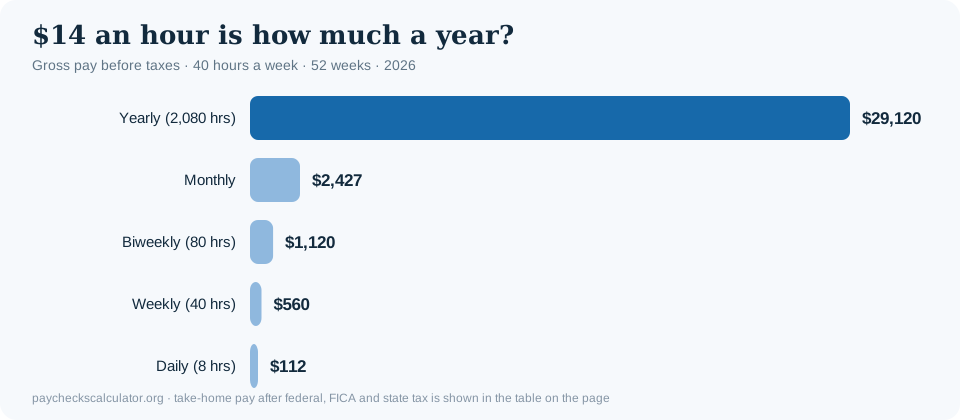
$14 an hour is how much a year? $29,120 before taxes at 40 hours a week for 52 weeks. That is about $2,427 a month, $1,120 every two weeks, or $560 a week in gross pay.
1
Your pay details at $14 an hour
Adjust the fields; results update instantly.
Pay frequency
2
Estimated take-home pay at $14 an hour
2026 source-backed withholding methods.
NET PAY · BIWEEKLY$810.32$21,068 per year
Take-home 72%Taxes 9%Deductions 18%
Gross pay$1,120.00
Federal income tax−$29.48
Social Security−$60.14
Medicare−$14.07
Texas income tax−$0.00
Pre-tax deductions−$206.00
ⓘ
No individual state income tax on wages.
After taxes, $14 an hour is closer to $25,578 a year in a no-income-tax state like Texas and $23,252 in Oregon. Enter your state, filing status and deductions above to see your own net paycheck.
2026 IRS MethodAll 50 StatesFree to Use
INCOME BREAKDOWN
$14 an Hour Is How Much a Year, a Month, and Biweekly?
$14 an hour converted to yearly, monthly, biweekly, weekly and daily gross pay.
The math behind “$14 an hour is how much a year” is simple: 40 hours a week × 52 weeks = 2,080 working hours, and 2,080 × $14 = $29,120. If your schedule is 35 hours a week, $14 an hour is $25,480 a year instead. Here is how that gross pay splits across common pay schedules before any taxes or deductions:
Annual (40 hrs/week): $29,120
Annual (35 hrs/week): $25,480
Monthly: $2,427
Biweekly (80 hrs): $1,120
Weekly (40 hrs): $560
Daily (8 hrs): $112
These are gross amounts. Your actual take-home depends on your state, filing status and deductions — the calculator above gives a state-specific net estimate, and the table below shows $14 an hour after tax in every supported state. Earning a little less? $13 an hour is how much a year — $2,080 less than $14. Expecting a raise? $15 an hour is how much a year — $2,080 more, or $80 per biweekly check.
AFTER-TAX PAY
$14 an Hour Is How Much a Year After Taxes?
$14 an hour is about $24,734 a year after taxes. On $29,120 of gross pay at 40 hours a week, a single filer with a standard W-4 keeps roughly 84.9% once federal income tax, Social Security (6.2%) and Medicare (1.45%) come out, with state withholding on top. Here is the same pay on every schedule, before and after tax:
Pay period
Gross
After taxes (typical state)
After taxes (no income tax)
Year (2,080 hrs)
$29,120
$24,734
$25,578
Month
$2,427
$2,061
$2,131
Biweekly (80 hrs)
$1,120
$951
$984
Week (40 hrs)
$560
$476
$492
Day (8 hrs)
$112
$95
$98
Effective hourly
$14.00
$11.89
$12.30
“Typical state” is the median of the 52 states on this page (Vermont); the no-income-tax column uses Texas. Single filer, standard W-4, biweekly pay, no pre-tax deductions.
$14 an hour is how much a month after taxes?
About $2,061 a month after taxes, against $2,427 a month gross. In a state with no income tax it is closer to $2,131. A monthly figure is not the same as two biweekly paychecks: you get 26 checks a year, so two months carry three paychecks instead of two.
$14 an hour is how much a week after taxes?
At 40 hours a week your gross is $560 and your take-home is about $476 — an effective $11.89 an hour after tax, versus the $14 on your offer letter. Over a day that is $95 net on $112 gross.
What is $14 an hour biweekly after taxes?
Eighty hours at $14 an hour is $1,120 gross per biweekly paycheck and about $951 after taxes — $984 if your state withholds no income tax. Across the year the best and worst states on this page differ by $2,326, or about $89 per paycheck.
JOBS AT THIS WAGE
What Jobs Pay About $14 an Hour?
These occupations have a national 25th-percentile (entry-level) wage closest to $14 an hour, according to the BLS Occupational Employment and Wage Statistics survey (May 2025).Few large occupations have a median this low, so the table shows jobs where the bottom quarter of workers — typically new hires — earn about $14 an hour; the median column shows what the job pays once established.
Occupation
Entry-level hourly
Median hourly
Median annual
U.S. jobs
Lifeguards, Ski Patrol, and Other Recreational Protective Service Workers
The largest of these is Retail Salespersons — about 3.9M jobs nationwide with a entry-level (25th-percentile) wage of $14.38 an hour — and together the 8 occupations listed employ roughly 8.7M people, with entry-level (25th-percentile) pay between $13.81 and $14.38.
Where $14 an hour sits among U.S. wages
$14 an hour is $6.75 above the federal minimum wage of $7.25, but it is below the 25th-percentile wage for all U.S. occupations ($18.07 in the BLS May 2025 survey). In other words, roughly three out of four American workers earn more than $14 an hour, and many states set their own minimum wage above this level. The national median is $24.51, so $14 is about 57% of a typical wage. Weighted by employment, about 0% of the 143.6M U.S. jobs in the 451 occupations we track have a median wage below $14 an hour.
OVERTIME
Overtime at $14 an Hour: What 5 Extra Hours a Week Is Worth
Non-exempt hourly employees earn time-and-a-half after 40 hours in a week under the FLSA, so overtime at $14 an hour pays $21.00 an hour (double time, where it applies, is $28.00). Working 5 overtime hours every week adds $5,460 to your annual gross — $210 per biweekly check.
Overtime is taxed like any other wage, not at a special rate, but because it stacks on top of your base pay some of it is withheld at your highest federal bracket. Run through the 2026 withholding tables for a single filer in a no-income-tax state, those 5 hours a week net about $4,387 a year ($169 per check), so you keep roughly 80% of the overtime you earn. Federal withholding follows IRS Publication 15-T; Social Security (6.2%, up to the $184,500 wage base) and Medicare (1.45%) apply to every dollar. Our methodology page lists the tables.
TAKE-HOME PAY BY STATE
How Much Is $14 an Hour After Taxes in Each State? (2026)
Working full-time at $14/hr ($29,120 a year gross), here is what $14 an hour is worth after tax in every supported state for 2026 — from $25,578 in Florida down to $23,252 in Oregon. Single filer, standard W-4, biweekly pay, 40 hrs/week. Sorted highest to lowest take-home pay.
Single filer · standard W-4 · biweekly pay · 40 hrs/week · no pre-tax deductions · 2026 federal and state withholding tables. Actual paychecks vary based on filing status, allowances, and deductions.
FREQUENTLY ASKED QUESTIONS
$14 an Hour — Frequently Asked Questions
$14 an hour is how much a year?+
$14 an hour is $29,120 a year before taxes if you work 40 hours a week for 52 weeks (2,080 hours). At 35 hours a week it is $25,480 a year. Your take-home pay will be lower after federal income tax, Social Security, Medicare and any state tax.
How much is $14 an hour after taxes?+
On $29,120 gross, a single filer with a standard W-4 keeps roughly 78%–85% depending on the state, because federal income tax, 6.2% Social Security and 1.45% Medicare come out of every check. The state table on this page shows the exact after-tax figure for all 38 supported states.
What is the biweekly paycheck for $14 an hour?+
At $14 an hour for 80 hours per biweekly period, your gross biweekly pay is $1,120. After taxes, net pay depends on your state and deductions — use the calculator above for your exact number.
$14 an hour is how much a month?+
At 40 hours a week, $14 an hour works out to about $2,427 a month in gross pay ($29,120 ÷ 12). Enter your details in the calculator for a monthly net pay estimate.
How much tax is taken out of a $14 an hour paycheck?+
Federal income tax (based on your W-4 and the 2026 IRS withholding tables), Social Security (6.2%) and Medicare (1.45%) are withheld from every U.S. paycheck. State income tax depends on where you work; nine states withhold none.
Is $14 an hour a good wage?+
$14 an hour is approximately $29,120 a year at full-time hours. Whether that is a good wage depends on your location and cost of living — compare the take-home figures for different states on this page.
14 dollars an hour is how much a year?+
14 dollars an hour is $29,120 a year at 40 hours a week, or $25,480 a year at 35 hours a week. Written either way — $14 an hour or 14 dollars an hour — the calculation is the same: the hourly rate times 2,080 working hours in a year.
How much is 14 dollars an hour annually?+
Annually, 14 dollars an hour comes to $29,120 before tax on a standard 2,080-hour year. That is the gross figure; what lands in your account depends on federal withholding, Social Security, Medicare and your state.
What is $14 an hour annually?+
$14 an hour annually is $29,120 gross. Part-time hours change it: at 35 hours a week it is $25,480, and at 30 hours a week about $21,840.
What is the $14 an hour salary equivalent?+
The salary equivalent of $14 an hour is $29,120 a year — $14 per hour annual salary at full-time hours. Converting $14 hourly to salary means multiplying by 2,080; going the other way, an $29,120 salary works out to $14 an hour.
How much is $14 an hour annually?+
How much is $14 an hour annually depends only on hours worked: $29,120 at 40 hours a week, $25,480 at 35. The $14 an hour salary most people quote is the 40-hour figure, $29,120.
What is the 14 hr salary — and how do I convert 14 hr to salary?+
The 14 hr salary is $29,120 a year. To convert 14 hr to salary, multiply by the hours you work in a year: 14 × 2,080 = $29,120 at full time. A 14 dollars an hour salary quoted as an annual number is that same $29,120.
14 hr is how much a year?+
14/hr is $29,120 a year at full time. Whether it is written 14 hr, $14 per hour or 14 dollars an hour, the annual figure is the same $29,120 before deductions.
Is $14 an hour a living wage?+
It depends heavily on where you live and whether you have dependents. $14 an hour is $2,427 a month before taxes; the common 30%-of-income rule puts affordable rent at about $728 a month, which is below the median one-bedroom rent in most U.S. metro areas. In lower-cost regions and for a single person it can cover basics; in high-cost cities it usually does not.
How much rent can I afford on $14 an hour?+
Using the 30% guideline, about $728 a month on $2,427 of gross monthly income. Many landlords screen for income of 2.5–3× rent, which caps you at roughly $809–$971.
How much is overtime at $14 an hour?+
Time-and-a-half at $14 an hour is $21.00 an hour. Five hours of overtime a week adds $5,460 a year in gross pay, of which you keep about $4,387 after federal tax, Social Security and Medicare in a no-income-tax state.
RELATED CALCULATORS
How Much a Year Is $13 or $15 an Hour — and Other Paycheck Calculators