How to Calculate 401k From Paycheck: Contributions, Take-Home Cost and 2026 Limits
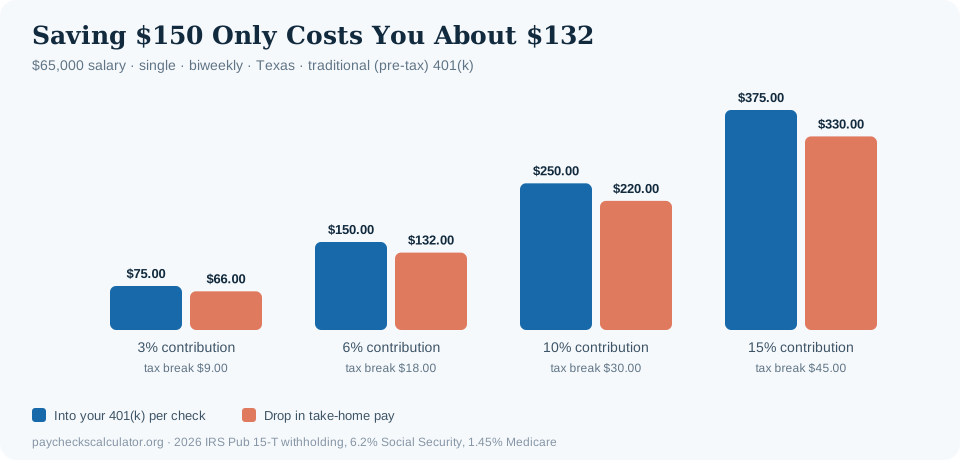
Here is how to calculate 401k from paycheck amounts: multiply your gross pay per period by your contribution percentage. On a $2,500.00 biweekly paycheck ($65,000 a year), a 6% contribution is $150.00 per check. With a traditional 401(k), your take-home pay drops by less — about $132.00 here — because the contribution lowers your income tax. The 2026 employee limit is $24,500.
- Per-check contribution = gross pay × contribution %.
- Take-home drop = contribution − income tax saved. FICA still applies to traditional 401(k) deferrals.
- 2026 limits: $24,500 deferral, +$8,000 at 50+, +$11,250 at 60–63.
- Max per biweekly check: $942.31. Mid-year: (limit − YTD) ÷ checks left.
- Capture the full employer match before anything else; check whether it is calculated per paycheck.
How to Calculate 401k From Paycheck: The Basic Formula
Most employers let you elect a percentage of pay; some also allow a flat dollar amount per paycheck. With a percentage election, payroll applies it to your eligible gross pay every pay period. This is how to calculate 401k from paycheck stubs in one line:
Annual contribution = per-paycheck contribution × number of paychecks
Take a $65,000 salary paid biweekly. Gross pay is $65,000 ÷ 26 = $2,500.00 per check. A 6% election is $2,500.00 × 0.06 = $150.00 per paycheck, or $3,900 for the year.
| Contribution rate | Per paycheck | Per year (× 26) |
|---|---|---|
| 3% | $75.00 | $1,950 |
| 6% | $150.00 | $3,900 |
| 10% | $250.00 | $6,500 |
| 15% | $375.00 | $9,750 |
If you are paid weekly, use 52 paychecks; semimonthly, 24; monthly, 12. Hourly workers should apply the percentage to the gross on each stub, because the contribution moves with your hours.
How Much Does 401k Actually Reduce Your Take-Home Pay?
Knowing how to calculate 401k from paycheck gross pay is only half the job. The take-home effect is the number most people actually want, and it is where generic calculators go wrong. A traditional 401(k) deferral is excluded from federal income tax withholding (and from state income tax in most states), but it is still subject to Social Security and Medicare. So your paycheck shrinks by the contribution minus the income tax you no longer have withheld:
| Rate | Contribution | Federal tax / check | Take-home / check | Take-home drop | Tax saved |
|---|---|---|---|---|---|
| 0% | $0.00 | $216.15 | $2,092.60 | $0.00 | $0.00 |
| 3% | $75.00 | $207.15 | $2,026.60 | $66.00 | $9.00 |
| 6% | $150.00 | $198.15 | $1,960.60 | $132.00 | $18.00 |
| 10% | $250.00 | $186.15 | $1,872.60 | $220.00 | $30.00 |
| 15% | $375.00 | $171.15 | $1,762.60 | $330.00 | $45.00 |
At 6%, $150.00 goes into the account but take-home falls by only $132.00; the other $18.00is federal tax you no longer prepay. A worker in the 12% bracket saves 12 cents of federal tax per dollar contributed. In a state with income tax, the saving is larger because state withholding drops too. Texas has no state income tax, so a Texan's tax break is federal only — see how Texas paycheck taxes are calculated.
2026 IRS 401k Contribution Limits
| Limit | 2026 amount | Who it applies to |
|---|---|---|
| Employee elective deferral | $24,500 | All participants (traditional + Roth combined) |
| Catch-up contribution | +$8,000 | Age 50 or older by Dec 31 |
| Higher catch-up (SECURE 2.0) | +$11,250 | Age 60, 61, 62 or 63 (replaces the $8,000) |
| Total annual additions (§415(c)) | $72,000 | Employee + employer, excluding catch-ups |
| Mandatory Roth catch-up threshold | $150,000 prior-year FICA wages | Catch-ups must be Roth above this |
New for 2026: if your FICA wages from the employer sponsoring the plan exceeded $150,000 in 2025, any catch-up contributions you make must go in as Roth (after-tax). That means catch-up dollars reduce your take-home pay one-for-one, even if your regular deferrals are traditional.
How Much to Contribute Per Paycheck to Max Out
If you start in January and want to hit the limit exactly, divide the annual limit by your paychecks:
| Pay frequency | Under 50 ($24,500) | Age 50–59 or 64+ ($32,500) | Age 60–63 ($35,750) |
|---|---|---|---|
| Weekly (52) | $471.15 | $625.00 | $687.50 |
| Biweekly (26) | $942.31 | $1,250.00 | $1,375.00 |
| Semimonthly (24) | $1,020.83 | $1,354.17 | $1,489.58 |
| Monthly (12) | $2,041.67 | $2,708.33 | $2,979.17 |
To convert that to a percentage, divide the per-paycheck amount by your gross pay per check. Starting mid-year or changing your rate? Use the remaining-balance formula:
Example: you have contributed $15,000 by mid-October and have six biweekly paychecks left. ($24,500 − $15,000) ÷ 6 = $1,583.33 per check. Make sure your net pay can absorb that — and see the match warning below before front-loading.
How to Calculate the Employer Match
Employer matches are usually expressed as "X% of your contributions, up to Y% of pay." Calculate it per paycheck:
With a common 50%-up-to-6% formula on the $2,500.00 paycheck, contributing 6% earns a match of 50% × 6% × $2,500.00 = $75.00 per check, or $1,950 a year. Contributing only 3% would cut the match in half. Because the match is effectively an immediate 50% return, contributing at least up to the cap is the first priority for most savers.
- Per-paycheck matching: many plans match each paycheck separately. If you hit the $24,500 limit in September, your contributions stop — and so does the match for October through December, unless the plan offers a year-end "true-up."
- Vesting: your own contributions are always 100% yours, but employer matches may vest over several years. Leaving early can forfeit part of the match.
- Eligible pay: some plans exclude bonuses or overtime from both your contribution and the match.
Traditional vs Roth 401k: The Paycheck Difference
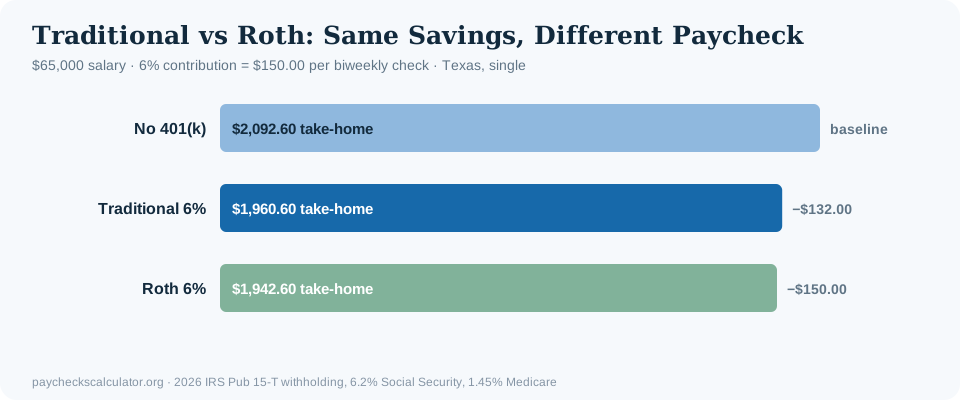
Roth 401(k) contributions are made with after-tax money. They do not reduce income tax withholding, so the paycheck reduction equals the full contribution. The payoff comes later: qualified Roth withdrawals, including growth, are tax-free.
| Traditional 401(k) | Roth 401(k) | |
|---|---|---|
| Lowers income tax withholding now | Yes | No |
| Subject to Social Security & Medicare | Yes | Yes |
| Take-home drop at 6% (this example) | $132.00 | $150.00 |
| Withdrawals in retirement | Taxed as income | Tax-free if qualified |
| Often favored when | Your tax rate is high now | Your tax rate is low now |
Where to Find 401k on Your Pay Stub
Look in the deductions section for lines such as 401K, 401(k) EE, Pre-Tax 401k or Roth 401k. The current column shows this paycheck; the YTD column shows your running total toward the limit. Employer matches usually appear in a separate "employer contributions" or "memo" section because they are not paid out of your wages. Check two things:
- Current 401(k) deduction ÷ current gross ≈ your elected percentage.
- Federal taxable wages ("FIT wages") are lower than gross by the traditional 401(k) amount, while Social Security and Medicare wages are not.
Common 401k Calculation Mistakes
- Using net pay as the base. The percentage applies to gross eligible pay, not your deposit.
- Assuming the paycheck drops by the full contribution. For traditional deferrals it drops by less; see the table above.
- Including FICA in the tax savings. Social Security and Medicare are still withheld on traditional 401(k) contributions.
- Forgetting the third paychecks. Biweekly workers get 26 checks; a monthly budget based on 24 misses two contributions. See how to convert biweekly pay to monthly.
- Ignoring the 2026 Roth catch-up rule.High earners' catch-up dollars no longer lower withholding.
To see your own numbers, enter your salary and 401(k) percentage in the paycheck calculator. It applies the same withholding method used for every figure in this guide, for all supported states.
COMMON QUESTIONS
Frequently Asked Questions
How do I calculate my 401(k) contribution per paycheck?+
Multiply your gross pay for the period by your contribution percentage. On a $65,000 salary paid biweekly ($2,500.00 per check), a 6% election puts $150.00 into your 401(k) each payday.
How much does a 401(k) contribution reduce my take-home pay?+
Less than the contribution, for a traditional 401(k). The deferral lowers federal (and state) income tax withholding but not Social Security or Medicare. In our $65,000 Texas example, a $150.00 contribution reduces take-home pay by $132.00.
What is the 401(k) contribution limit for 2026?+
Employees can defer up to $24,500 in 2026. Workers 50 or older can add an $8,000 catch-up, and those aged 60 to 63 can add $11,250 instead. Total employee plus employer additions are capped at $72,000, not counting catch-ups.
How much should I contribute per paycheck to max out my 401(k)?+
Divide the annual limit by your number of paychecks. For 2026 that is $942.31 per biweekly check, $1,020.83 semimonthly, or $471.15 weekly. Mid-year, use (limit − year-to-date contributions) ÷ paychecks remaining.
Is a 401(k) contribution calculated on gross or net pay?+
On gross pay — specifically, whatever your plan defines as eligible compensation. Most plans include base salary and hourly wages; some exclude bonuses, overtime or commissions. Check your plan's summary plan description.
Does a Roth 401(k) reduce my paycheck more than a traditional 401(k)?+
Yes. Roth contributions come out after tax, so your take-home falls by the full contribution. At 6% on $65,000, take-home is $1,960.60 with traditional and $1,942.60 with Roth per biweekly check — but Roth withdrawals in retirement can be tax-free.
Sources and How We Checked the Numbers
Every dollar figure in this article is produced by the same 2026 payroll engine that runs our calculators: the IRS percentage method from Publication 15-T for federal withholding, the 2026 Social Security wage base, and the state rules documented on our methodology page. Rates and limits were checked against these primary sources:
- IRS, 401k limit increases to $24,500 for 2026 (news release)
- IRS, Retirement topics — 401k and profit-sharing plan contribution limits
- IRS Publication 15-B, Employer's Tax Guide to Fringe Benefits
- IRS Publication 15-T (2026), Federal Income Tax Withholding Methods
- IRS, Roth catch-up contributions final regulations (SECURE 2.0 §603)
- U.S. Department of Labor, What You Should Know About Your Retirement Plan
Disclaimer:examples are estimates for a single W-4 with no adjustments unless stated otherwise. Your employer's payroll system, benefit elections and year-to-date wages determine your actual paycheck.