Biweekly Pay Chart: 2026–27 Pay Dates and Take-Home by Salary
This biweekly pay chart lists every Friday pay date for 2026 and 2027, then shows what each salary and hourly wage leaves per check after tax. Most Friday payrolls follow one of two cycles: one first paid on January 2, 2026, the other on January 9. The first pays three checks in January and July 2026, the second in May and October. New to this schedule? See what biweekly pay means and how to calculate it.
Updated November 5, 2026 · 2026 IRS and state withholding tables
THE CALENDAR
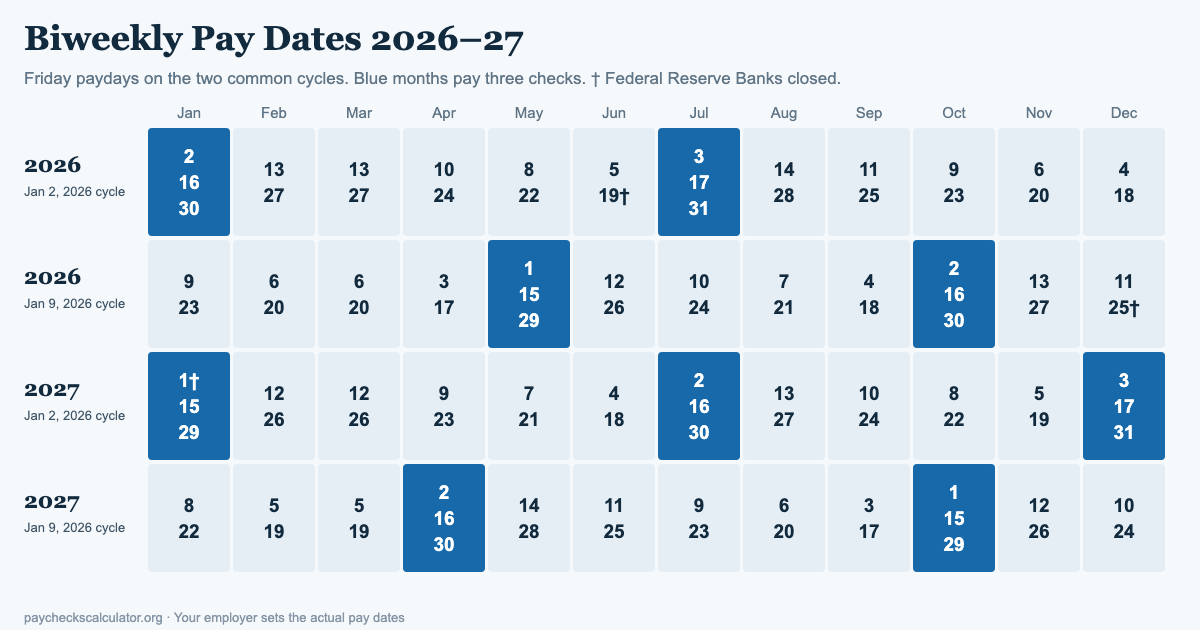
Biweekly Pay Schedule 2026 and 2027: Every Pay Date
Find your cycle first. Take any recent payday and count back in two-week steps until you land on a date below. Bold dates sit in a three-paycheck month. A dagger marks a Friday when Federal Reserve Banks are closed, so direct deposit cannot settle that day. Payroll providers generally advise paying a business day early, though no federal law requires it and state rules vary. Paid on another weekday? Shift each date by the same number of days, and check your three-paycheck months again, because they can move.
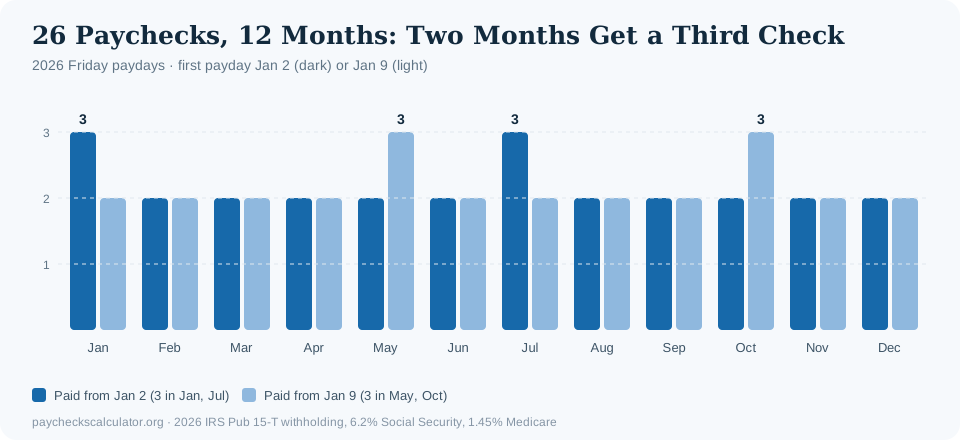
Twenty-six checks do not divide evenly into 12 months, so most years have ten two-check months and two three-check months. Budget on the two-check month and treat the third check as extra.
Friday cycle
2026 three-check months
2027 three-check months
Paydays in 2027
Paid January 2, 2026
January, July
January, July, December
27
Paid January 9, 2026
May, October
April, October
26
The first cycle reaches both January 1 and December 31 in 2027, which is how a biweekly year can hold 27 Fridays. January 1 is a bank holiday, so many payrolls would pay that check on December 31, 2026 instead. If your employer does keep 27 paydays in a year and divides salaries by 27, each gross check shrinks by about 4%, so it is worth asking in advance.
THE CHART
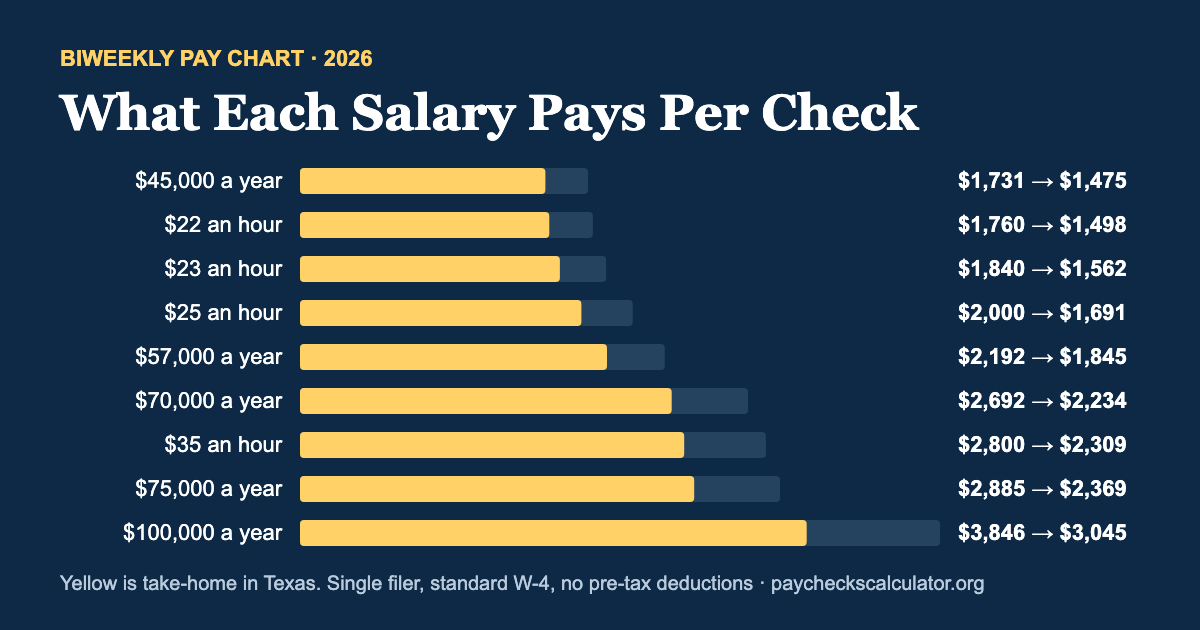
Biweekly Pay Chart by Salary and Hourly Wage
Each row shows one paycheck for a single filer with a standard W-4 and no pre-tax deductions, using 2026 withholding tables. Across this chart, federal tax, Social Security, Medicare and state tax together take about 12% to 36% of a check. Open a row for the full breakdown at that pay.
Working from a pay stub? Multiply the gross check by 26 for annual pay, divide that by 12 for the monthly average, and divide the check by 80 for the hourly rate on a 40-hour week.
Biweekly gross
Per year
Monthly average
Per hour (80 hours)
$1,000
$26,000
$2,167
$12.50
$1,500
$39,000
$3,250
$18.75
$2,000
$52,000
$4,333
$25.00
$2,500
$65,000
$5,417
$31.25
$3,000
$78,000
$6,500
$37.50
$3,500
$91,000
$7,583
$43.75
$4,000
$104,000
$8,667
$50.00
$5,000
$130,000
$10,833
$62.50
$6,000
$156,000
$13,000
$75.00
Before taxes, 26 pay periods. A two-check month pays less than the monthly average.
PAY SCHEDULES
Same $60,000, Four Pay Schedules
The same $60,000 salary gives very different checks depending on the schedule, while the annual total stays the same. Biweekly and semimonthly are the two that get mixed up most often: they sound alike, but a biweekly year has two more checks, each one smaller.
Schedule
Paid
Checks a year
Gross per check
Take-home per check
Weekly
Every week
52
$1,153.85
$969.04
Biweekly
Every two weeks
26
$2,307.69
$1,938.08
Semimonthly
Twice a month
24
$2,500.00
$2,099.58
Monthly
Once a month
12
$5,000.00
$4,199.17
$60,000 a year, single filer in Texas, standard W-4, no pre-tax deductions, 2026 withholding tables.
BY STATE
Biweekly Checks in Your State
State tax is the biggest reason the same biweekly gross leaves different take-home. See nine salary levels for your state:
26 on either Friday cycle. A Thursday payroll that paid on January 1, 2026 is the exception: it lands on 27 Thursdays, ending December 31. January 1 is a bank holiday, so that first check may have arrived on December 31, 2025.
How many biweekly pay periods are there in 2027?
Usually 26, but the January 2 Friday cycle lands on 27 Fridays in 2027, starting January 1 and ending December 31. January 1 is a bank holiday, so that first check may arrive on December 31, 2026 instead. Ask your payroll team how they handle it.
Which months have three biweekly paychecks in 2027?
January, July and December on the January 2 cycle, and April and October on the January 9 cycle. If your employer pays the January 1 check on December 31, 2026, January 2027 drops to two checks and December 2026 gains a third.
What happens when a biweekly payday falls on a holiday?
Federal Reserve Banks close on June 19 and December 25, 2026 and January 1, 2027, all Fridays on one of these cycles, so direct deposit cannot settle on those days. Payroll providers generally advise paying a business day early, but no federal law requires it and state rules vary, so ask your payroll team for the date.
How do I know which biweekly cycle I am on?
Take any recent payday and count back in two-week steps. If you reach January 2, 2026 you are on the first cycle, and if you reach January 9 you are on the second. If you are paid on another weekday, your dates shift by the same number of days and your three-check months can change.
How do you turn biweekly pay into annual or monthly income?
Multiply a biweekly check by 26 to get annual pay, then divide by 12 for the monthly average. A $2,000 biweekly check is $52,000 a year, or $4,333 a month on average. Most months only pay two checks, so that month brings in $4,000 before taxes.
Does biweekly pay change how overtime works?
No. Under the federal Fair Labor Standards Act overtime is counted by the workweek, not the pay period. Working 50 hours one week and 30 the next earns 10 overtime hours, even though the two weeks total 80.