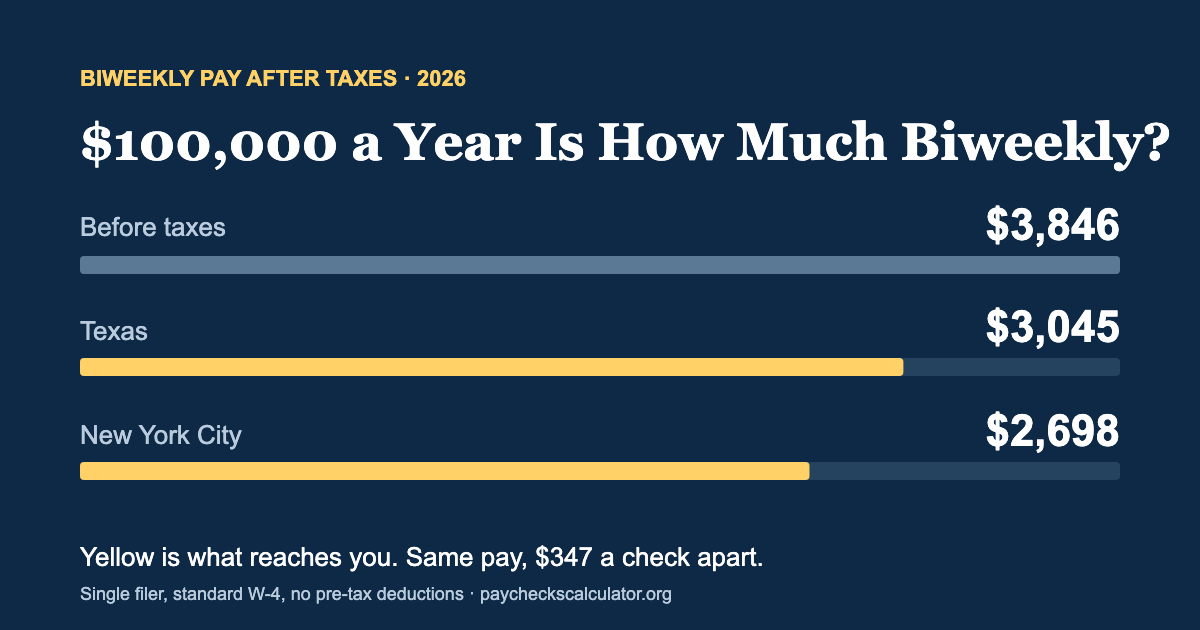
$100,000 a year is how much biweekly? $3,846 before taxes and about $3,045 after taxes for a single filer in Texas, because a biweekly schedule splits your salary into 26 checks. The same check is $3,045 in 6 other places with no state tax at this pay, about $2,888 in a typical state, and $2,698 in New York City, the lowest of the 52 locations we calculate.
Updated November 5, 2026 · 2026 IRS and state withholding tables
1
Your pay details on $100,000 a year
Adjust the fields; results update instantly.
Pay frequency
2
Estimated take-home pay on $100,000 a year
2026 source-backed withholding methods.
NET PAY · BIWEEKLY$3,045.38$79,180 per year
Take-home 79%Taxes 21%Deductions 0%
Gross pay$3,846.15
Federal income tax−$506.54
Social Security−$238.46
Medicare−$55.77
Texas income tax−$0.00
Pre-tax deductions−$0.00
ⓘ
No individual state income tax on wages.
Figures assume a single filer, standard W-4 and no pre-tax deductions. Change any field to match your pay stub.
PER CHECK
$100,000 a Year Is How Much Biweekly? Where the $3,846 Goes
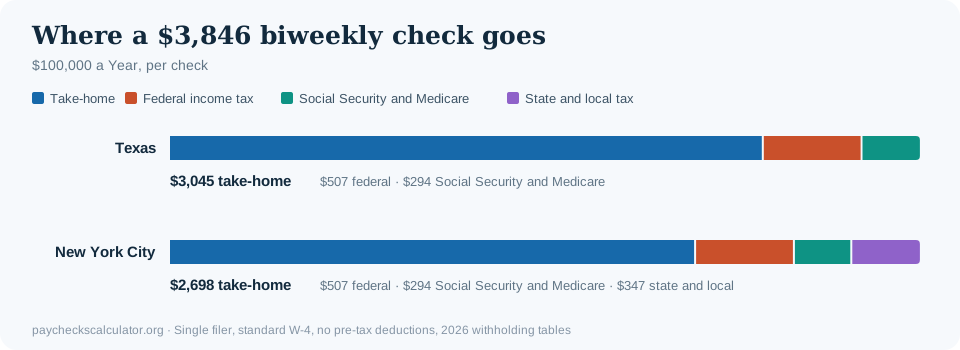
Federal income tax is far larger than payroll tax at this level, $507 against $294. Filing jointly with one earner adds $213 a check, a bigger gain than at any lower salary on this site, because the joint table keeps wages in the 12% range up to $133,000.
Per biweekly check
Single
Married filing jointly
Head of household
Gross pay
$3,846.15
$3,846.15
$3,846.15
Federal income tax
−$506.54
−$293.85
−$368.77
Social Security (6.2%)
−$238.46
−$238.46
−$238.46
Medicare (1.45%)
−$55.77
−$55.77
−$55.77
Take-home
$3,045.38
$3,258.08
$3,183.15
Effective tax rate
20.8%
15.3%
17.2%
Tax on your next dollar
29.65%
19.65%
29.65%
No-income-tax state, standard W-4 with Step 2 unchecked, no pre-tax deductions, 2026 withholding tables. The next-dollar rate is the federal bracket plus 7.65% for Social Security and Medicare; state tax adds to both rates.
EVERY PAY PERIOD
$100,000 a Year After Taxes: Per Month, Week, Day and Hour
$100,000 a year after taxes is about $6,598 a month, $1,523 a week and $38.07 an hour for a single filer with no state income tax.
Per
Before taxes
After taxes
Year
$100,000
$79,180
Month (average)
$8,333
$6,598
Twice a month
$4,167
$3,299
Every two weeks
$3,846
$3,045
Week
$1,923
$1,523
Day (8 hours)
$385
$305
Hour
$48.08
$38.07
Annual take-home divided by the period, based on 2,080 paid hours a year. A monthly average, not what lands in a two-check month.
How Much Is $100k a Year Monthly After Taxes?
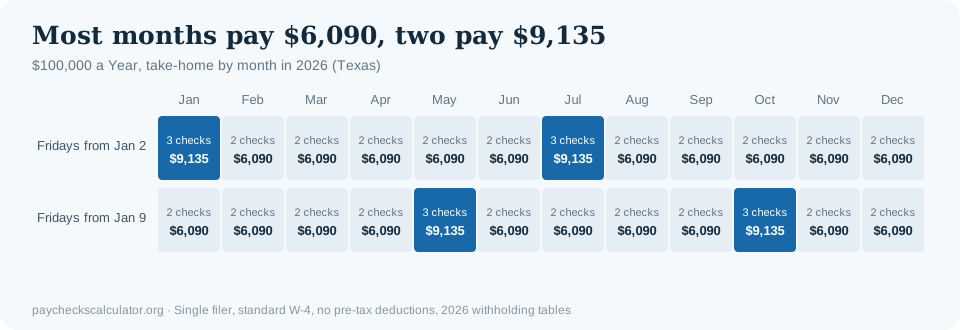
About $6,598 a month on average for a single filer in Texas, and $6,090 in the ten months that pay two checks. In New York City the average is $5,846 and a two-check month is $5,396.
A six-figure salary keeps about 79% of each check in a no-income-tax state. Federal income tax takes $507 and Social Security and Medicare take $294. Crossing $100,000 does not change the tax by itself: withholding has been at 22% since $66,500 and stays there until $121,800.
California Joins the Bottom Five at $100,000
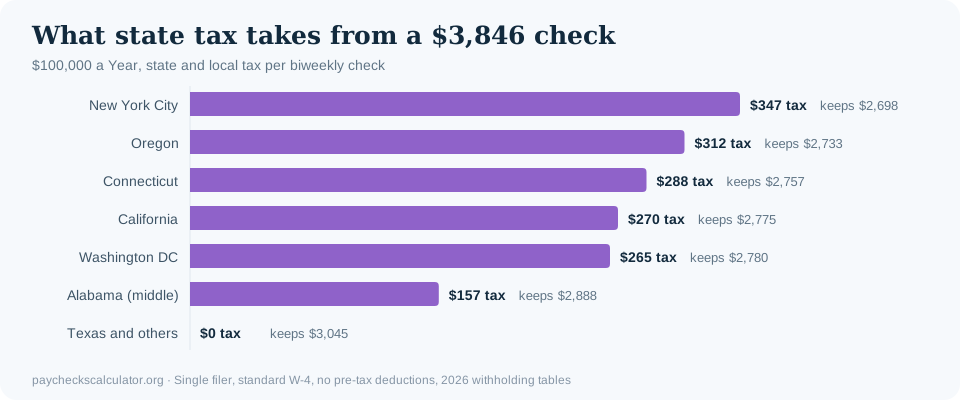
Up to $75,000 the five smallest checks on this site are New York City, Oregon, Connecticut, Washington DC and Minnesota. At $100,000 California replaces Minnesota, at $2,775 a check, because its withholding table has climbed from 8.8% to 10.23% on the top dollar.
The gap between Texas and New York City is also the largest of any salary here: $347 a check, or $9,022 a year. That is worth pricing into a relocation or a remote-work move, although housing and other living costs can easily outweigh it. Washington has no income tax, yet its paid leave and long-term care programs still take $53 a check.
What Maxing a 401(k) Does to a $100,000 Check
The 2026 employee limit of $24,500 works out to $942 a check, or 24.5% of pay. All of it comes out of wages withheld at 22%, so your check falls by $735, to $2,310.
Your 401(k) also affects your IRA options. With a workplace plan, a single filer's traditional IRA deduction phases out between $81,000 and $91,000 of modified adjusted gross income in 2026, so at $100,000 with no 401(k) contributions there is no deduction. Contributions of $9,000 or more bring that income to $91,000 or less, and part of the deduction can come back. Roth IRA contributions remain fully available at this income, because that phase-out starts at $153,000.
BENCHMARKS
Is $100,000 a Year a Good Salary?
$100,000 a year puts you in the top quarter of U.S. wages, which starts at $80,520, and well above the $64,064 median for full-time workers. Where you live changes the answer too: this pay leaves $3,045 a check in Texas and $2,698 in New York City, about $9,022 a year apart.
Benchmark
Per year
Per hour
$100k a year compared
25th percentile, all U.S. jobs
$37,590
$18.07
+$62,410 a year
Median, all U.S. jobs
$50,980
$24.51
+$49,020 a year
Median, full-time workers
$64,064
$30.80
+$35,936 a year
75th percentile, all U.S. jobs
$80,520
$38.71
+$19,480 a year
Jobs with a median wage close to this pay include Occupational Therapists ($100,330), Computer Programmers ($100,390), Clinical and Counseling Psychologists ($100,580) and Architects, Except Landscape and Naval ($99,280).
$100,000 a Year Is $21,800 Under the 24% Line: What a 401(k) Does to Your Check
Every row below stays in the 22% range, so the federal saving is proportional: 22 cents on each dollar. You have $21,800 of room before withholding reaches 24% at $121,800, and a $704 after-tax gain on each $1,000 raise until then.
Two months a year pay $9,135 instead of $6,090. Together those extra checks add $6,090 over the year, not far from the $7,500 IRA limit for 2026. Paying fixed bills from the two-check figure and treating the third checks as savings is one way to use the schedule.
RENT
How Much Rent Can You Afford on $100,000 a Year?
HUD counts a household as cost burdened when housing, including utilities, takes more than 30% of its income. On $100,000 a year that line is $2,500 a month before tax, which is 41% of what a two-check month deposits in Texas. Setting your limit from take-home gives a lower, safer number.
Rule of thumb
Housing per month
Set aside per check
30% of gross pay
$2,500
$1,250
30% of take-home in a two-check month, Texas
$1,827
$914
30% of take-home in a two-check month, New York City
What $100,000 a Year Really Pays After Health Insurance and a 401(k)
Workers paid an average of $1,672 a year for single health coverage and $7,471 for family coverage in 2026, according to KFF. Premiums taken through a cafeteria plan and traditional 401(k) contributions both lower the tax on your check, so your take-home falls by less than the amount that comes out.
Flat-tax states hold up better at six figures than progressive ones: Illinois leaves $2,855, Pennsylvania $2,927 before local tax, Colorado $2,869 and Massachusetts $2,850.
$3,045 in Texas, about $2,888 in a typical state and $2,698 in New York City, for a single filer with no pre-tax deductions.
How much is $100,000 a year biweekly before taxes?
$3,846.15. Divide $100,000 by the 26 pay periods in a biweekly year. Taxes and deductions come out after that.
Why is my real paycheck on $100k a year smaller than this?
Workplace deductions. A 5% 401(k) plus $150 a check for benefits brings $3,045 down to $2,790 in Texas.
How much is $100k a year biweekly in California?
About $2,775 per check after taxes for a single filer, $270 less than Texas. California income tax and state disability insurance account for the difference.
Is $100,000 a year taxed at 24%?
No. On a standard single W-4 the top dollar is withheld at 22%, and the 24% rate starts at $121,800 of annual wages. Federal withholding of $507 a check works out to about 13% of gross pay overall.