How to Calculate Taxes on Paycheck in Texas: 2026 Step-by-Step Guide
Here is how to calculate taxes on paycheck in Texas: take your gross pay, subtract pre-tax deductions, and withhold three federal taxes: federal income tax (from the IRS Publication 15-T tables and your W-4), Social Security at 6.2% and Medicare at 1.45%. Texas has no state or local income tax, so nothing else is withheld for taxes. A single filer earning $60,000 paid biweekly keeps about $1,938.08 of each $2,307.69 check.
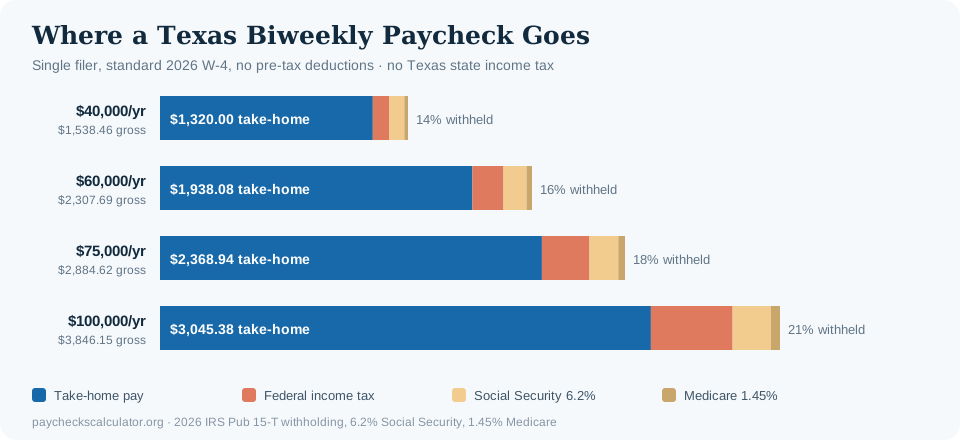
- Only three taxes come out of a Texas paycheck: federal income tax, Social Security and Medicare.
- FICA is a flat 7.65% (6.2% + 1.45%) up to the $184,500 Social Security wage base in 2026.
- Federal withholding uses IRS Pub 15-T: annualize, subtract the W-4 adjustment, apply the bracket table, divide back.
- 401(k) deferrals cut income tax but not FICA; most Section 125 health premiums cut both.
- Texas SUTA is paid by employers on the first $9,000 of wages — it is never deducted from you.
What Taxes Come Out of a Texas Paycheck?
Texas is one of the few states without a personal income tax, and a 2019 amendment to the Texas Constitution prohibits the state from adopting one. No Texas city, county or school district taxes wages either. That makes a Texas paycheck one of the simplest in the country to calculate: every tax line on your stub is federal. That is why knowing how to calculate taxes on paycheck in Texas really means knowing three federal formulas.
| Tax | Rate | Wage limit | Set by |
|---|---|---|---|
| Federal income tax | 10%–37% brackets, via W-4 | None | IRS Pub 15-T |
| Social Security (OASDI) | 6.2% | $184,500 of wages | SSA / IRS |
| Medicare | 1.45% | None | IRS |
| Additional Medicare | 0.9% | Wages over $200,000 | IRS |
| Texas state income tax | 0% | — | Texas has none |
| Local income tax | 0% | — | None in Texas |
Your stub can still show other deductions — health insurance, 401(k), HSA, union dues, wage garnishments or child support — but those are not taxes. They matter for the calculation only because some of them reduce the wages that tax is figured on.
How to Calculate Taxes on Paycheck in Texas, Step by Step
Step 1: Start with gross pay
For salaried workers, divide annual salary by the number of pay periods: 52 weekly, 26 biweekly, 24 semimonthly or 12 monthly. For hourly workers, multiply your rate by hours worked, adding overtime at 1.5× for hours over 40 in a workweek.
Step 2: Subtract pre-tax deductions
Traditional 401(k) or 403(b) deferrals, HSA payroll contributions and Section 125 health, dental and vision premiums are taken out before federal income tax. The result is your federal taxable wages.
Step 3: Calculate federal income tax withholding
Employers use the percentage method in IRS Publication 15-T (Worksheet 1A for automated payroll with a 2020-or-later W-4). In plain terms:
Adjusted wages = annual wages − W-4 adjustment ($8,600 single / $12,900 married)
Annual tax = bracket base + rate × (adjusted wages − bracket floor)
Withholding per check = (annual tax − W-4 Step 3 credits) ÷ pay periods + Step 4(c) extra
The W-4 adjustment applies when the Step 2 "multiple jobs" box is unchecked. If it is checked, the employer uses a narrower table with no adjustment, which withholds more.
Step 4: Calculate Social Security and Medicare (FICA)
Multiply Social Security wages by 6.2% until your year-to-date wages reach $184,500, then stop. Multiply Medicare wages by 1.45% with no cap, adding 0.9% on wages above $200,000 in the year.
Step 5: Skip state and local income tax
Texas withholds nothing here. In most other states, this is where state income tax would be subtracted.
Step 6: Subtract everything from gross pay
Worked Example: $60,000 Salary Paid Biweekly
This is how to calculate taxes on paycheck in Texas from start to finish for a single filer in Houston earning $60,000 a year, paid every two weeks, with a 2026 W-4 that has no adjustments and no pre-tax deductions.
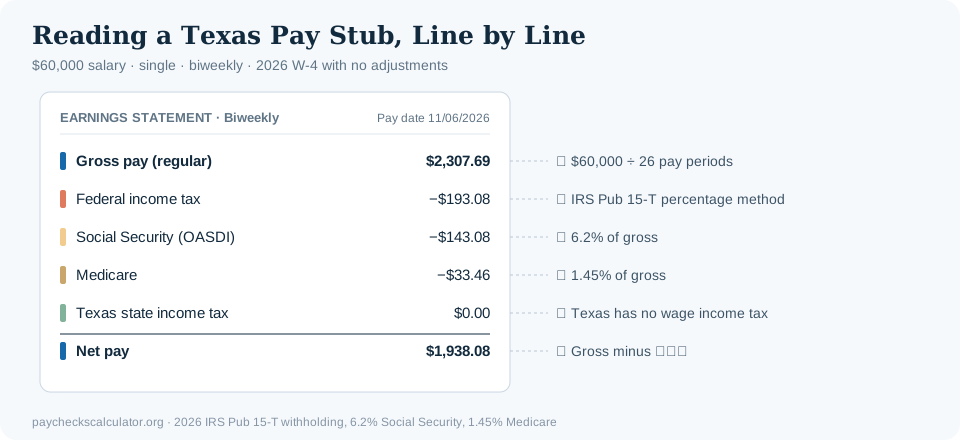
- Gross pay: $60,000 ÷ 26 = $2,307.69.
- Annualize and adjust: $60,000 − $8,600 single-filer adjustment = $51,400.
- Apply the 2026 single bracket table: $51,400 falls in the 12% row that starts at $19,900. Tax = $1,240 + 12% × ($51,400 − $19,900) = $5,020.00 a year.
- Federal withholding per check: $5,020.00 ÷ 26 = $193.08.
- Social Security: $2,307.69 × 6.2% = $143.08.
- Medicare: $2,307.69 × 1.45% = $33.46.
- Texas income tax: $0.00.
- Net pay: $2,307.69 − $193.08 − $143.08 − $33.46 = $1,938.08.
Total withholding is $369.61, or 16.0% of gross. Over a year that is $5,020 of federal income tax and $4,590 of FICA. The same worker filing married jointly (spouse not working) would have about $109.23 of federal tax withheld per check and take home $2,021.92.
Texas Paycheck Taxes by Salary
Because FICA is flat and federal income tax is progressive, the share withheld rises slowly with income. The chart and table below use the same assumptions as the worked example.
| Annual salary | Gross / check | Federal tax | Social Security | Medicare | Take-home | Withheld |
|---|---|---|---|---|---|---|
| $40,000 | $1,538.46 | $100.77 | $95.38 | $22.31 | $1,320.00 | 14.2% |
| $60,000 | $2,307.69 | $193.08 | $143.08 | $33.46 | $1,938.08 | 16.0% |
| $75,000 | $2,884.62 | $295.00 | $178.85 | $41.83 | $2,368.94 | 17.9% |
| $100,000 | $3,846.15 | $506.54 | $238.46 | $55.77 | $3,045.38 | 20.8% |
Want a different salary, filing status or pay schedule? The Texas paycheck calculator runs the same method on your numbers in a few seconds.
How Pre-Tax Deductions Change the Math
Not every deduction is treated the same way, and this is the most common reason a hand calculation misses the real paycheck by a few dollars.
| Deduction | Reduces federal income tax? | Reduces Social Security & Medicare? |
|---|---|---|
| Traditional 401(k) / 403(b) | Yes | No |
| Roth 401(k) | No | No |
| Section 125 health, dental, vision | Yes | Yes |
| HSA via payroll (Section 125) | Yes | Yes |
| Commuter benefits | Yes | Yes |
| Post-tax deductions (garnishments, Roth) | No | No |
Example: add a $100-per-check Section 125 health premium to the $60,000 worker above. Federal withholding drops to $181.08, Social Security to $136.88 and Medicare to $32.01. Take-home falls by only $80.35, not the full $100, because the premium is taken out before all three taxes. For retirement deductions, see our guide on how to calculate 401(k) from a paycheck.
Bonuses, Overtime, Dependents and High Earners
- Bonuses: supplemental wages paid separately are usually withheld at a flat 22% federal rate (37% on supplemental wages over $1 million), plus FICA. Texas adds nothing. Model it with the Texas bonus calculator.
- Overtime: overtime is taxed through regular withholding. A large overtime check is annualized as if you earned that much every period, so withholding can look high; the difference is settled when you file.
- Dependents: W-4 Step 3 credits are subtracted from annual tax before it is divided by pay periods, which lowers withholding. See the dependents calculator.
- High earners: once year-to-date wages pass $184,500, Social Security stops for the rest of 2026 and checks get bigger. Above $200,000, the extra 0.9% Medicare tax starts.
- Child support: income withholding orders come out after taxes and are capped by federal law. See the child support calculator.
Taxes Texas Employers Pay (Not From Your Check)
If you run payroll for a Texas business, a few taxes sit on the employer side of the ledger. They never reduce the employee's paycheck, but they are part of the cost of each hire:
- Employer FICA: a matching 6.2% Social Security and 1.45% Medicare on the same wages.
- Texas unemployment tax (SUTA): paid to the Texas Workforce Commission on the first $9,000of each employee's wages per year. New employers are generally assigned 2.7% or their industry average, whichever is higher; experienced employers get a rate based on their claims history.
- Federal unemployment tax (FUTA): 6.0% on the first $7,000 of wages, reduced to an effective 0.6% when state unemployment tax is paid on time.
Employers must also report new hires to the Texas Employer New Hire Reporting Operations Center within 20 days. None of this changes the employee calculation above.
Texas vs Other States: What No Income Tax Is Worth
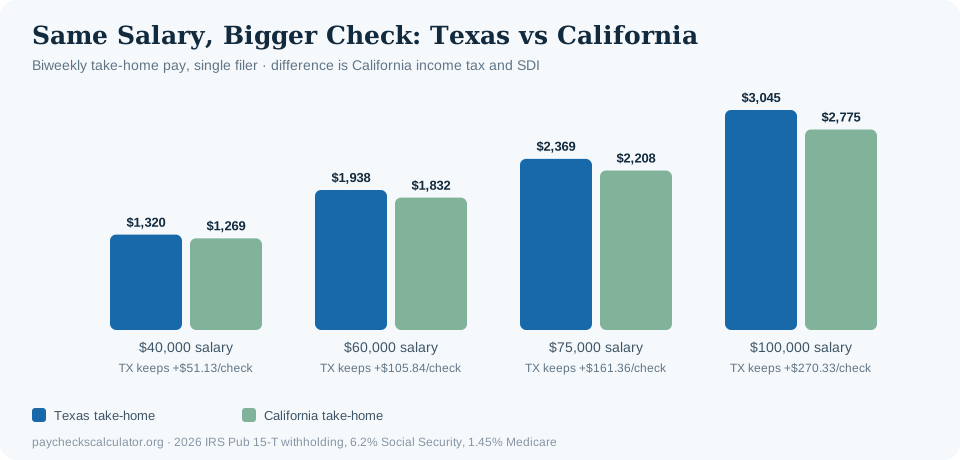
At $100,000 a year, a single Texas worker takes home $3,045.38 per biweekly check, versus $2,775.05 in California — about $7,029 more per year. Texas makes up some of that through higher property taxes and a 6.25% state sales tax (up to 8.25% with local taxes), so compare total cost of living, not just paychecks. See all state paycheck calculators to run the comparison for your state.
How to Check the Taxes on Your Own Texas Pay Stub
- Confirm your gross pay matches your salary ÷ pay periods, or rate × hours.
- Check that Social Security ≈ 6.2% and Medicare ≈ 1.45% of gross minus Section 125 deductions.
- If federal withholding looks off, review your W-4: filing status, the Step 2 checkbox, Step 3 credits and Step 4 entries all change it.
- Use the IRS Tax Withholding Estimator once a year, especially after a raise, a new job or a new child.
- Make sure no state income tax line appears. If one does, ask payroll; you may be set up under another state.
COMMON QUESTIONS
Frequently Asked Questions
How do you calculate taxes on a paycheck in Texas?+
Start with gross pay, subtract pre-tax deductions, then figure federal income tax withholding with the IRS Publication 15-T percentage method, 6.2% Social Security and 1.45% Medicare. Texas has no state income tax, so gross pay minus those three amounts and any other deductions is your take-home pay.
What percentage of my paycheck goes to taxes in Texas?+
For a single filer with a standard W-4, roughly 14.2% of gross pay is withheld at $40,000, 16.0% at $60,000 and 20.8% at $100,000. The 7.65% FICA portion is flat; federal income tax rises with income.
Does Texas take state taxes out of your paycheck?+
No. Texas does not have a personal income tax, and no Texas city or county levies an income tax on wages. The only taxes withheld from a Texas paycheck are federal income tax, Social Security and Medicare.
How much federal tax is taken out of a $60,000 paycheck in Texas?+
A single filer paid biweekly on $60,000 has about $193.08 of federal income tax, $143.08 of Social Security and $33.46 of Medicare withheld from each $2,307.69 check, leaving $1,938.08 take-home.
Do Texas employers pay state payroll taxes?+
Yes, but not from your paycheck. Texas employers pay state unemployment tax (SUTA) to the Texas Workforce Commission on the first $9,000 of each employee's wages, plus federal unemployment tax (FUTA) and their matching share of Social Security and Medicare.
How are bonuses taxed in Texas?+
Bonuses paid separately from regular wages are usually withheld at a flat 22% federal supplemental rate, plus 6.2% Social Security and 1.45% Medicare. There is no Texas tax on the bonus.
Sources and How We Checked the Numbers
Every dollar figure in this article is produced by the same 2026 payroll engine that runs our calculators: the IRS percentage method from Publication 15-T for federal withholding, the 2026 Social Security wage base, and the state rules documented on our methodology page. Rates and limits were checked against these primary sources:
- IRS Publication 15-T (2026), Federal Income Tax Withholding Methods
- IRS Publication 15 (Circular E), Employer's Tax Guide
- IRS Topic 751, Social Security and Medicare Withholding Rates
- Social Security Administration, Contribution and Benefit Base
- Texas Comptroller, Texas taxes overview (no personal income tax)
- Texas Workforce Commission (unemployment tax for employers)
- IRS Tax Withholding Estimator
Disclaimer:examples are estimates for a single W-4 with no adjustments unless stated otherwise. Your employer's payroll system, benefit elections and year-to-date wages determine your actual paycheck.