How to Calculate Gross Monthly Income From Biweekly Paychecks
Here is how to calculate gross monthly income from biweekly paycheck amounts: multiply one paycheck's gross pay by 26, then divide by 12. A $2,000 biweekly gross equals $4,333.33 a month. Do not double the check: that gives $4,000 and leaves out the two extra paychecks every biweekly worker receives each year.
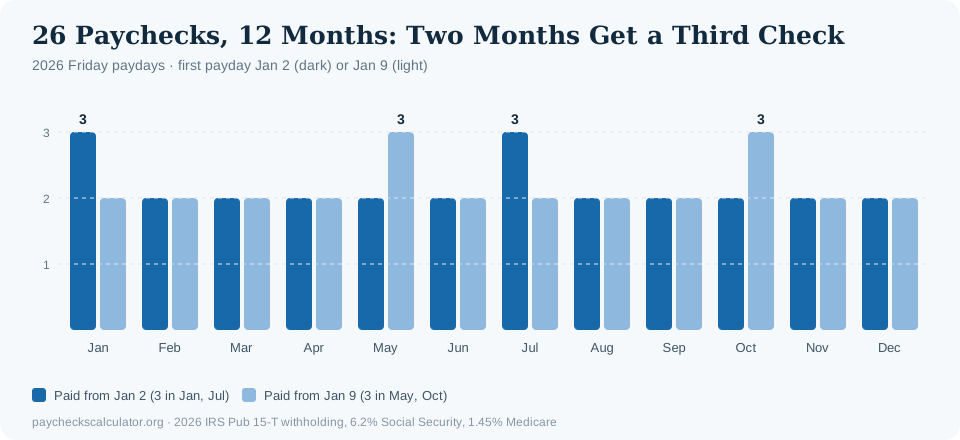
- Formula: biweekly gross × 26 ÷ 12 (or × 2.1667).
- Use the gross amount at the top of your pay stub, not the net deposit.
- In 2026 two months bring a third paycheck (January and July or May and October for Friday payers).
- Variable pay? Average your year-to-date gross per check first.
- Budget on take-home; apply for loans and leases with gross.
How to Calculate Gross Monthly Income From Biweekly Paychecks: The Formula
"Biweekly" means you are paid every two weeks, usually on the same weekday. Because a year has 52 weeks, that schedule produces 26 paychecks a year, the same count the IRS uses for the biweekly payroll period in Publication 15-T. A month, however, is not exactly four weeks long, so the paychecks do not divide evenly into months. The reliable way to convert — and the short answer to how to calculate gross monthly income from biweekly paycheck stubs — is to annualize first and then divide by twelve:
Shortcut: biweekly gross pay × 2.1667
That one line answers the question for most salaried and steady hourly workers. The multiplier 26 ÷ 12 equals 2.1667, which is why the result is always a little more than double a single paycheck. Use the full fraction (multiply by 26, then divide by 12) when the figure is going on a loan or rental application, because rounding the multiplier can shift the answer by a few dollars.
| Biweekly gross | Annual gross (× 26) | Gross monthly (÷ 12) | If you doubled it |
|---|---|---|---|
| $1,200.00 | $31,200.00 | $2,600.00 | $2,400.00 |
| $1,500.00 | $39,000.00 | $3,250.00 | $3,000.00 |
| $2,000.00 | $52,000.00 | $4,333.33 | $4,000.00 |
| $2,500.00 | $65,000.00 | $5,416.67 | $5,000.00 |
| $3,000.00 | $78,000.00 | $6,500.00 | $6,000.00 |
| $4,000.00 | $104,000.00 | $8,666.67 | $8,000.00 |
Step-by-Step: Calculate It From Your Pay Stub
If you are learning how to calculate gross monthly income from biweekly paycheck stubs for the first time, follow these four steps with your most recent stub in front of you.
1. Find the gross pay line
Open your most recent pay stub and look for Gross Pay, Total Earnings or Current Gross. It is the first total on the stub, before the deductions section. Do not use the "Net Pay" or direct-deposit amount; that number has already had taxes, retirement contributions and insurance premiums removed. If your employer pays a regular salary, gross pay is your annual salary divided by 26.
2. Multiply by 26
This gives your annual gross income. A worker whose stub shows $1,846.15 of gross pay is earning $1,846.15 × 26 = $48,000 a year.
3. Divide by 12
$48,000 ÷ 12 = $4,000.00 of gross monthly income. Compare that with doubling the check ($3,692.30), and you can see the gap: $307.70 a month, or about 8.3%.
4. Add other regular income if the form asks for total income
Many applications ask for total gross monthly income, not just wages. Convert each recurring source to a monthly figure the same way — weekly side-gig income × 52 ÷ 12, quarterly payments × 4 ÷ 12 — and add them together. Keep documentation for each source, because underwriters and landlords usually ask for it.
Why Doubling a Biweekly Paycheck Is Wrong
Doubling works for semimonthly pay, where you are paid on two fixed dates each month (for example, the 1st and 15th) and receive exactly 24 checks. Biweekly pay is different: the two-week cycle drifts across the calendar, so ten months contain two paydays and two months contain three. Doubling counts only 24 checks and drops the other two.
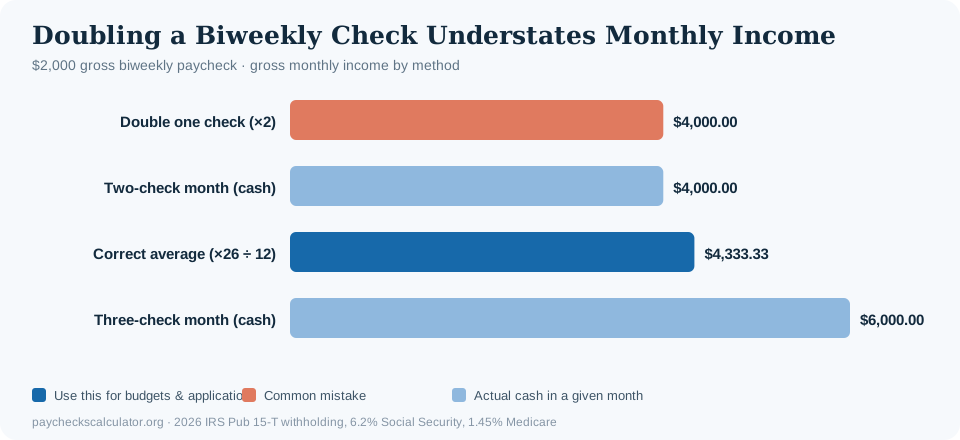
On a $2,000 biweekly check, the error is $333.33 a month or $4,000 a year. That gap matters when an apartment requires income of three times the rent, or when a lender caps your debt-to-income ratio: understating income can push you just below a threshold you actually meet.
Which Months Have Three Paychecks in 2026?
Gross monthly income is an average. The cash that lands in your bank account in a given month is either two or three paychecks. Knowing which months bring the third check helps you plan savings, extra debt payments or a sinking fund. For Friday payers in 2026 there are two common schedules:
| First 2026 payday | Three-paycheck months | Paychecks in 2026 |
|---|---|---|
| Friday, January 2 | January and July | 26 |
| Friday, January 9 | May and October | 26 |
Hourly Pay, Overtime and Bonuses
Steady hourly pay
If you work the same hours every period, multiply your hourly rate by hours per pay period to get the biweekly gross, then apply the formula. At $25 an hour and 80 hours per two weeks, gross pay is $2,000 per check and gross monthly income is $4,333.33. A quicker route for full-time hourly work is rate × 2,080 hours ÷ 12.
Variable hours or overtime
When hours change from check to check, a single stub can mislead. Use the year-to-date (YTD) gross printed on your latest stub instead:
Then multiply the average by 26 and divide by 12. Do not divide YTD gross by months elapsed: if you have just had a three-paycheck month, that shortcut overstates your income. Overtime under the Fair Labor Standards Act is paid at one and a half times the regular rate for hours over 40 in a workweek, so it can swing a biweekly check noticeably. Mortgage lenders typically count overtime and bonus income only when it has a history (often two years) and is likely to continue.
Bonuses and commissions
Keep one-time bonuses out of the biweekly figure. If a form asks for total income, add the annual bonus ÷ 12 as a separate line, and only if it recurs. Bonuses are also withheld differently from regular pay; see our bonus paycheck calculator for the take-home side.
Converting Other Pay Frequencies to Monthly
The same annualize-then-divide approach works for every schedule. The only thing that changes is the number of pay periods per year:
| Pay frequency | Checks per year | Monthly multiplier | Gross per check | Gross monthly |
|---|---|---|---|---|
| Weekly | 52 | × 4.3333 | $1,153.85 | $5,000.00 |
| Biweekly | 26 | × 2.1667 | $2,307.69 | $5,000.00 |
| Semimonthly | 24 | × 2 | $2,500.00 | $5,000.00 |
| Monthly | 12 | × 1 | $5,000.00 | $5,000.00 |
Notice that the same $60,000 salary produces the same $5,000 gross monthly income no matter how often you are paid. Only the size of each check changes.
Gross vs Net Monthly Income
Gross monthly income is the right figure for applications, but it is not what you can spend. To get net monthly income, apply the same 26 ÷ 12 conversion to your take-home pay. For a single filer earning $60,000 in Texas, a biweekly check is $2,307.69 gross and about $1,938.08 net after federal income tax, Social Security and Medicare. That is:
| Per biweekly check | Monthly (× 26 ÷ 12) | |
|---|---|---|
| Gross pay | $2,307.69 | $5,000.00 |
| Federal income tax | $193.08 | $418.34 |
| Social Security + Medicare | $176.54 | $382.50 |
| Take-home pay | $1,938.08 | $4,199.17 |
In a state with income tax the net figure is lower. Run your own numbers with the biweekly paycheck calculator, then multiply the take-home result by 26 ÷ 12 to get the number your monthly budget should be built on.
How Lenders, Landlords and Agencies Use Gross Monthly Income
- Mortgage and auto lenderscompare monthly debt payments with gross monthly income to compute your debt-to-income (DTI) ratio. Fannie Mae's guidelines annualize biweekly pay by multiplying by 26 and dividing by 12 — the same formula above.
- Landlords frequently require gross monthly income of about three times the monthly rent. At $4,333.33 gross, that rule points to rent of roughly $1,444.44.
- Benefit programs may use their own conversion. Federal SNAP rules, for example, multiply biweekly income by 2.15 rather than 2.1667, so an agency figure can differ slightly from yours.
- Credit card applications usually ask for annual income; use biweekly gross × 26.
Whatever the form, write down how you calculated the figure and keep two recent pay stubs on hand. If the number you report matches what the reviewer can reproduce from your stubs, the application moves faster.
COMMON QUESTIONS
Frequently Asked Questions
How do I calculate gross monthly income from a biweekly paycheck?+
Take the gross pay from one biweekly paycheck (before taxes and deductions), multiply it by 26 and divide by 12. A $2,000 biweekly gross works out to $4,333.33 a month. The shortcut multiplier is 2.1667.
Why can't I just multiply my biweekly paycheck by 2?+
Because a year has 26 biweekly pay periods, not 24. Doubling ignores the two extra paychecks you receive each year and understates your monthly income by about 8.3%, or $333 a month on a $2,000 check.
Is gross monthly income before or after taxes?+
Before. Gross monthly income is what you earn before federal income tax, Social Security, Medicare, state tax, 401(k) contributions and benefit premiums come out. Take-home (net) monthly income is what is left after those deductions.
Which months have three biweekly paychecks in 2026?+
If your first 2026 payday was Friday, January 2, you get three paychecks in January and July. If it was Friday, January 9, the three-paycheck months are May and October. Every other month has two.
What if my biweekly paycheck changes because of overtime?+
Use your year-to-date gross from your latest pay stub. Divide it by the number of paychecks you have received so far to get an average check, then multiply by 26 and divide by 12. Lenders usually ask for a two-year history before counting overtime.
Do lenders use the same biweekly-to-monthly formula?+
Mortgage lenders generally annualize biweekly pay by multiplying by 26 and dividing by 12, which is the same method shown here. Some benefit programs use a slightly different shortcut; SNAP, for example, converts biweekly income by multiplying by 2.15.
Sources and How We Checked the Numbers
Every dollar figure in this article is produced by the same 2026 payroll engine that runs our calculators: the IRS percentage method from Publication 15-T for federal withholding, the 2026 Social Security wage base, and the state rules documented on our methodology page. Rates and limits were checked against these primary sources:
- IRS Publication 15-T, Federal Income Tax Withholding Methods (pay periods per year)
- Fannie Mae Selling Guide B3-3.1-01, General Income Information
- 7 CFR 273.10(c)(2), SNAP income conversion (×2.15 for biweekly)
- U.S. Department of Labor, Overtime Pay under the FLSA
- Consumer Financial Protection Bureau, What is a debt-to-income ratio?
Disclaimer:examples are estimates for a single W-4 with no adjustments unless stated otherwise. Your employer's payroll system, benefit elections and year-to-date wages determine your actual paycheck.