BIWEEKLY PAY · 2026

$80,000 a Year Is How Much Biweekly After Taxes?

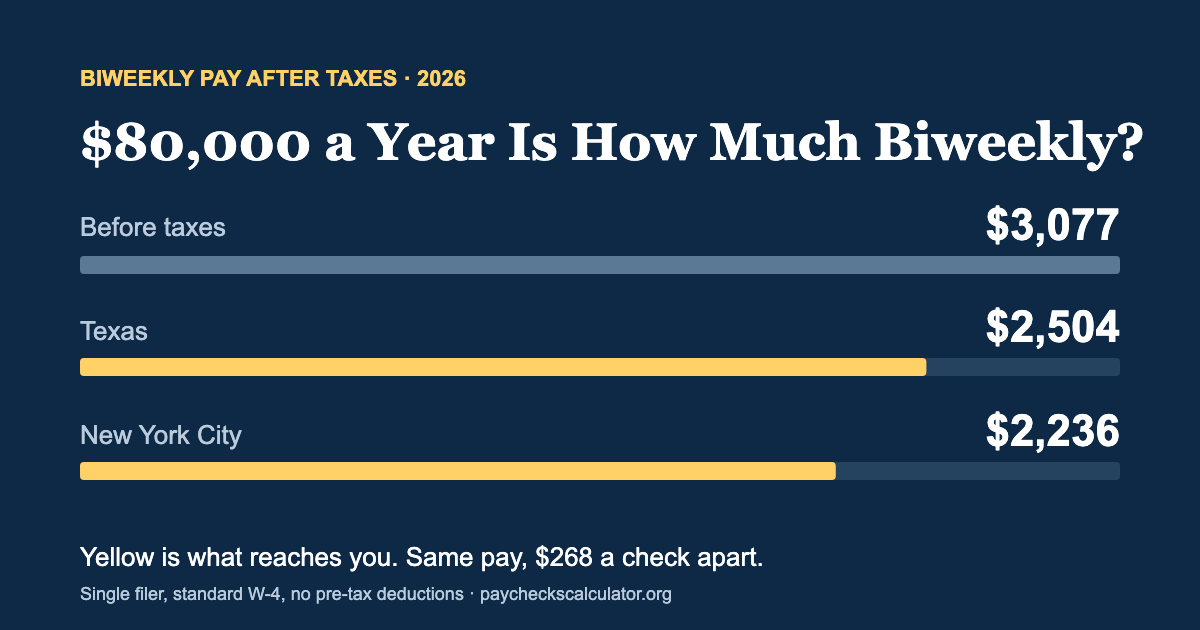
$80,000 a year is how much biweekly? $3,077 before taxes and about $2,504 after taxes for a single filer in Texas, because a biweekly schedule splits your salary into 26 checks. The same check is $2,504 in 6 other places with no state tax at this pay, about $2,382 in a typical state, and $2,236 in New York City, the lowest of the 52 locations we calculate.

Updated November 5, 2026 · 2026 IRS and state withholding tables

$80,000 a year is how much biweekly: $3,077 before taxes, $2,504 after taxes in Texas and $2,236 in New York City
1

Your pay details on $80,000 a year

Adjust the fields; results update instantly.

Pay frequency
2

Estimated take-home pay on $80,000 a year

2026 source-backed withholding methods.

NET PAY · BIWEEKLY$2,504.23$65,110 per year
Take-home 81%Taxes 19%Deductions 0%
Gross pay$3,076.92
Federal income tax−$337.31
Social Security−$190.77
Medicare−$44.62
Texas income tax−$0.00
Pre-tax deductions−$0.00
ⓘ

No individual state income tax on wages.

Figures assume a single filer, standard W-4 and no pre-tax deductions. Change any field to match your pay stub.

PER CHECK

$80,000 a Year Is How Much Biweekly? Where the $3,077 Goes
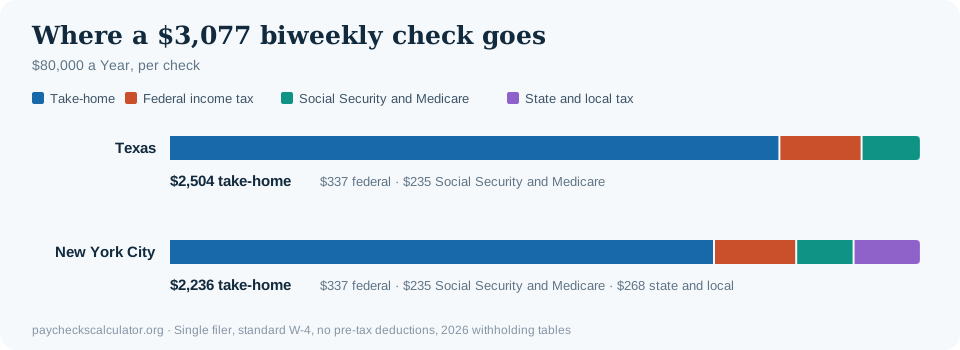
Where a $3,077 biweekly check goes on $80,000 a year: $2,504 take-home in Texas, $2,236 in New York City, with the rest going to federal, Social Security, Medicare and state tax

Federal income tax is $337, well past the $235 for Social Security and Medicare. A joint W-4 brings it down far enough to add $136 a check, because the married table stays at 12% until $133,000 of wages.

Per biweekly checkSingleMarried filing jointlyHead of household
Gross pay$3,076.92$3,076.92$3,076.92
Federal income tax−$337.31−$201.54−$244.15
Social Security (6.2%)−$190.77−$190.77−$190.77
Medicare (1.45%)−$44.62−$44.62−$44.62
Take-home$2,504.23$2,640.00$2,597.38
Effective tax rate18.6%14.2%15.6%
Tax on your next dollar29.65%19.65%19.65%

No-income-tax state, standard W-4 with Step 2 unchecked, no pre-tax deductions, 2026 withholding tables. The next-dollar rate is the federal bracket plus 7.65% for Social Security and Medicare; state tax adds to both rates.
EVERY PAY PERIOD

$80,000 a Year After Taxes: Per Month, Week, Day and Hour

$80,000 a year after taxes is about $5,426 a month, $1,252 a week and $31.30 an hour for a single filer with no state income tax.

PerBefore taxesAfter taxes
Year$80,000$65,110
Month (average)$6,667$5,426
Twice a month$3,333$2,713
Every two weeks$3,077$2,504
Week$1,538$1,252
Day (8 hours)$308$250
Hour$38.46$31.30

Annual take-home divided by the period, based on 2,080 paid hours a year. A monthly average, not what lands in a two-check month.

$80,000 Is Just Under the IRA Deduction Limit

If you have a retirement plan at work, a single filer's traditional IRA deduction starts to phase out at $81,000 of modified adjusted gross income in 2026 and disappears at $91,000. At $80,000 you are $1,000 below the start, so a full $7,500 contribution can still be deductible. That gives you a second place to save without losing the write-off.

A raise changes this quickly, but a traditional 401(k) moves the other way, because each dollar you contribute lowers that income figure by a dollar. A 5% contribution, $154 a check or $4,000 a year, gives you room for a raise of up to $5,000 before the deduction starts to shrink. A Roth IRA is not affected at this income, because that phase-out begins at $153,000.

$13,500 in the 22% Range: How Far a 401(k) Reaches

Wages are $13,500 past the $66,500 line, so the first $13,500 of traditional 401(k) contributions save 22 cents of federal tax on the dollar. That is 16.9% of pay, or $519 a check, and it lowers your take-home by $405. Past that point each dollar saves 12 cents.

An employer match usually matters more than this math, so take that first. After the match, this is the range where cutting your taxable pay is cheapest. Someone contributing the full $24,500 would put $942 a check into the plan, leaving $1,727 of take-home in Texas.

California Falls Behind New York State by $80,000

At lower salaries California usually leaves more than New York State. By $80,000 the order has flipped: California leaves $2,323 and New York State $2,346, because California's withholding rate on the top dollar has reached 10.23%. Massachusetts, with a flat rate, is about level with New York at $2,348.

New York City is still the smallest check at $2,236, and Oregon is next at $2,265. The gap between the city and Texas is $268 a check, or $6,968 a year, which is worth pricing in if a job offer asks you to move.

BENCHMARKS

Is $80,000 a Year a Good Salary?

$80,000 a year is above both the $50,980 median for all U.S. jobs and the $64,064 median for full-time workers, but short of the top quarter of wages, which starts at $80,520. Where you live changes the answer too: this pay leaves $2,504 a check in Texas and $2,236 in New York City, about $6,968 a year apart.

BenchmarkPer yearPer hour$80k a year compared
25th percentile, all U.S. jobs$37,590$18.07+$42,410 a year
Median, all U.S. jobs$50,980$24.51+$29,020 a year
Median, full-time workers$64,064$30.80+$15,936 a year
75th percentile, all U.S. jobs$80,520$38.71−$520 a year

Jobs with a median wage close to this pay include First-Line Supervisors of Construction Trades and Extraction Workers ($79,920), Radiologic Technologists and Technicians ($80,110), Aircraft Mechanics and Service Technicians ($79,870) and First-Line Supervisors of Mechanics, Installers, and Repairers ($79,860).

Wages before tax. All-jobs figures and job wages: BLS Occupational Employment and Wage Statistics, May 2025, with hourly pay multiplied by 2,080. Full-time median: $1,232 a week, from BLS Usual Weekly Earnings, Q3 2026.

TAX BRACKET

$80,000 a Year Is $41,800 Under the 24% Line: What a 401(k) Does to Your Check

A 10% contribution, $308 a check, still sits inside the 22% slice, so the tax saved keeps a steady pace: $20 at 3%, $34 at 5% and $68 at 10%.

401(k) contributionYou save per checkTake-home falls byFederal tax saved
3% of pay$92$72$20
5% of pay$154$120$34
10% of pay$308$240$68

Single filer, no-income-tax state, traditional 401(k). 2026 limit: $24,500.

MONTHLY BUDGET

Budget on $5,008 a Month, Not $5,426

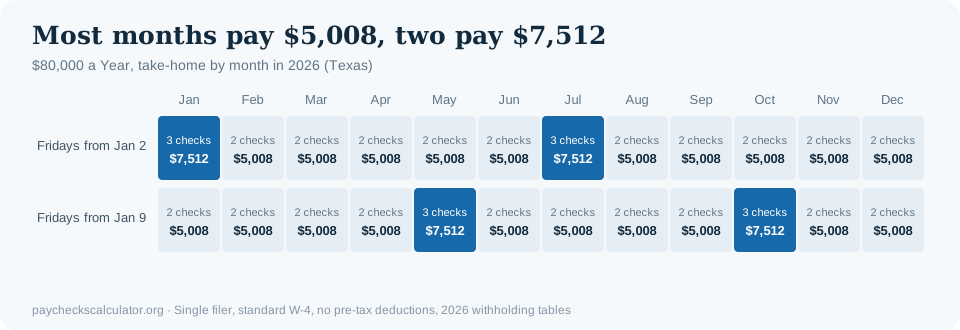
2026 biweekly paydays on $80,000 a year: most months pay $5,008 after taxes in Texas, and the two three-check months pay $7,512

A two-check month deposits $5,008, $418 below the $5,426 average, while the same month's pay on paper is $6,667 before tax. If you pay rent or a mortgage from one check and everything else from the other, each three-check month leaves a clean $2,504 to put toward savings or debt.

RENT

How Much Rent Can You Afford on $80,000 a Year?

HUD counts a household as cost burdened when housing, including utilities, takes more than 30% of its income. On $80,000 a year that line is $2,000 a month before tax, which is 40% of what a two-check month deposits in Texas. Setting your limit from take-home gives a lower, safer number.

Rule of thumbHousing per monthSet aside per check
30% of gross pay$2,000$1,000
30% of take-home in a two-check month, Texas$1,502$751
30% of take-home in a two-check month, New York City$1,342$671

Definition: HUD housing cost burden definition. Single filer, no pre-tax deductions. Lenders and landlords may use their own limits.

YOUR REAL CHECK

What $80,000 a Year Really Pays After Health Insurance and a 401(k)

Workers paid an average of $1,672 a year for single health coverage and $7,471 for family coverage in 2026, according to KFF. Premiums taken through a cafeteria plan and traditional 401(k) contributions both lower the tax on your check, so your take-home falls by less than the amount that comes out.

DeductionsComes out per checkTake-home
No deductions$0$2,504
Average single health premium$64$2,459
Single premium plus a 5% 401(k)$218$2,339
Family premium plus a 5% 401(k)$441$2,182
5% 401(k) plus $150 of benefits$304$2,279

Single filer, no-income-tax state. Premiums: KFF 2026 Employer Health Benefits Survey. Your plan will differ. The last row matches the starting deductions on our $80,000 a year calculator page, which is why it shows a smaller check than this page.

BY STATE

Which States Take the Most From a $80,000 Biweekly Check?

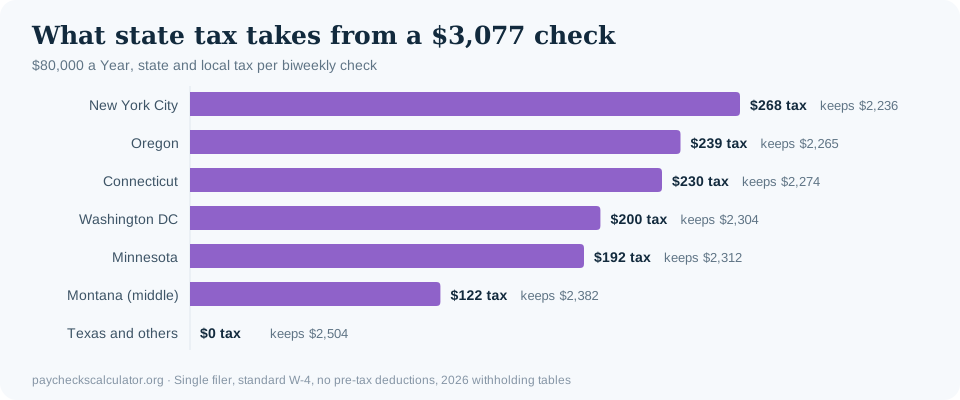
State and local tax per biweekly check on $80,000 a year: New York City $268, Oregon $239, Connecticut $230, Washington DC $200, Minnesota $192, compared with $0 in no-income-tax states
LocationState and local tax per checkTake-home per check
New York City$268$2,236
Oregon$239$2,265
Connecticut$230$2,274
Washington DC$200$2,304
Minnesota$192$2,312
Montana (middle of the 52)$122$2,382
Texas and 6 others$0$2,504

Pennsylvania leaves $2,410 before any local earned income tax, Ohio $2,426, Colorado $2,365 and Minnesota $2,312.

All 52 locations, ranked by take-home
LocationRankState and local tax per checkTake-home per check
Florida1$0$2,504
Nevada1$0$2,504
Tennessee1$0$2,504
Texas1$0$2,504
New Hampshire1$0$2,504
South Dakota1$0$2,504
Wyoming1$0$2,504
Alaska8$10$2,494
North Dakota9$17$2,487
Washington10$42$2,462
Arizona11$61$2,443
Ohio12$78$2,426
Louisiana13$80$2,424
Indiana14$91$2,413
Pennsylvania15$94$2,410
Mississippi16$95$2,409
Arkansas17$96$2,408
Iowa18$98$2,406
Kentucky19$103$2,401
North Carolina20$106$2,398
Missouri21$109$2,395
New Mexico22$115$2,389
Rhode Island22$115$2,389
West Virginia24$118$2,386
Oklahoma25$119$2,385
Nebraska26$120$2,384
Montana27$122$2,382
Georgia28$125$2,379
Alabama29$128$2,376
Vermont30$129$2,375
Michigan31$131$2,373
Idaho32$133$2,371
New Jersey33$134$2,370
Utah34$137$2,367
Colorado35$139$2,365
Maryland36$140$2,364
Kansas37$141$2,363
Virginia38$147$2,357
Wisconsin39$151$2,353
Illinois40$152$2,352
Delaware41$155$2,349
Massachusetts42$156$2,348
New York43$158$2,346
South Carolina44$159$2,345
Maine45$166$2,338
Hawaii46$178$2,326
California47$181$2,323
Minnesota48$192$2,312
Washington DC49$200$2,304
Connecticut50$230$2,274
Oregon51$239$2,265
New York City52$268$2,236

Assumes you live and work in the same place. Annual figures: $80,000 a year after tax in every state.

NEARBY PAY

How $80,000 a Year Compares to Nearby Salaries

Annual salaryBefore taxes per checkTake-home per checkDifference per check
$70,000 a year$2,692$2,234−$270
$75,000 a year$2,885$2,369−$135
$80,000 a year$3,077$2,504—
$85,000 a year$3,269$2,640+$136
$90,000 a year$3,462$2,775+$271

Single filer, no-income-tax state, no pre-tax deductions.

THE MATH

How to Calculate $80,000 a Year Biweekly, Step by Step

  1. Gross per check: $80,000 ÷ 26 = $3,076.92.
  2. Annualize, then subtract the W-4 adjustment: $80,000 − $8,600 = $71,400.
  3. Apply the single-filer table: $71,400 falls in the $57,900 to $113,200 row, so $5,800 + 22% × ($71,400 − $57,900) = $8,770 a year.
  4. Federal withholding per check: $8,770 ÷ 26 = $337.31.
  5. Social Security and Medicare: 6.2% and 1.45% of $3,076.92 = $190.77 and $44.62.
  6. Take-home in a no-income-tax state: $2,504.23.

Steps follow IRS Publication 15-T, Worksheet 1A. More in how we calculate paychecks.

FREQUENTLY ASKED QUESTIONS

$80,000 a Year Biweekly: Common Questions

$80k a year is how much biweekly after taxes?

$2,504 in Texas, about $2,382 in a typical state and $2,236 in New York City, for a single filer with no pre-tax deductions.

How much is $80,000 a year biweekly before taxes?

$3,076.92. Divide $80,000 by the 26 pay periods in a biweekly year. Taxes and deductions come out after that.

Why is my real paycheck on $80k a year smaller than this?

Workplace deductions. A 5% 401(k) plus $150 a check for benefits brings $2,504 down to $2,279 in Texas.

How much is $80k a year biweekly in New York City?

About $2,236 after taxes for a single filer with a standard W-4 and no pre-tax deductions. That is $268 a check less than Texas, the largest gap of any location we calculate at this salary.

How much is $80k a year biweekly after a 5% 401(k)?

About $2,384 in Texas. You put $154 a check into the plan, and your take-home falls by $120, because all of that contribution comes out of wages withheld at 22%.

KEEP GOING

More on Your Biweekly Paycheck

Updated November 5, 2026. Sources: IRS Publication 15-T, state withholding tables listed in how we calculate paychecks, BLS, HUD and KFF.