BIWEEKLY PAY · 2026

$70,000 a Year Is How Much Biweekly After Taxes?

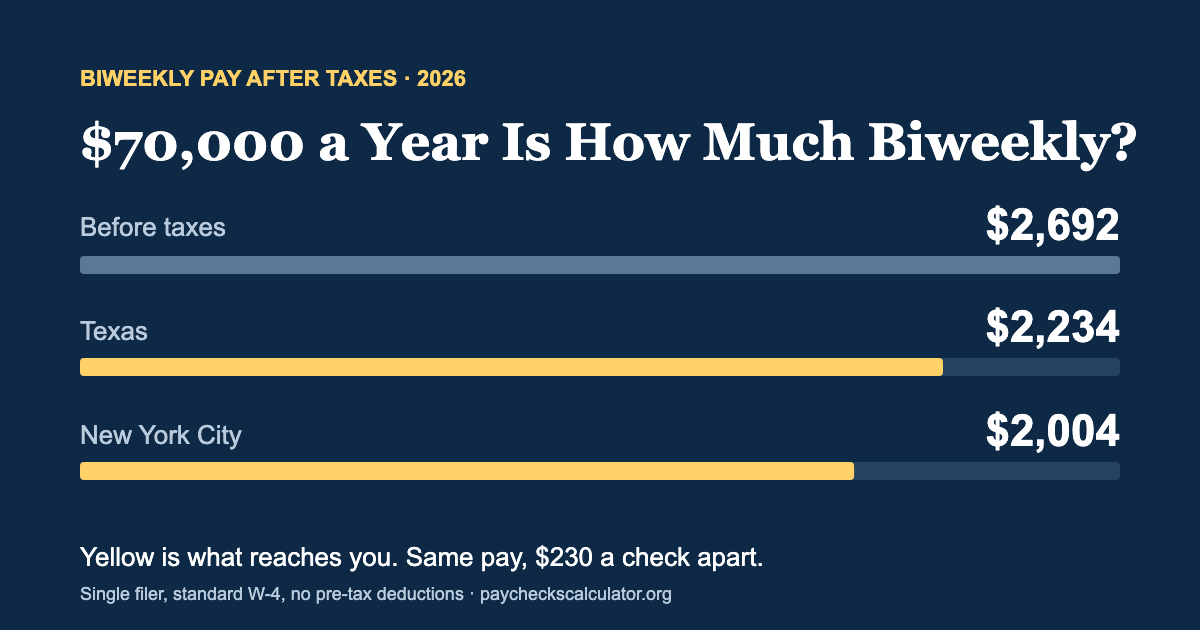
$70,000 a year is how much biweekly? $2,692 before taxes and about $2,234 after taxes for a single filer in Texas, because a biweekly schedule splits your salary into 26 checks. The same check is $2,234 in 6 other places with no state tax at this pay, about $2,131 in a typical state, and $2,004 in New York City, the lowest of the 52 locations we calculate.

Updated November 5, 2026 · 2026 IRS and state withholding tables

$70,000 a year is how much biweekly: $2,692 before taxes, $2,234 after taxes in Texas and $2,004 in New York City
1

Your pay details on $70,000 a year

Adjust the fields; results update instantly.

Pay frequency
2

Estimated take-home pay on $70,000 a year

2026 source-backed withholding methods.

NET PAY · BIWEEKLY$2,233.65$58,075 per year
Take-home 83%Taxes 17%Deductions 0%
Gross pay$2,692.31
Federal income tax−$252.69
Social Security−$166.92
Medicare−$39.04
Texas income tax−$0.00
Pre-tax deductions−$0.00
ⓘ

No individual state income tax on wages.

Figures assume a single filer, standard W-4 and no pre-tax deductions. Change any field to match your pay stub.

PER CHECK

$70,000 a Year Is How Much Biweekly? Where the $2,692 Goes
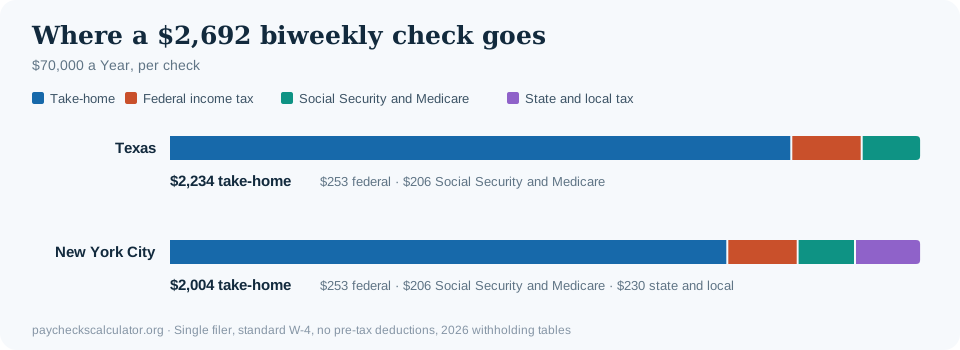
Where a $2,692 biweekly check goes on $70,000 a year: $2,234 take-home in Texas, $2,004 in New York City, with the rest going to federal, Social Security, Medicare and state tax

Federal income tax is now the larger deduction in Texas, $253 against $206 for Social Security and Medicare. New York City takes another $230 on top. The married column assumes one earner with Step 2 of the W-4 unchecked, and it shows $97 more per check than the single column.

Per biweekly checkSingleMarried filing jointlyHead of household
Gross pay$2,692.31$2,692.31$2,692.31
Federal income tax−$252.69−$155.38−$198.00
Social Security (6.2%)−$166.92−$166.92−$166.92
Medicare (1.45%)−$39.04−$39.04−$39.04
Take-home$2,233.65$2,330.96$2,288.35
Effective tax rate17.0%13.4%15.0%
Tax on your next dollar29.65%19.65%19.65%

No-income-tax state, standard W-4 with Step 2 unchecked, no pre-tax deductions, 2026 withholding tables. The next-dollar rate is the federal bracket plus 7.65% for Social Security and Medicare; state tax adds to both rates.
EVERY PAY PERIOD

$70,000 a Year After Taxes: Per Month, Week, Day and Hour

$70,000 a year after taxes is about $4,840 a month, $1,117 a week and $27.92 an hour for a single filer with no state income tax.

PerBefore taxesAfter taxes
Year$70,000$58,075
Month (average)$5,833$4,840
Twice a month$2,917$2,420
Every two weeks$2,692$2,234
Week$1,346$1,117
Day (8 hours)$269$223
Hour$33.65$27.92

Annual take-home divided by the period, based on 2,080 paid hours a year. A monthly average, not what lands in a two-check month.

Why the First 5% in a 401(k) Goes Furthest at $70,000

A $70,000 salary sits just past the point where single-filer withholding jumps from 12% to 22%. That position makes the first slice of a traditional 401(k) worth more than the next one.

The first $3,500 you contribute comes out of wages that would otherwise be withheld at 22%, so every dollar you save costs 78 cents of take-home. Contributing 5%, or $135 a check, lowers your check by only $105. Past that point you are back in the 12% range and each dollar costs 88 cents. Going from 5% to 10% saves just $16 more in federal tax per check, against $30 for the first 5%.

None of this is a reason to stop at 5%. An employer match usually beats either tax rate, and the money can keep growing after the withholding math is done. It only means that when cash is tight, the first $135 a check buys the most federal tax relief. A Roth 401(k) works differently: contributions come out after tax, so your check falls by the full amount.

Married on $70,000: The 22% Line Is $63,000 Away

The same salary looks different on a joint W-4. The married table does not reach 22% until $133,000 of annual wages, so one earner at $70,000 has $63,000 of room and is withheld at 12% on the top dollar. That is most of why the check is $2,331 rather than $2,234.

The picture changes when both spouses work. Checking Step 2 on each W-4 tells payroll to withhold at higher rates, closer to the single column. Two earners at $70,000 who leave the box unchecked get the bigger $2,331 check through the year and can owe the difference when they file.

New York City, Not Oregon, Is the Low Point at $70,000

Of the 52 locations on this site, New York City leaves the smallest check at $2,004. New York State outside the city is $2,098, so the city's own resident income tax accounts for about $94 every two weeks. Oregon follows at $2,023. California is $2,092, $88 above the city.

North Dakota has an income tax, but it takes just $10 a check at this salary. Washington has no income tax, yet its paid leave and long-term care programs take $38. When you compare job offers across states, no income tax and no deductions are not the same thing.

BENCHMARKS

Is $70,000 a Year a Good Salary?

$70,000 a year is above both the $50,980 median for all U.S. jobs and the $64,064 median for full-time workers, but short of the top quarter of wages, which starts at $80,520. Where you live changes the answer too: this pay leaves $2,234 a check in Texas and $2,004 in New York City, about $5,980 a year apart.

BenchmarkPer yearPer hour$70k a year compared
25th percentile, all U.S. jobs$37,590$18.07+$32,410 a year
Median, all U.S. jobs$50,980$24.51+$19,020 a year
Median, full-time workers$64,064$30.80+$5,936 a year
75th percentile, all U.S. jobs$80,520$38.71−$10,520 a year

Jobs with a median wage close to this pay include Sales Representatives of Services, Except Advertising, Insurance, Financial Services, and Travel ($69,990), Property, Real Estate, and Community Association Managers ($69,990), First-Line Supervisors of Office and Administrative Support Workers ($69,500) and Food Service Managers ($69,390).

Wages before tax. All-jobs figures and job wages: BLS Occupational Employment and Wage Statistics, May 2025, with hourly pay multiplied by 2,080. Full-time median: $1,232 a week, from BLS Usual Weekly Earnings, Q3 2026.

TAX BRACKET

$70,000 a Year Is $3,500 Over the 22% Line: What a 401(k) Does to Your Check

Run the same math at three contribution levels and watch the last column. Federal tax saved goes from $18 a check at 3% to $30 at 5%, then reaches only $46 at 10%, because the part past 5% of pay comes out of wages withheld at 12%.

401(k) contributionYou save per checkTake-home falls byFederal tax saved
3% of pay$81$63$18
5% of pay$135$105$30
10% of pay$269$223$46

Single filer, no-income-tax state, traditional 401(k). 2026 limit: $24,500.

MONTHLY BUDGET

Budget on $4,468 a Month, Not $4,840

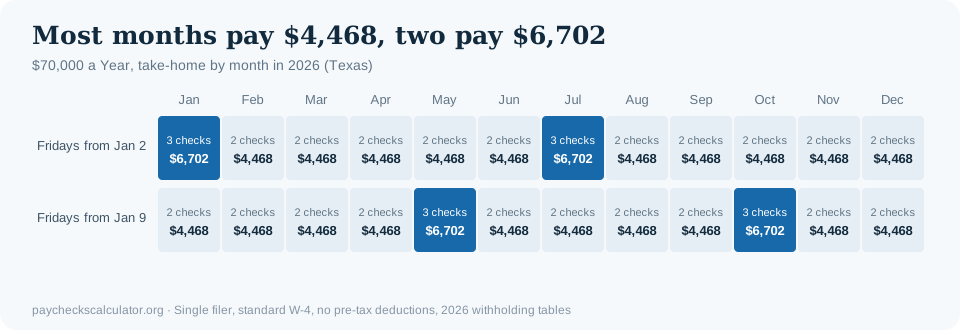
2026 biweekly paydays on $70,000 a year: most months pay $4,468 after taxes in Texas, and the two three-check months pay $6,702

Most months pay $4,468, $372 under the $4,840 average, and two months pay $6,702. Next year adds a wrinkle. Fridays that started January 2, 2026 reach both January 1 and December 31 in 2027, which makes 27 paydays unless the January 1 check moves to December 31 for the holiday. If your employer divides salaries by 27 in a year like that, each gross check falls from $2,692 to $2,593.

RENT

How Much Rent Can You Afford on $70,000 a Year?

HUD counts a household as cost burdened when housing, including utilities, takes more than 30% of its income. On $70,000 a year that line is $1,750 a month before tax, which is 39% of what a two-check month deposits in Texas. Setting your limit from take-home gives a lower, safer number.

Rule of thumbHousing per monthSet aside per check
30% of gross pay$1,750$875
30% of take-home in a two-check month, Texas$1,340$670
30% of take-home in a two-check month, New York City$1,202$601

Definition: HUD housing cost burden definition. Single filer, no pre-tax deductions. Lenders and landlords may use their own limits.

YOUR REAL CHECK

What $70,000 a Year Really Pays After Health Insurance and a 401(k)

Workers paid an average of $1,672 a year for single health coverage and $7,471 for family coverage in 2026, according to KFF. Premiums taken through a cafeteria plan and traditional 401(k) contributions both lower the tax on your check, so your take-home falls by less than the amount that comes out.

DeductionsComes out per checkTake-home
No deductions$0$2,234
Average single health premium$64$2,188
Single premium plus a 5% 401(k)$199$2,077
Family premium plus a 5% 401(k)$422$1,898
5% 401(k) plus $150 of benefits$285$2,008

Single filer, no-income-tax state. Premiums: KFF 2026 Employer Health Benefits Survey. Your plan will differ. The last row matches the starting deductions on our $70,000 a year calculator page, which is why it shows a smaller check than this page.

BY STATE

Which States Take the Most From a $70,000 Biweekly Check?

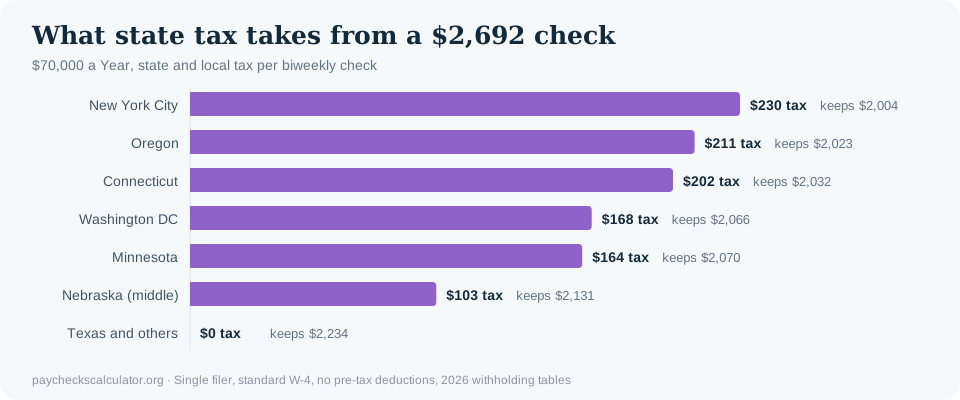
State and local tax per biweekly check on $70,000 a year: New York City $230, Oregon $211, Connecticut $202, Washington DC $168, Minnesota $164, compared with $0 in no-income-tax states
LocationState and local tax per checkTake-home per check
New York City$230$2,004
Oregon$211$2,023
Connecticut$202$2,032
Washington DC$168$2,066
Minnesota$164$2,070
Nebraska (middle of the 52)$103$2,131
Texas and 6 others$0$2,234

Mid-table states sit well above that low point. Georgia leaves $2,128, North Carolina $2,144, Arizona $2,180 and Colorado $2,113.

All 52 locations, ranked by take-home
LocationRankState and local tax per checkTake-home per check
Florida1$0$2,234
Nevada1$0$2,234
Tennessee1$0$2,234
Texas1$0$2,234
New Hampshire1$0$2,234
South Dakota1$0$2,234
Wyoming1$0$2,234
North Dakota8$10$2,224
Alaska9$11$2,223
Washington10$38$2,196
Arizona11$54$2,180
Ohio12$67$2,167
Louisiana13$68$2,166
Indiana14$80$2,154
Mississippi14$80$2,154
Arkansas16$82$2,152
Pennsylvania17$83$2,151
Iowa18$84$2,150
Kentucky19$90$2,144
Missouri19$90$2,144
North Carolina19$90$2,144
New Mexico22$97$2,137
Montana23$100$2,134
West Virginia24$101$2,133
Rhode Island24$101$2,133
Oklahoma26$102$2,132
Nebraska27$103$2,131
Vermont28$105$2,129
Georgia29$106$2,128
New Jersey30$110$2,124
Idaho31$112$2,122
Alabama32$113$2,121
Michigan33$115$2,119
Kansas34$120$2,114
Utah34$120$2,114
Colorado36$121$2,113
Maryland37$122$2,112
Virginia38$126$2,108
Wisconsin39$130$2,104
Delaware40$131$2,103
Illinois41$134$2,100
New York42$136$2,098
South Carolina43$137$2,097
Massachusetts43$137$2,097
Maine45$139$2,095
California46$142$2,092
Hawaii47$150$2,084
Minnesota48$164$2,070
Washington DC49$168$2,066
Connecticut50$202$2,032
Oregon51$211$2,023
New York City52$230$2,004

Assumes you live and work in the same place. Annual figures: $70,000 a year after tax in every state.

NEARBY PAY

How $70,000 a Year Compares to Nearby Salaries

Annual salaryBefore taxes per checkTake-home per checkDifference per check
$60,000 a year$2,308$1,938−$296
$65,000 a year$2,500$2,093−$141
$70,000 a year$2,692$2,234—
$75,000 a year$2,885$2,369+$135
$80,000 a year$3,077$2,504+$270

Single filer, no-income-tax state, no pre-tax deductions.

THE MATH

How to Calculate $70,000 a Year Biweekly, Step by Step

  1. Gross per check: $70,000 ÷ 26 = $2,692.31.
  2. Annualize, then subtract the W-4 adjustment: $70,000 − $8,600 = $61,400.
  3. Apply the single-filer table: $61,400 falls in the $57,900 to $113,200 row, so $5,800 + 22% × ($61,400 − $57,900) = $6,570 a year.
  4. Federal withholding per check: $6,570 ÷ 26 = $252.69.
  5. Social Security and Medicare: 6.2% and 1.45% of $2,692.31 = $166.92 and $39.04.
  6. Take-home in a no-income-tax state: $2,233.65.

Steps follow IRS Publication 15-T, Worksheet 1A. More in how we calculate paychecks.

FREQUENTLY ASKED QUESTIONS

$70,000 a Year Biweekly: Common Questions

$70k a year is how much biweekly after taxes?

$2,234 in Texas, about $2,131 in a typical state and $2,004 in New York City, for a single filer with no pre-tax deductions.

How much is $70,000 a year biweekly before taxes?

$2,692.31. Divide $70,000 by the 26 pay periods in a biweekly year. Taxes and deductions come out after that.

Why is my real paycheck on $70k a year smaller than this?

Workplace deductions. A 5% 401(k) plus $150 a check for benefits brings $2,234 down to $2,008 in Texas.

What tax bracket is $70,000 in for 2026?

On a standard single W-4, the top dollar of a $70,000 salary is withheld at 22%, because wages are $3,500 past the $66,500 line. Everything below that line is withheld at 12% or less, so your overall federal rate is far lower than 22%.

How much is $70k a year biweekly after a 5% 401(k)?

About $2,129 in Texas. You put $135 a check into the plan, and your take-home falls by $105 because the contribution is not subject to federal income tax. Social Security and Medicare still apply to the full $2,692.

KEEP GOING

More on Your Biweekly Paycheck

Updated November 5, 2026. Sources: IRS Publication 15-T, state withholding tables listed in how we calculate paychecks, BLS, HUD and KFF.