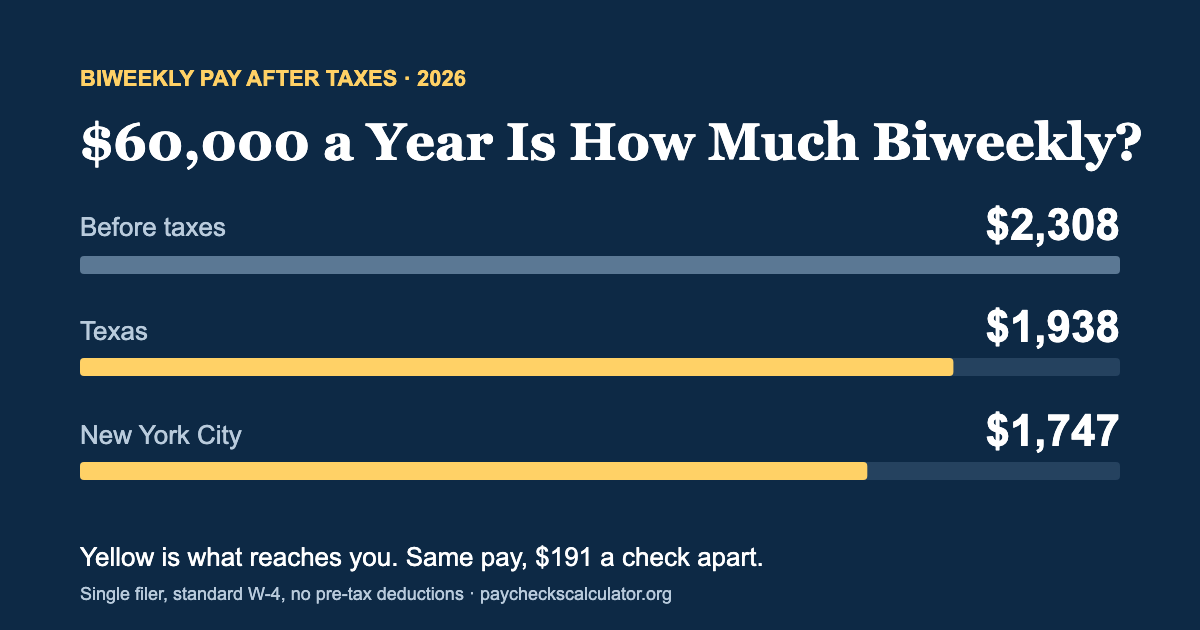
$60,000 a year is how much biweekly? $2,308 before taxes and about $1,938 after taxes for a single filer in Texas, because a biweekly schedule splits your salary into 26 checks. The same check is $1,938 in 6 other places with no state tax at this pay, about $1,852 in a typical state, and $1,747 in New York City, the lowest of the 52 locations we calculate.
Updated November 5, 2026 · 2026 IRS and state withholding tables
1
Your pay details on $60,000 a year
Adjust the fields; results update instantly.
Pay frequency
2
Estimated take-home pay on $60,000 a year
2026 source-backed withholding methods.
NET PAY · BIWEEKLY$1,938.08$50,390 per year
Take-home 84%Taxes 16%Deductions 0%
Gross pay$2,307.69
Federal income tax−$193.08
Social Security−$143.08
Medicare−$33.46
Texas income tax−$0.00
Pre-tax deductions−$0.00
ⓘ
No individual state income tax on wages.
Figures assume a single filer, standard W-4 and no pre-tax deductions. Change any field to match your pay stub.
PER CHECK
$60,000 a Year Is How Much Biweekly? Where the $2,308 Goes
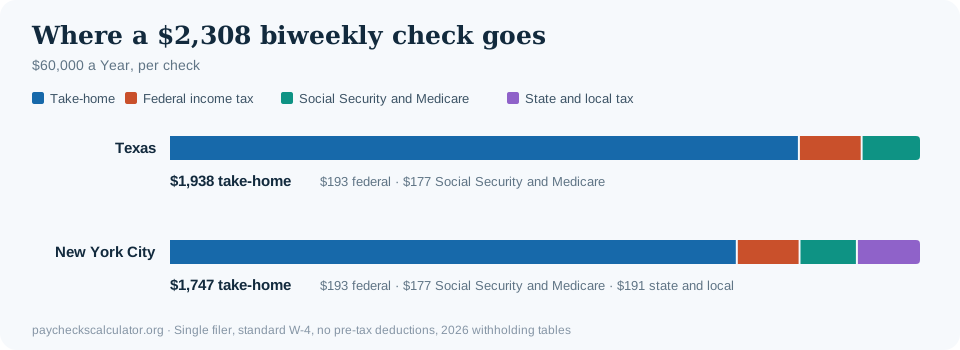
A single filer keeps 84% of the gross check in Texas, and New York City takes another $191. One earner on a joint W-4 gets $84 more, because the married table shelters more of the pay before withholding starts. Head of household falls in between at $41 more.
Per biweekly check
Single
Married filing jointly
Head of household
Gross pay
$2,307.69
$2,307.69
$2,307.69
Federal income tax
−$193.08
−$109.23
−$151.85
Social Security (6.2%)
−$143.08
−$143.08
−$143.08
Medicare (1.45%)
−$33.46
−$33.46
−$33.46
Take-home
$1,938.08
$2,021.92
$1,979.31
Effective tax rate
16.0%
12.4%
14.2%
Tax on your next dollar
19.65%
19.65%
19.65%
No-income-tax state, standard W-4 with Step 2 unchecked, no pre-tax deductions, 2026 withholding tables. The next-dollar rate is the federal bracket plus 7.65% for Social Security and Medicare; state tax adds to both rates.
EVERY PAY PERIOD
$60,000 a Year After Taxes: Per Month, Week, Day and Hour
$60,000 a year after taxes is about $4,199 a month, $969 a week and $24.23 an hour for a single filer with no state income tax.
Per
Before taxes
After taxes
Year
$60,000
$50,390
Month (average)
$5,000
$4,199
Twice a month
$2,500
$2,100
Every two weeks
$2,308
$1,938
Week
$1,154
$969
Day (8 hours)
$231
$194
Hour
$28.85
$24.23
Annual take-home divided by the period, based on 2,080 paid hours a year. A monthly average, not what lands in a two-check month.
$6,500 of Room Before the 22% Line
A single filer's withholding stays at 12% until $66,500 of annual wages, so $60,000 has $6,500 of room. Federal income tax takes $193 a check and Social Security and Medicare $177, and this is about where the federal line moves ahead of payroll tax for good.
That room matters when a raise or a bonus shows up. A raise to $65,000 adds $155 a check, and you keep 81% of the extra gross. Cross the line and only the wages above it move to 22%. A $10,000 raise to $70,000 still adds $296 a check, 77% of the extra gross, so crossing the line never lowers your take-home.
Twenty-Six Checks or Twenty-Four on $60,000
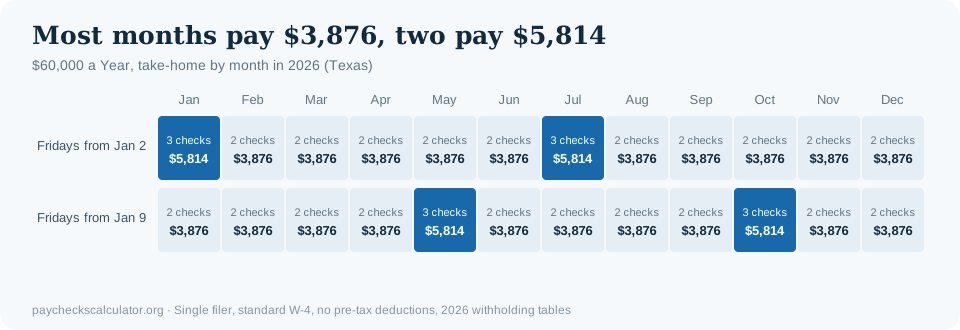
Two jobs paying $60,000 can feel quite different if one pays every two weeks and the other twice a month. Biweekly gives you $1,938 a check after taxes in Texas, and twice a month gives you $2,100. In an ordinary month the twice-a-month job deposits $4,200 against $3,876 for the biweekly one.
The biweekly job catches up with two $5,814 months, and the year comes out the same. When you compare offers, compare the annual figure first. Then build the budget on the monthly deposit you will actually see, because a $3,876 month is what has to cover rent.
What New York City Alone Costs on $60,000
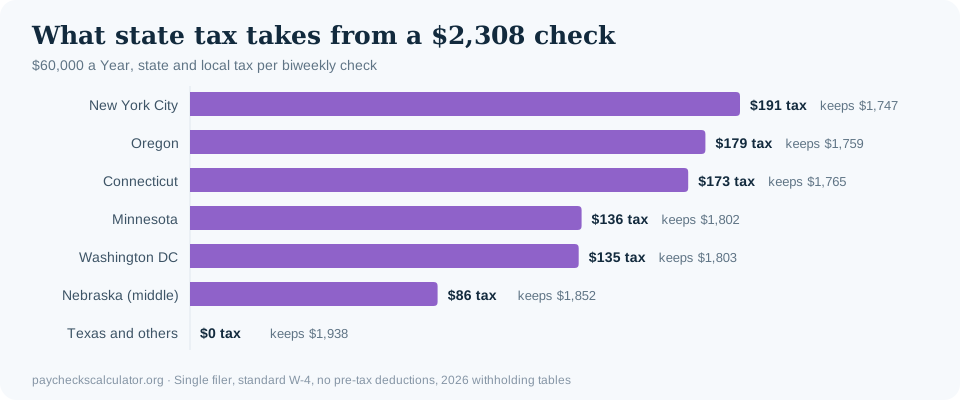
New York State outside the city leaves $1,825. Live in one of the five boroughs and the check falls to $1,747, because the city's resident income tax costs another $78 every two weeks. That makes the city the smallest check of our 52 locations at this salary, just ahead of Oregon at $1,759 and Connecticut at $1,765.
City tax follows where you live rather than where you work, so people who commute in from outside the city generally do not pay it. New Jersey leaves $1,851 and Pennsylvania $1,867 before any local earned income tax, though someone crossing a state line for work should check how both states treat those wages.
BENCHMARKS
Is $60,000 a Year a Good Salary?
$60,000 a year beats the $50,980 median for all U.S. jobs but falls short of the $64,064 median for full-time workers, which is the fairer comparison if you work full time. Where you live changes the answer too: this pay leaves $1,938 a check in Texas and $1,747 in New York City, about $4,966 a year apart.
Benchmark
Per year
Per hour
$60k a year compared
25th percentile, all U.S. jobs
$37,590
$18.07
+$22,410 a year
Median, all U.S. jobs
$50,980
$24.51
+$9,020 a year
Median, full-time workers
$64,064
$30.80
−$4,064 a year
75th percentile, all U.S. jobs
$80,520
$38.71
−$20,520 a year
Jobs with a median wage close to this pay include Water and Wastewater Treatment Plant and System Operators ($60,020), Security and Fire Alarm Systems Installers ($60,070), Operating Engineers and Other Construction Equipment Operators ($59,850) and Interpreters and Translators ($60,170).
$60,000 a Year Is $6,500 Under the 22% Line: What a 401(k) Does to Your Check
With $6,500 to the line, every dollar in a traditional 401(k) saves 12 cents of federal tax. Putting in $115 a check, or 5%, lowers your take-home by $102. You would need a raise past $66,500 before the first dollars of a contribution save 22 cents.
A year on this salary deposits $3,876 ten times and $5,814 twice. Together the two extra checks come to $3,876, the same as an ordinary month, so treating them as one planned month of savings or debt payments is an easy rule to keep.
RENT
How Much Rent Can You Afford on $60,000 a Year?
HUD counts a household as cost burdened when housing, including utilities, takes more than 30% of its income. On $60,000 a year that line is $1,500 a month before tax, which is 39% of what a two-check month deposits in Texas. Setting your limit from take-home gives a lower, safer number.
Rule of thumb
Housing per month
Set aside per check
30% of gross pay
$1,500
$750
30% of take-home in a two-check month, Texas
$1,163
$581
30% of take-home in a two-check month, New York City
What $60,000 a Year Really Pays After Health Insurance and a 401(k)
Workers paid an average of $1,672 a year for single health coverage and $7,471 for family coverage in 2026, according to KFF. Premiums taken through a cafeteria plan and traditional 401(k) contributions both lower the tax on your check, so your take-home falls by less than the amount that comes out.
Georgia and New Jersey land near the middle at $1,852 and $1,851. Arizona leaves $1,892, and North Dakota withholds just $2 a check, because its table does not start until $57,625 of wages for a single filer.
$1,938 in Texas, about $1,852 in a typical state and $1,747 in New York City, for a single filer with no pre-tax deductions.
How much is $60,000 a year biweekly before taxes?
$2,307.69. Divide $60,000 by the 26 pay periods in a biweekly year. Taxes and deductions come out after that.
Why is my real paycheck on $60k a year smaller than this?
Workplace deductions. A 5% 401(k) plus $150 a check for benefits brings $1,938 down to $1,716 in Texas.
How much is $60k a year biweekly in New York City?
About $1,747 after taxes for a single filer with a standard W-4 and no pre-tax deductions. State and city income tax plus Paid Family Leave take $191 a check, the most of any location we calculate at this salary.
How much is $60k a year a month after taxes?
$4,199 on average in Texas for a single filer. Most months pay two checks, so $3,876 is the amount you can count on, and two months a year pay $5,814.