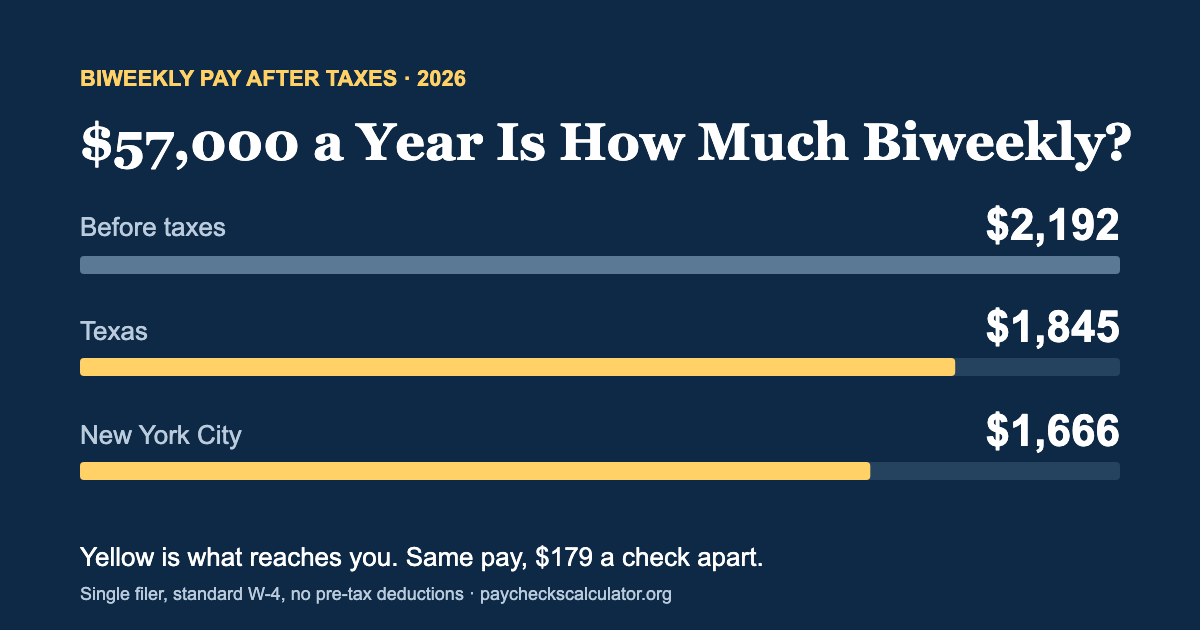
$57,000 a year is how much biweekly? $2,192 before taxes and about $1,845 after taxes for a single filer in Texas, because a biweekly schedule splits your salary into 26 checks. The same check is $1,845 in 7 other places with no state tax at this pay, about $1,765 in a typical state, and $1,666 in New York City, the lowest of the 52 locations we calculate.
Updated November 5, 2026 · 2026 IRS and state withholding tables
1
Your pay details on $57,000 a year
Adjust the fields; results update instantly.
Pay frequency
2
Estimated take-home pay on $57,000 a year
2026 source-backed withholding methods.
NET PAY · BIWEEKLY$1,845.37$47,980 per year
Take-home 84%Taxes 16%Deductions 0%
Gross pay$2,192.31
Federal income tax−$179.23
Social Security−$135.92
Medicare−$31.79
Texas income tax−$0.00
Pre-tax deductions−$0.00
ⓘ
No individual state income tax on wages.
Figures assume a single filer, standard W-4 and no pre-tax deductions. Change any field to match your pay stub.
PER CHECK
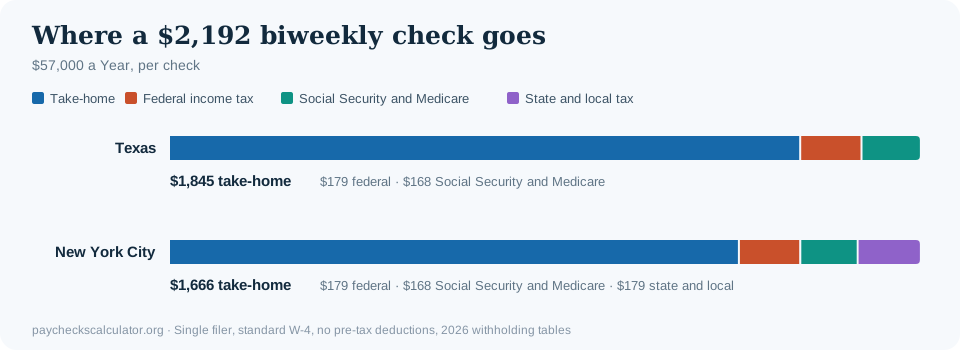
$57,000 a Year Is How Much Biweekly? Where the $2,192 Goes
Federal income tax and payroll taxes are nearly level here, $179 and $168 in Texas, so you keep 84% of each check. By $70,000 federal tax is clearly the bigger bite. A joint W-4 adds $84 a check, and head of household adds $41.
Per biweekly check
Single
Married filing jointly
Head of household
Gross pay
$2,192.31
$2,192.31
$2,192.31
Federal income tax
−$179.23
−$95.38
−$138.00
Social Security (6.2%)
−$135.92
−$135.92
−$135.92
Medicare (1.45%)
−$31.79
−$31.79
−$31.79
Take-home
$1,845.37
$1,929.21
$1,886.60
Effective tax rate
15.8%
12.0%
13.9%
Tax on your next dollar
19.65%
19.65%
19.65%
No-income-tax state, standard W-4 with Step 2 unchecked, no pre-tax deductions, 2026 withholding tables. The next-dollar rate is the federal bracket plus 7.65% for Social Security and Medicare; state tax adds to both rates.
EVERY PAY PERIOD
$57,000 a Year After Taxes: Per Month, Week, Day and Hour
$57,000 a year after taxes is about $3,998 a month, $923 a week and $23.07 an hour for a single filer with no state income tax.
Per
Before taxes
After taxes
Year
$57,000
$47,980
Month (average)
$4,750
$3,998
Twice a month
$2,375
$1,999
Every two weeks
$2,192
$1,845
Week
$1,096
$923
Day (8 hours)
$219
$185
Hour
$27.40
$23.07
Annual take-home divided by the period, based on 2,080 paid hours a year. A monthly average, not what lands in a two-check month.
Your Next $9,500 at $57,000 Is Worth More Than the Dollars After It
Single-filer withholding stays at 12% until wages reach $66,500, and $57,000 has $9,500 of room left. Every raise inside that gap keeps about 80 cents on the dollar in a no-income-tax state. Past the line, the same dollar keeps about 70 cents.
In check terms, a raise all the way to $66,500 lifts your take-home from $1,845 to $2,139, or $294 more every two weeks. It also changes how you read job offers: $57,000 and $62,000 differ by $155 a check, not the $192 the gross figures suggest.
The same position shapes a 401(k) decision. A traditional 5% contribution of $110 a check lowers your take-home by $96, while a Roth contribution lowers it by the full $110. At this income, picking traditional saves $14 a check today, a smaller gap than someone already past the 22% line would see.
A Side Job on Top of $57,000: Why Neither Check Shows the Tax
Each employer withholds as if its paycheck were your only income. Add a $12,000 side job to $57,000 and the second employer withholds no federal income tax at all, because $12,000 on its own is below the $16,100 where single-filer withholding starts.
Together the two jobs come to $69,000, which is over the $66,500 line. That extra $12,000 carries about $1,690 of federal income tax, and neither check has paid it. Checking Step 2 on your W-4 forms, or asking one employer to withhold about $65 more a check in Step 4(c), closes the gap before April.
North Dakota Still Withholds $0 at $57,000, but Only Just
North Dakota has an income tax, yet its withholding table charges a single filer nothing on the first $57,625 of wages. $57,000 sits $625 below that point. At $70,000 the state takes about $10 a check, still one of the smallest amounts on the list.
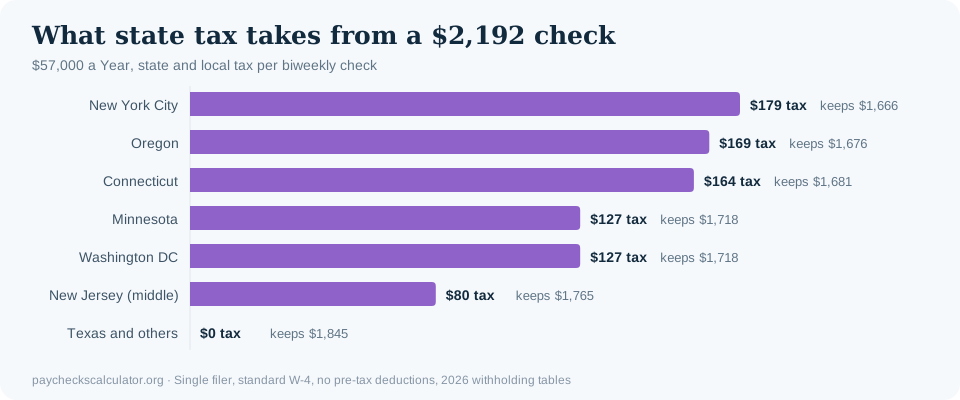
The middle of the 52 locations at this pay is New Jersey at $1,765. Pennsylvania's flat tax leaves $1,778 before any local earned income tax, and Illinois leaves $1,737. California still beats New York State here, $1,749 against $1,739, but that order flips by $70,000. New York City is at the bottom with $1,666, $179 below Texas.
BENCHMARKS
Is $57,000 a Year a Good Salary?
$57,000 a year beats the $50,980 median for all U.S. jobs but falls short of the $64,064 median for full-time workers, which is the fairer comparison if you work full time. Where you live changes the answer too: this pay leaves $1,845 a check in Texas and $1,666 in New York City, about $4,654 a year apart.
Benchmark
Per year
Per hour
$57k a year compared
25th percentile, all U.S. jobs
$37,590
$18.07
+$19,410 a year
Median, all U.S. jobs
$50,980
$24.51
+$6,020 a year
Median, full-time workers
$64,064
$30.80
−$7,064 a year
75th percentile, all U.S. jobs
$80,520
$38.71
−$23,520 a year
Jobs with a median wage close to this pay include Cement Masons and Concrete Finishers ($57,020), Glaziers ($57,080), Community and Social Service Specialists, All Other ($56,730) and Excavating and Loading Machine and Dragline Operators, Surface Mining ($57,430).
$57,000 a Year Is $9,500 Under the 22% Line: What a 401(k) Does to Your Check
Because the top of this salary is withheld at 12%, each traditional 401(k) dollar saves 12 cents of federal tax at any of the percentages below. The rate only changes for wages above $66,500, where the slice over that line would save 22 cents.
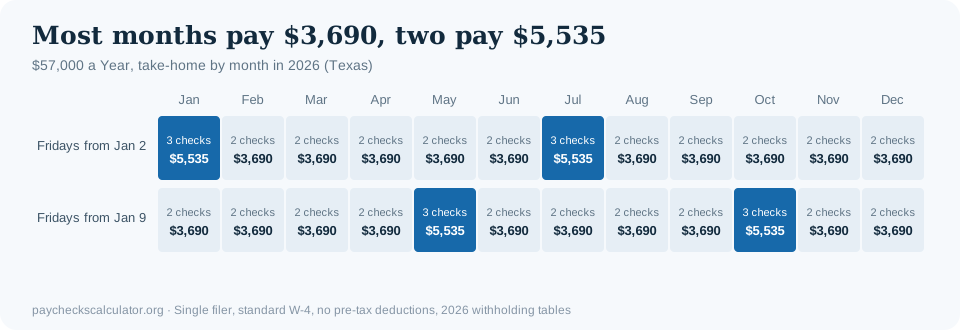
If your employer offers semimonthly pay, the same $57,000 becomes $2,375 gross and $1,999 net per check, 24 times a year. Every month then pays $3,998, the same as the biweekly average. On a biweekly schedule most months pay $3,690, $308 below that average, and two months pay $5,535.
RENT
How Much Rent Can You Afford on $57,000 a Year?
HUD counts a household as cost burdened when housing, including utilities, takes more than 30% of its income. On $57,000 a year that line is $1,425 a month before tax, which is 39% of what a two-check month deposits in Texas. Setting your limit from take-home gives a lower, safer number.
Rule of thumb
Housing per month
Set aside per check
30% of gross pay
$1,425
$713
30% of take-home in a two-check month, Texas
$1,107
$554
30% of take-home in a two-check month, New York City
What $57,000 a Year Really Pays After Health Insurance and a 401(k)
Workers paid an average of $1,672 a year for single health coverage and $7,471 for family coverage in 2026, according to KFF. Premiums taken through a cafeteria plan and traditional 401(k) contributions both lower the tax on your check, so your take-home falls by less than the amount that comes out.
To match a Texas check in New York City, this salary would need a raise of about $6,600. The range from top to bottom is $179 a check, and the middle of the list loses $80.
$1,845 in Texas, about $1,765 in a typical state and $1,666 in New York City, for a single filer with no pre-tax deductions.
How much is $57,000 a year biweekly before taxes?
$2,192.31. Divide $57,000 by the 26 pay periods in a biweekly year. Taxes and deductions come out after that.
Why is my real paycheck on $57k a year smaller than this?
Workplace deductions. A 5% 401(k) plus $150 a check for benefits brings $1,845 down to $1,628 in Texas.
How much is $57k a year biweekly in California?
About $1,749 after taxes for a single filer with a standard W-4 and no pre-tax deductions. That is $96 less than the same check in Texas, because California income tax and state disability insurance come out.
Is $57,000 close to the 22% tax bracket?
Yes. For a single filer, withholding moves to 22% at $66,500 of annual wages, $9,500 above this salary. Only the part of your pay above that line would be withheld at 22%, so a raise past it does not change the tax on what you already earn.