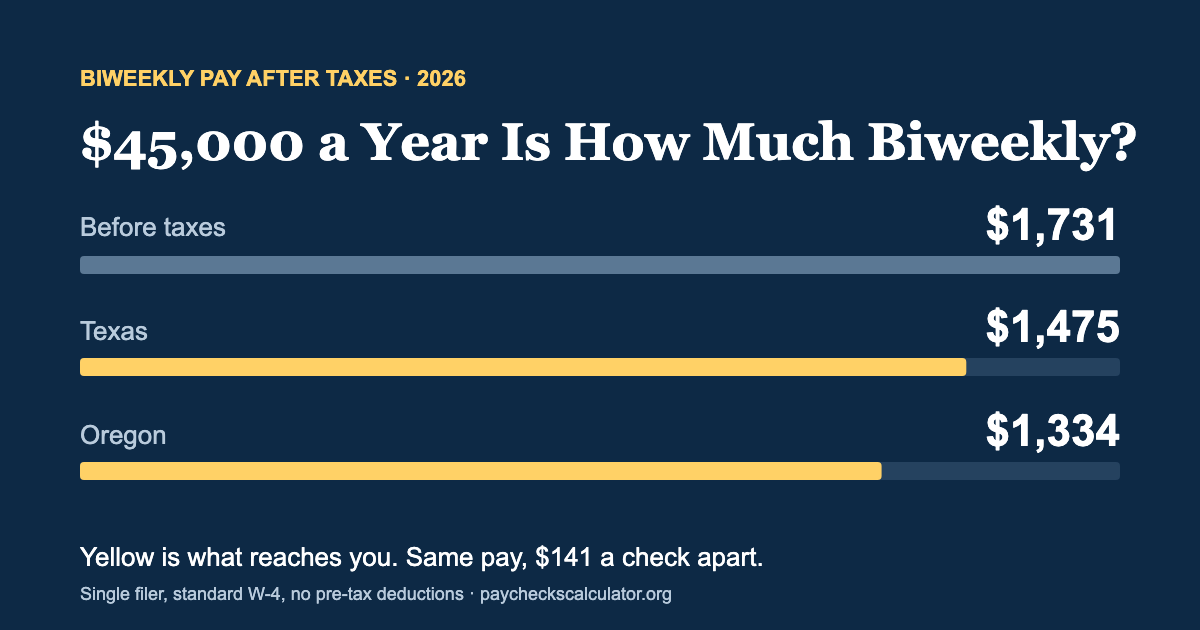
$45,000 a year is how much biweekly? $1,731 before taxes and about $1,475 after taxes for a single filer in Texas, because a biweekly schedule splits your salary into 26 checks. The same check is $1,475 in 7 other places with no state tax at this pay, about $1,417 in a typical state, and $1,334 in Oregon, the lowest of the 52 locations we calculate.
Updated November 5, 2026 · 2026 IRS and state withholding tables
1
Your pay details on $45,000 a year
Adjust the fields; results update instantly.
Pay frequency
2
Estimated take-home pay on $45,000 a year
2026 source-backed withholding methods.
NET PAY · BIWEEKLY$1,474.52$38,338 per year
Take-home 85%Taxes 15%Deductions 0%
Gross pay$1,730.77
Federal income tax−$123.85
Social Security−$107.31
Medicare−$25.10
Texas income tax−$0.00
Pre-tax deductions−$0.00
ⓘ
No individual state income tax on wages.
Figures assume a single filer, standard W-4 and no pre-tax deductions. Change any field to match your pay stub.
PER CHECK
$45,000 a Year Is How Much Biweekly? Where the $1,731 Goes
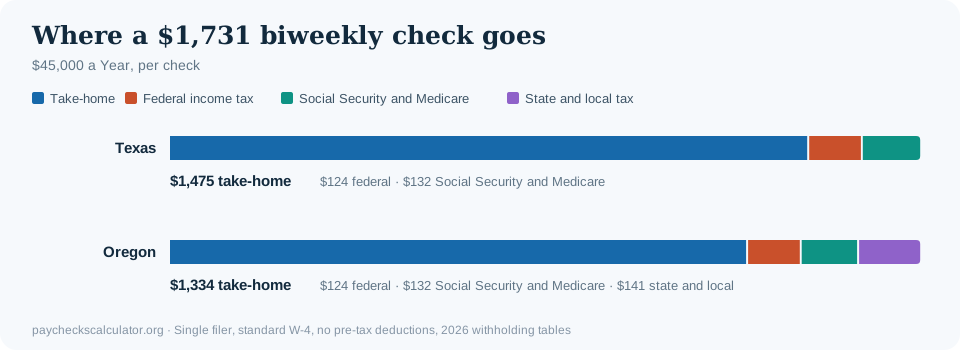
At this salary federal income tax is the smaller deduction: $124 a check against $132 for Social Security and Medicare. Oregon adds $141 in state charges, which is why its check lands at $1,334. Filing jointly adds $75 and head of household adds $41.
Per biweekly check
Single
Married filing jointly
Head of household
Gross pay
$1,730.77
$1,730.77
$1,730.77
Federal income tax
−$123.85
−$49.23
−$82.62
Social Security (6.2%)
−$107.31
−$107.31
−$107.31
Medicare (1.45%)
−$25.10
−$25.10
−$25.10
Take-home
$1,474.52
$1,549.13
$1,515.75
Effective tax rate
14.8%
10.5%
12.4%
Tax on your next dollar
19.65%
17.65%
19.65%
No-income-tax state, standard W-4 with Step 2 unchecked, no pre-tax deductions, 2026 withholding tables. The next-dollar rate is the federal bracket plus 7.65% for Social Security and Medicare; state tax adds to both rates.
EVERY PAY PERIOD
$45,000 a Year After Taxes: Per Month, Week, Day and Hour
$45,000 a year after taxes is about $3,195 a month, $737 a week and $18.43 an hour for a single filer with no state income tax.
Per
Before taxes
After taxes
Year
$45,000
$38,338
Month (average)
$3,750
$3,195
Twice a month
$1,875
$1,597
Every two weeks
$1,731
$1,475
Week
$865
$737
Day (8 hours)
$173
$147
Hour
$21.63
$18.43
Annual take-home divided by the period, based on 2,080 paid hours a year. A monthly average, not what lands in a two-check month.
At $45,000, Oregon Takes More Than New York City
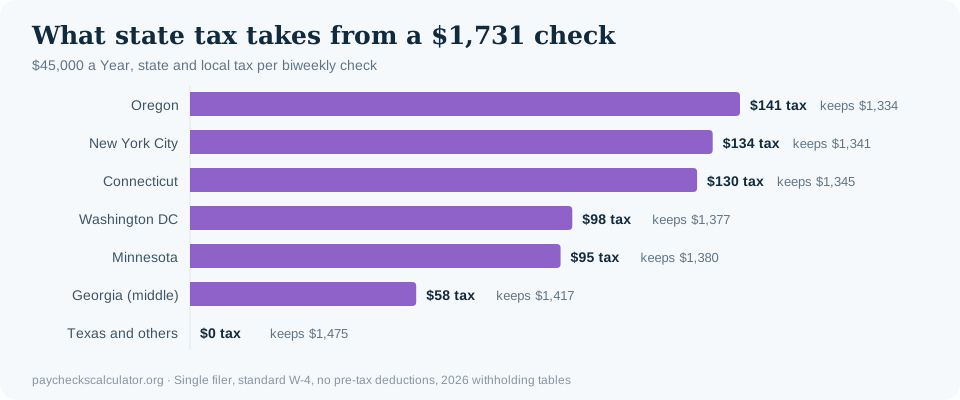
This is the pay level where the ranking of high-tax places flips. Oregon leaves $1,334 a check and New York City leaves $1,341, a gap of $7 in the city's favor. Above roughly $50,000 a year the order reverses, and New York City becomes the lowest on the list.
The reason is the shape of Oregon's tax. It reaches its 8.75% rate on taxable income well below $45,000, and its transit tax, paid leave and workers' benefit charges come on top. New York's combined state and city rates start lower, so they only catch up at higher pay.
North Dakota is the other surprise at this salary. It has an income tax, but its first bracket is taxed at 0%, and $45,000 stays inside it on a single W-4. State withholding is $0, the same as Texas. In Washington, which has no income tax, you actually keep less at $1,451, because paid leave and long-term care programs take $24 a check.
How $4,750 in a 401(k) Can Unlock the Saver's Credit at $45,000
For 2026 a single filer qualifies for the Saver's Credit with adjusted gross income up to $40,250. A $45,000 salary misses by $4,750, but traditional 401(k) contributions lower your adjusted gross income dollar for dollar.
Contributing $4,750 over the year is $183 a check, or 10.6% of pay. Because that money escapes federal withholding, your check falls by about $161, not $183. At this income the credit is 10% of up to $2,000 in contributions, so it can take as much as $200 off your tax bill when you file Form 8880.
You must be at least 18 and cannot be a full-time student or claimed as someone's dependent, and income from other sources counts toward the limit. Pre-tax health premiums lower your wages too, so you may need to contribute less than this.
Why $45,000 Feels Smaller Than $3,750 a Month
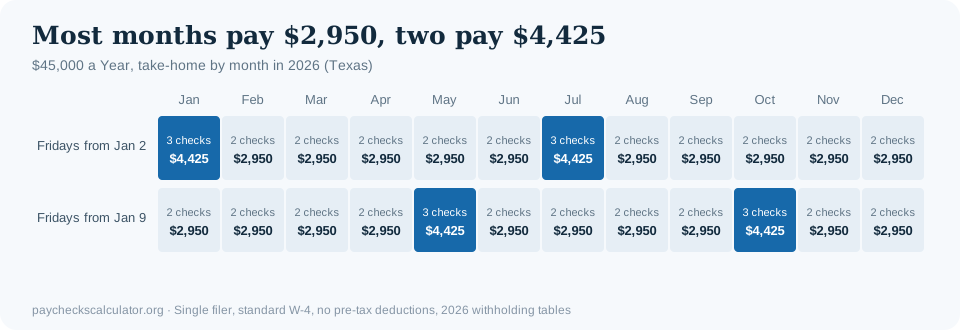
Divide $45,000 by 12 and you get $3,750, but no month pays that. A normal two-check month brings in $2,950 after taxes in Texas, which is $800 less.
One workable setup is to set fixed bills against the $2,950 figure and treat the two extra checks as a separate pot. Together they add another $2,950 a year, close to a full month of income, and they suit costs that do not arrive monthly, such as car repairs or insurance premiums paid twice a year.
BENCHMARKS
Is $45,000 a Year a Good Salary?
$45,000 a year is below the national median of $50,980, so more than half of U.S. jobs pay more, though it clears the 25th percentile of $37,590. Where you live changes the answer too: this pay leaves $1,475 a check in Texas and $1,334 in Oregon, about $3,666 a year apart.
Benchmark
Per year
Per hour
$45k a year compared
25th percentile, all U.S. jobs
$37,590
$18.07
+$7,410 a year
Median, all U.S. jobs
$50,980
$24.51
−$5,980 a year
Median, full-time workers
$64,064
$30.80
−$19,064 a year
75th percentile, all U.S. jobs
$80,520
$38.71
−$35,520 a year
Jobs with a median wage close to this pay include Office Clerks, General ($45,010), Psychiatric Aides ($44,910), Psychiatric Technicians ($45,130) and Light Truck Drivers ($44,860).
$45,000 a Year Is $21,500 Under the 22% Line: What a 401(k) Does to Your Check
$45,000 has $21,500 of room before single-filer withholding reaches 22% at $66,500, so a $1,000 raise adds a steady $804 a year after federal and payroll taxes. For the same reason, every 401(k) dollar here saves 12 cents of federal tax whether you contribute 3% or 10%.
On $1,475 a check, ten months a year deposit $2,950 and two months deposit $4,425. The yearly average of $3,195 never actually lands in your account, and rent is where that shows up first. The old guideline of 30% of gross income suggests $1,125 a month, which is 38% of a two-check month. In 2026 the three-check months were January and July for Fridays that started January 2, and May and October for those that started January 9.
RENT
How Much Rent Can You Afford on $45,000 a Year?
HUD counts a household as cost burdened when housing, including utilities, takes more than 30% of its income. On $45,000 a year that line is $1,125 a month before tax, which is 38% of what a two-check month deposits in Texas. Setting your limit from take-home gives a lower, safer number.
What $45,000 a Year Really Pays After Health Insurance and a 401(k)
Workers paid an average of $1,672 a year for single health coverage and $7,471 for family coverage in 2026, according to KFF. Premiums taken through a cafeteria plan and traditional 401(k) contributions both lower the tax on your check, so your take-home falls by less than the amount that comes out.
8 places withhold no state tax at this pay: Florida, Nevada, Tennessee, Texas, New Hampshire, North Dakota, South Dakota, Wyoming. Alaska has no income tax either, but its unemployment insurance costs $9 a check.
$1,475 in Texas, about $1,417 in a typical state and $1,334 in Oregon, for a single filer with no pre-tax deductions.
How much is $45,000 a year biweekly before taxes?
$1,730.77. Divide $45,000 by the 26 pay periods in a biweekly year. Taxes and deductions come out after that.
Why is my real paycheck on $45k a year smaller than this?
Workplace deductions. A 5% 401(k) plus $150 a check for benefits brings $1,475 down to $1,278 in Texas.
How much is $45k a year biweekly in Oregon?
About $1,334 after taxes for a single filer, the lowest of any location on this site at this salary. Oregon withholds income tax plus transit, paid leave and workers' benefit charges, which together take $141 a check.
Is $45,000 a year above the typical U.S. wage?
No. The Bureau of Labor Statistics puts the national median annual wage at $50,980 (May 2025), so $45,000 is about $5,980 below the midpoint.