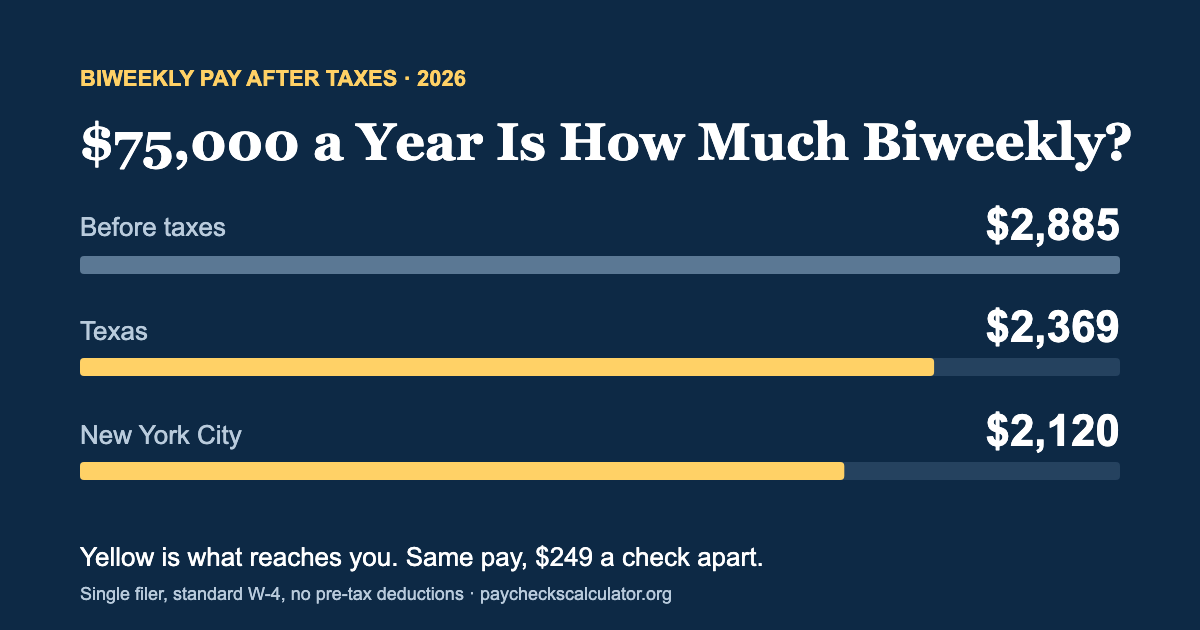
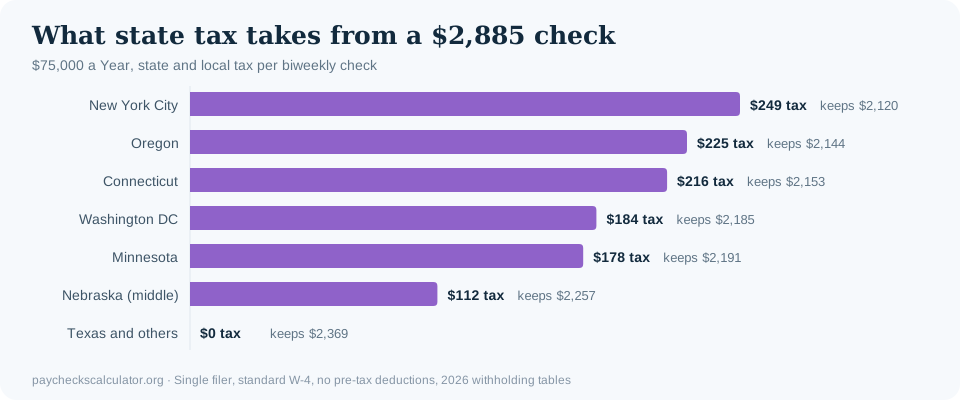
$75,000 a year is how much biweekly? $2,885 before taxes and about $2,369 after taxes for a single filer in Texas, because a biweekly schedule splits your salary into 26 checks. The same check is $2,369 in 6 other places with no state tax at this pay, about $2,257 in a typical state, and $2,120 in New York City, the lowest of the 52 locations we calculate.
Updated November 5, 2026 · 2026 IRS and state withholding tables
1
Your pay details on $75,000 a year
Adjust the fields; results update instantly.
Pay frequency
2
Estimated take-home pay on $75,000 a year
2026 source-backed withholding methods.
NET PAY · BIWEEKLY$2,368.94$61,593 per year
Take-home 82%Taxes 18%Deductions 0%
Gross pay$2,884.62
Federal income tax−$295.00
Social Security−$178.85
Medicare−$41.83
Texas income tax−$0.00
Pre-tax deductions−$0.00
ⓘ
No individual state income tax on wages.
Figures assume a single filer, standard W-4 and no pre-tax deductions. Change any field to match your pay stub.
PER CHECK
$75,000 a Year Is How Much Biweekly? Where the $2,885 Goes
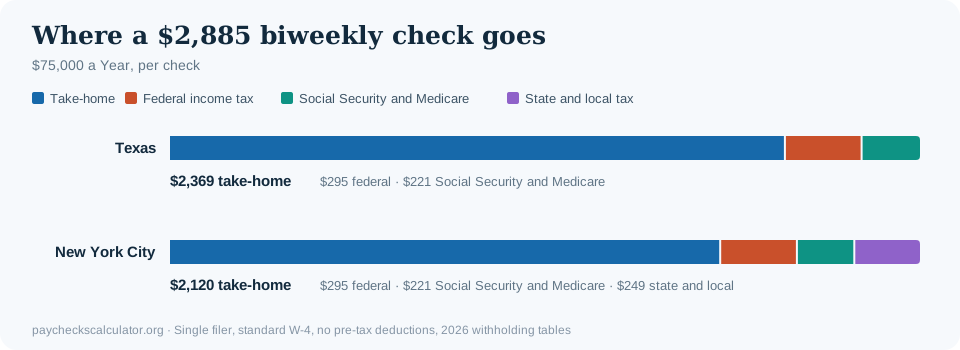
Of each $2,885 check in Texas, $295 goes to federal income tax and $221 to payroll taxes, leaving 82%. Head of household at $2,443 sits closer to the married figure of $2,485 than to the single filer's $2,369.
Per biweekly check
Single
Married filing jointly
Head of household
Gross pay
$2,884.62
$2,884.62
$2,884.62
Federal income tax
−$295.00
−$178.46
−$221.08
Social Security (6.2%)
−$178.85
−$178.85
−$178.85
Medicare (1.45%)
−$41.83
−$41.83
−$41.83
Take-home
$2,368.94
$2,485.48
$2,442.87
Effective tax rate
17.9%
13.8%
15.3%
Tax on your next dollar
29.65%
19.65%
19.65%
No-income-tax state, standard W-4 with Step 2 unchecked, no pre-tax deductions, 2026 withholding tables. The next-dollar rate is the federal bracket plus 7.65% for Social Security and Medicare; state tax adds to both rates.
EVERY PAY PERIOD
$75,000 a Year After Taxes: Per Month, Week, Day and Hour
$75,000 a year after taxes is about $5,133 a month, $1,184 a week and $29.61 an hour for a single filer with no state income tax.
Per
Before taxes
After taxes
Year
$75,000
$61,593
Month (average)
$6,250
$5,133
Twice a month
$3,125
$2,566
Every two weeks
$2,885
$2,369
Week
$1,442
$1,184
Day (8 hours)
$288
$237
Hour
$36.06
$29.61
Annual take-home divided by the period, based on 2,080 paid hours a year. A monthly average, not what lands in a two-check month.
$75k a Year Is How Much a Month After Taxes?
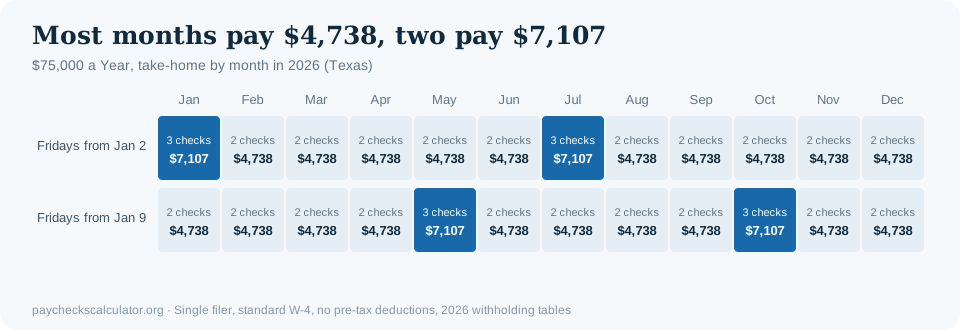
About $5,133 a month on average for a single filer in Texas. A biweekly job does not pay an average, though. Ten months of the year you receive two checks, $4,738, and the other two months you receive three, $7,107.
Your state moves the monthly answer by hundreds of dollars. New York City averages $4,593 a month, or $4,240 in a two-check month. California averages $4,783, New York State outside the city $4,815, and Pennsylvania $4,941 before any local earned income tax.
What It Takes to Get Back Under the 22% Line at $75,000
$75,000 is $8,500 past the point where single-filer withholding moves from 12% to 22%. Clearing that with a traditional 401(k) takes 11.3% of pay, or $327 a check, and your take-home falls by $255. At $70,000 the same move takes only 5%.
A 401(k) is not the only pre-tax route. HSA contributions and health premiums taken through a payroll cafeteria plan also skip Social Security and Medicare, which a 401(k) does not. Putting $100 a check into an HSA this way lowers your take-home by about $70, against $78 for the same $100 in a 401(k). The 2026 HSA limit is $4,400 for self-only coverage, and you need an eligible high-deductible health plan to contribute.
What a Raise From $70,000 to $75,000 Actually Adds
A $5,000 raise adds $192 to each gross check. In Texas $135 of that reaches you, about 70%, because the whole raise sits above the 22% line and also pays 7.65% for Social Security and Medicare.
State tax takes its share as well. The same raise adds $116 a check in New York City and $121 in Oregon. This matters when a new job offers a raise and a move at once: going from $70,000 in Texas to $75,000 in New York City leaves your check $114 smaller, not larger.
BENCHMARKS
Is $75,000 a Year a Good Salary?
$75,000 a year is above both the $50,980 median for all U.S. jobs and the $64,064 median for full-time workers, but short of the top quarter of wages, which starts at $80,520. Where you live changes the answer too: this pay leaves $2,369 a check in Texas and $2,120 in New York City, about $6,474 a year apart.
Benchmark
Per year
Per hour
$75k a year compared
25th percentile, all U.S. jobs
$37,590
$18.07
+$37,410 a year
Median, all U.S. jobs
$50,980
$24.51
+$24,020 a year
Median, full-time workers
$64,064
$30.80
+$10,936 a year
75th percentile, all U.S. jobs
$80,520
$38.71
−$5,520 a year
Jobs with a median wage close to this pay include Public Relations Specialists ($74,750), Construction and Building Inspectors ($74,690), Surveyors ($75,440) and Mechanical Engineering Technologists and Technicians ($74,510).
$75,000 a Year Is $8,500 Over the 22% Line: What a 401(k) Does to Your Check
All three contribution levels below stay inside the $8,500 slice that is withheld at 22%, even 10%, which is $288 a check. So the federal saving holds at 22 cents on the dollar all the way down the table.
The 30% rent guideline works out to $1,875 a month at this salary. That is 40% of a two-check month, and a much easier share of a three-check month. Which months those were in 2026 depends on your cycle: January and July, or May and October.
RENT
How Much Rent Can You Afford on $75,000 a Year?
HUD counts a household as cost burdened when housing, including utilities, takes more than 30% of its income. On $75,000 a year that line is $1,875 a month before tax, which is 40% of what a two-check month deposits in Texas. Setting your limit from take-home gives a lower, safer number.
Rule of thumb
Housing per month
Set aside per check
30% of gross pay
$1,875
$938
30% of take-home in a two-check month, Texas
$1,421
$711
30% of take-home in a two-check month, New York City
What $75,000 a Year Really Pays After Health Insurance and a 401(k)
Workers paid an average of $1,672 a year for single health coverage and $7,471 for family coverage in 2026, according to KFF. Premiums taken through a cafeteria plan and traditional 401(k) contributions both lower the tax on your check, so your take-home falls by less than the amount that comes out.
$2,369 in Texas, about $2,257 in a typical state and $2,120 in New York City, for a single filer with no pre-tax deductions.
How much is $75,000 a year biweekly before taxes?
$2,884.62. Divide $75,000 by the 26 pay periods in a biweekly year. Taxes and deductions come out after that.
Why is my real paycheck on $75k a year smaller than this?
Workplace deductions. A 5% 401(k) plus $150 a check for benefits brings $2,369 down to $2,151 in Texas.
$75k a year is how much a month after taxes?
About $5,133 on average in a no-income-tax state, based on annual take-home divided by 12. On a biweekly schedule most months actually pay $4,738, with two months a year paying $7,107.
How much is $75,000 a year biweekly in California?
About $2,208 per check after taxes for a single filer, $161 less than Texas. That leaves $4,416 in a normal two-check month.