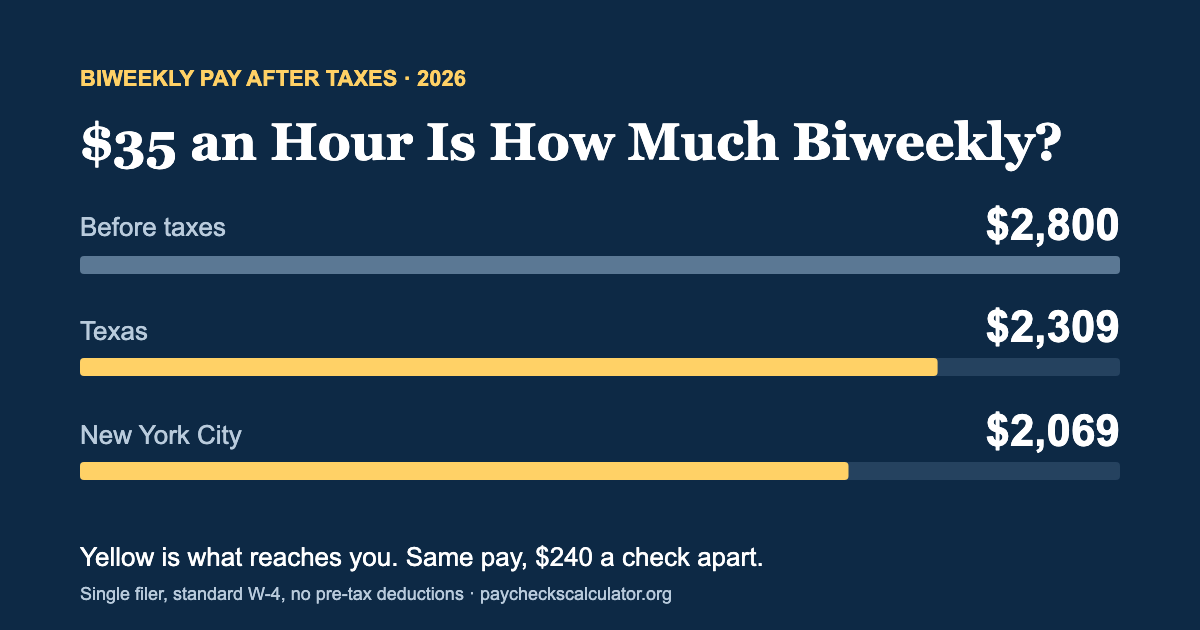
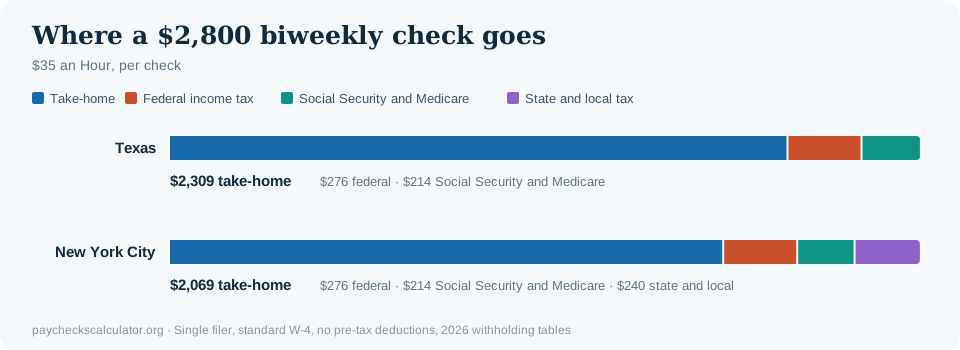
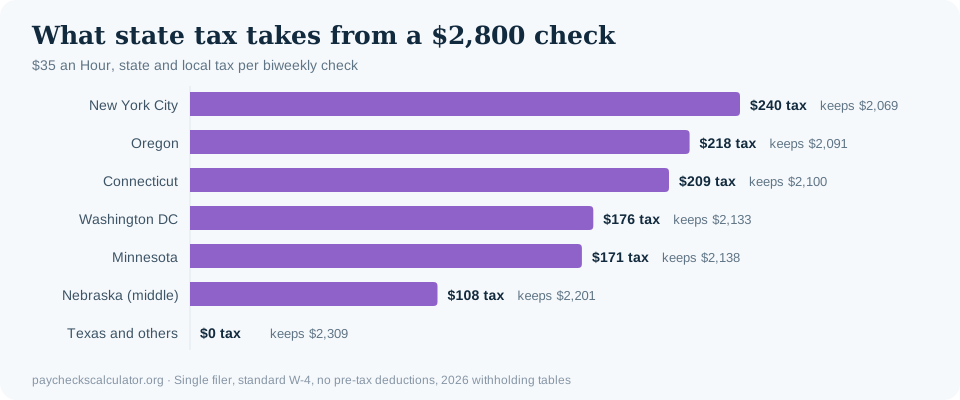
$35 an hour is how much biweekly? $2,800 before taxes and about $2,309 after taxes for a single filer in Texas, on a standard 80-hour pay period. The same check is $2,309 in 6 other places with no state tax at this pay, about $2,201 in a typical state, and $2,069 in New York City, the lowest of the 52 locations we calculate.
Updated November 5, 2026 · 2026 IRS and state withholding tables
1
Your pay details at $35 an hour
Adjust the fields; results update instantly.
Pay frequency
2
Estimated take-home pay at $35 an hour
2026 source-backed withholding methods.
NET PAY · BIWEEKLY$2,309.42$60,045 per year
Take-home 82%Taxes 18%Deductions 0%
Gross pay$2,800.00
Federal income tax−$276.38
Social Security−$173.60
Medicare−$40.60
Texas income tax−$0.00
Pre-tax deductions−$0.00
ⓘ
No individual state income tax on wages.
Figures assume a single filer, standard W-4 and no pre-tax deductions. Change any field to match your pay stub.
PER CHECK
$35 an Hour Is How Much Biweekly? Where the $2,800 Goes
A $2,800 check gives up $276 of federal income tax and $214 of payroll taxes. On a joint W-4 federal withholding falls to $168, because the married table keeps this pay at 12%. Head of household takes home $2,375.
Per biweekly check
Single
Married filing jointly
Head of household
Gross pay
$2,800.00
$2,800.00
$2,800.00
Federal income tax
−$276.38
−$168.31
−$210.92
Social Security (6.2%)
−$173.60
−$173.60
−$173.60
Medicare (1.45%)
−$40.60
−$40.60
−$40.60
Take-home
$2,309.42
$2,417.49
$2,374.88
Effective tax rate
17.5%
13.7%
15.2%
Tax on your next dollar
29.65%
19.65%
19.65%
No-income-tax state, standard W-4 with Step 2 unchecked, no pre-tax deductions, 2026 withholding tables. The next-dollar rate is the federal bracket plus 7.65% for Social Security and Medicare; state tax adds to both rates.
EVERY PAY PERIOD
$35 an Hour After Taxes: Per Month, Week, Day and Hour
$35 an hour after taxes is about $5,004 a month, $1,155 a week and $28.87 an hour for a single filer with no state income tax.
Per
Before taxes
After taxes
Year
$72,800
$60,045
Month (average)
$6,067
$5,004
Twice a month
$3,033
$2,502
Every two weeks
$2,800
$2,309
Week
$1,400
$1,155
Day (8 hours)
$280
$231
Hour
$35.00
$28.87
Annual take-home divided by the period, based on 2,080 paid hours a year. A monthly average, not what lands in a two-check month.
Overtime at $35 an Hour Keeps About 70 Cents on the Dollar
At this wage you are already past the 22% line, so every overtime dollar is withheld at 22% plus 7.65% for Social Security and Medicare. Eight overtime hours at $52.50 add $420 of gross pay and $296 to your check, about 70%. At $22 an hour the same eight hours keep about 80%.
The federal overtime deduction does more at this rate, because the premium half of FLSA overtime is $17.50 an hour. The $12,500 cap for a single filer takes about 714 overtime hours a year to reach, or roughly 14 a week. It is claimed on your return, so it does not raise this check unless you adjust your W-4.
$35 an Hour on a 1099 Is Not the Same Check
A W-2 employee pays 7.65% for Social Security and Medicare, $214 a check here, and the employer pays a matching amount. A 1099 contractor pays both halves as self-employment tax: 15.3% on 92.35% of net earnings, about $396 every two weeks on the same $72,800.
Nobody withholds that for you, so you set it aside yourself and pay quarterly estimated taxes. Half of the self-employment tax is deductible, the qualified business income deduction may apply, and business expenses lower the bill. You also give up paid leave, any employer 401(k) match and employer health coverage, so the same $35 buys less on a contract.
One Missed Shift Drops a $35-an-Hour Check Under the 22% Line
A full 80-hour check annualizes to $72,800, which is $6,300 past the 22% line. Miss one 8-hour shift and the 72-hour check annualizes to $65,520, just under it. Gross falls by $280 to $2,520, and take-home falls by $200 to $2,109.
Salaries on either side show the same position. $70,000 pays $2,234 a check and $75,000 pays $2,369, with $35 an hour in between at $2,309, as long as all 2,080 hours are paid.
BENCHMARKS
Is $35 an Hour a Good Wage?
$35 an hour is above both the $50,980 median for all U.S. jobs and the $64,064 median for full-time workers, but short of the top quarter of wages, which starts at $80,520. Where you live changes the answer too: this pay leaves $2,309 a check in Texas and $2,069 in New York City, about $6,240 a year apart.
Benchmark
Per year
Per hour
$35 an hour compared
25th percentile, all U.S. jobs
$37,590
$18.07
+$35,210 a year
Median, all U.S. jobs
$50,980
$24.51
+$21,820 a year
Median, full-time workers
$64,064
$30.80
+$8,736 a year
75th percentile, all U.S. jobs
$80,520
$38.71
−$7,720 a year
Jobs with a median wage close to this pay include Fundraisers ($34.88), Real Estate Brokers ($35.20), Occupational Therapy Assistants ($34.76) and Legal Support Workers, All Other ($34.67).
$35 an Hour Is $6,300 Over the 22% Line: What a 401(k) Does to Your Check
$72,800 is $6,300 past the 22% line. Contributing 8.7%, about $242 a check, takes taxable wages back to it and lowers take-home by $189. Check whether your plan counts overtime as eligible pay, because a percentage contribution may rise with it.
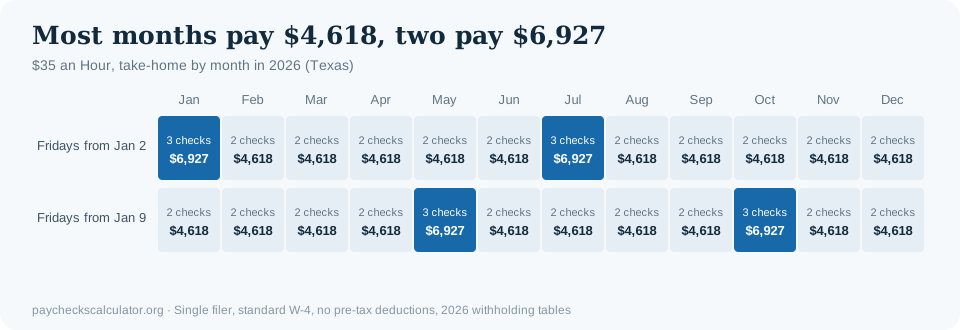
Regular hours deposit $4,618 in most months and $6,927 in two of them. With 8 overtime hours in every pay period, a two-check month rises to $5,210, although every one of those overtime dollars is withheld at 22%.
RENT
How Much Rent Can You Afford on $35 an Hour?
HUD counts a household as cost burdened when housing, including utilities, takes more than 30% of its income. On $35 an hour that line is $1,820 a month before tax, which is 39% of what a two-check month deposits in Texas. Setting your limit from take-home gives a lower, safer number.
Rule of thumb
Housing per month
Set aside per check
30% of gross pay
$1,820
$910
30% of take-home in a two-check month, Texas
$1,385
$693
30% of take-home in a two-check month, New York City
What $35 an Hour Really Pays After Health Insurance and a 401(k)
Workers paid an average of $1,672 a year for single health coverage and $7,471 for family coverage in 2026, according to KFF. Premiums taken through a cafeteria plan and traditional 401(k) contributions both lower the tax on your check, so your take-home falls by less than the amount that comes out.
$2,309 in Texas, about $2,201 in a typical state and $2,069 in New York City, for a single filer with no pre-tax deductions.
How much is $35 an hour biweekly before taxes?
$2,800.00. An 80-hour pay period at $35 an hour is $2,800.00 gross, and 26 of those checks add up to $72,800 a year.
Why is my real paycheck on $35 an hour smaller than this?
Workplace deductions. A 5% 401(k) plus $150 a check for benefits brings $2,309 down to $2,090 in Texas.
How much is $35 an hour biweekly in California?
About $2,157 per check after taxes for a single filer working 80 hours, $152 less than Texas.
Is $35 an hour taxed at 22%?
Only the top slice. Full-time pay of $72,800 is $6,300 past the line where single-filer withholding reaches 22%, and everything below it is withheld at 12% or less. Federal withholding of $276 a check is about 10% of gross pay overall.