$36 an Hour Is How Much a Year — 2026 Paycheck Calculator
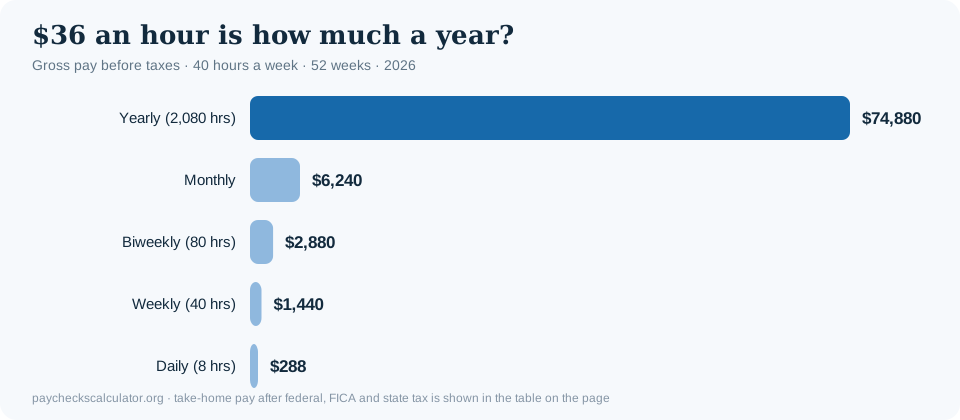
$36 an hour is how much a year? $74,880 before taxes at 40 hours a week for 52 weeks. That is about $6,240 a month, $2,880 every two weeks, or $1,440 a week in gross pay.
1
Your pay details at $36 an hour
Adjust the fields; results update instantly.
Pay frequency
2
Estimated take-home pay at $36 an hour
2026 source-backed withholding methods.
NET PAY · BIWEEKLY$2,147.85$55,844 per year
Take-home 75%Taxes 15%Deductions 10%
Gross pay$2,880.00
Federal income tax−$229.30
Social Security−$169.26
Medicare−$39.59
Texas income tax−$0.00
Pre-tax deductions−$294.00
ⓘ
No individual state income tax on wages. Assumes a current federal W-4 with Step 2 unchecked and no credits. Address-specific local taxes are included only from the rate you enter; fixed local fees and employer-specific rules remain excluded.
After taxes, $36 an hour is closer to $61,508 a year in a no-income-tax state like Texas and $55,049 in New York City. Enter your state, filing status and deductions above to see your own net paycheck.
2026 IRS MethodAll 50 StatesFree to Use
INCOME BREAKDOWN
$36 an Hour Is How Much a Year, a Month, and Biweekly?
$36 an hour converted to yearly, monthly, biweekly, weekly and daily gross pay.
The math behind “$36 an hour is how much a year” is simple: 40 hours a week × 52 weeks = 2,080 working hours, and 2,080 × $36 = $74,880. If your schedule is 35 hours a week, $36 an hour is $65,520 a year instead. Here is how that gross pay splits across common pay schedules before any taxes or deductions:
Annual (40 hrs/week): $74,880
Annual (35 hrs/week): $65,520
Monthly: $6,240
Biweekly (80 hrs): $2,880
Weekly (40 hrs): $1,440
Daily (8 hrs): $288
These are gross amounts. Your actual take-home depends on your state, filing status and deductions — the calculator above gives a state-specific net estimate, and the table below shows $36 an hour after tax in every supported state. Earning a little less? $35 an hour is how much a year — $2,080 less than $36. Expecting a raise? $37 an hour is how much a year — $2,080 more, or $80 per biweekly check.
JOBS AT THIS WAGE
What Jobs Pay About $36 an Hour?
These occupations have a national median wage closest to $36 an hour, according to the BLS Occupational Employment and Wage Statistics survey (May 2025).The median is the midpoint — half of workers in the job earn more, half earn less.
Occupation
Median hourly
Median annual
U.S. jobs
Public Relations Specialists
$35.94
$74,750
283K
Construction and Building Inspectors
$35.91
$74,690
147K
Mechanical Engineering Technologists and Technicians
$35.82
$74,510
36K
First-Line Supervisors of Production and Operating Workers
$35.79
$74,450
673K
Control and Valve Installers and Repairers, Except Mechanical Door
The largest of these is First-Line Supervisors of Production and Operating Workers — about 673K jobs nationwide with a median wage of $35.79 an hour — and together the 8 occupations listed employ roughly 1.4M people, with median pay between $35.73 and $36.27.
Where $36 an hour sits among U.S. wages
$36 an hour is above the national median of $24.51 (BLS May 2025) — about 147% of the typical U.S. wage — but still below the 75th percentile of $38.71. That puts $36 an hour in the upper-middle of the wage distribution: more than half of American workers earn less, and it is a common rate for experienced tradespeople, technicians and administrative specialists. Weighted by employment, about 73% of the 143.6M U.S. jobs in the 451 occupations we track have a median wage below $36 an hour.
OVERTIME
Overtime at $36 an Hour: What 5 Extra Hours a Week Is Worth
Non-exempt hourly employees earn time-and-a-half after 40 hours in a week under the FLSA, so overtime at $36 an hour pays $54.00 an hour (double time, where it applies, is $72.00). Working 5 overtime hours every week adds $14,040 to your annual gross — $540 per biweekly check.
Overtime is taxed like any other wage, not at a special rate, but because it stacks on top of your base pay some of it is withheld at your highest federal bracket. Run through the 2026 withholding tables for a single filer in a no-income-tax state, those 5 hours a week net about $9,877 a year ($380 per check), so you keep roughly 70% of the overtime you earn. Federal withholding follows IRS Publication 15-T; Social Security (6.2%, up to the $184,500 wage base) and Medicare (1.45%) apply to every dollar. Our methodology page lists the tables.
TAKE-HOME PAY BY STATE
How Much Is $36 an Hour After Taxes in Each State? (2026)
Working full-time at $36/hr ($74,880 a year gross), here is what $36 an hour is worth after tax in every supported state for 2026 — from $61,508 in Florida down to $55,049 in New York City. Single filer, standard W-4, biweekly pay, 40 hrs/week. Sorted highest to lowest take-home pay.
Single filer · standard W-4 · biweekly pay · 40 hrs/week · no pre-tax deductions · 2026 federal and state withholding tables. Actual paychecks vary based on filing status, allowances, and deductions.
FREQUENTLY ASKED QUESTIONS
$36 an Hour — Frequently Asked Questions
$36 an hour is how much a year?+
$36 an hour is $74,880 a year before taxes if you work 40 hours a week for 52 weeks (2,080 hours). At 35 hours a week it is $65,520 a year. Your take-home pay will be lower after federal income tax, Social Security, Medicare and any state tax.
How much is $36 an hour after taxes?+
On $74,880 gross, a single filer with a standard W-4 keeps roughly 78%–85% depending on the state, because federal income tax, 6.2% Social Security and 1.45% Medicare come out of every check. The state table on this page shows the exact after-tax figure for all 38 supported states.
What is the biweekly paycheck for $36 an hour?+
At $36 an hour for 80 hours per biweekly period, your gross biweekly pay is $2,880. After taxes, net pay depends on your state and deductions — use the calculator above for your exact number.
$36 an hour is how much a month?+
At 40 hours a week, $36 an hour works out to about $6,240 a month in gross pay ($74,880 ÷ 12). Enter your details in the calculator for a monthly net pay estimate.
How much tax is taken out of a $36 an hour paycheck?+
Federal income tax (based on your W-4 and the 2026 IRS withholding tables), Social Security (6.2%) and Medicare (1.45%) are withheld from every U.S. paycheck. State income tax depends on where you work; nine states withhold none.
Is $36 an hour a good wage?+
$36 an hour is approximately $74,880 a year at full-time hours. Whether that is a good wage depends on your location and cost of living — compare the take-home figures for different states on this page.
How much is time-and-a-half at $36 an hour?+
Time-and-a-half is $54.00 an hour and double time is $72.00. Working 5 overtime hours a week for a year adds $14,040 gross, or about $9,877 net (70% kept) in a state with no income tax.
How much rent can I afford on $36 an hour?+
On $6,240 a month gross, the 30% rule suggests about $1,872 a month for rent. Lenders and landlords typically use a similar ceiling, so $1,872 is a reasonable budget line before utilities.
Is $36 an hour a good wage?+
$36 an hour is above the U.S. median wage of $24.51 (BLS May 2025). Whether it feels good depends on your state's cost of living — the state table above shows how much of it you actually keep.
RELATED CALCULATORS
How Much a Year Is $35 or $37 an Hour — and Other Paycheck Calculators