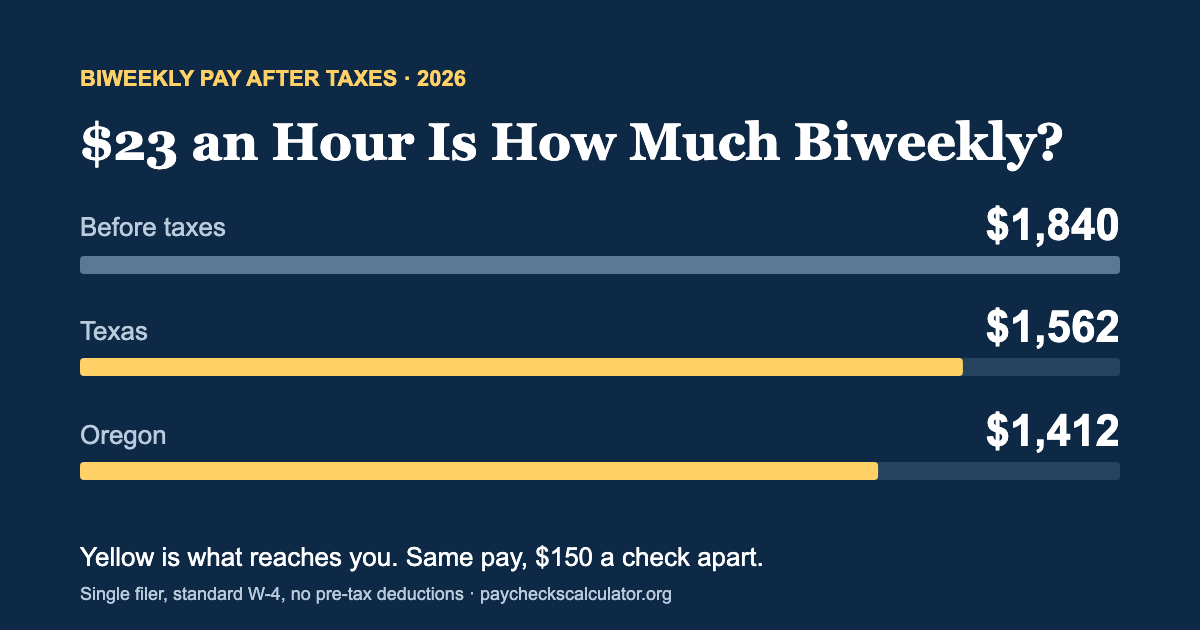
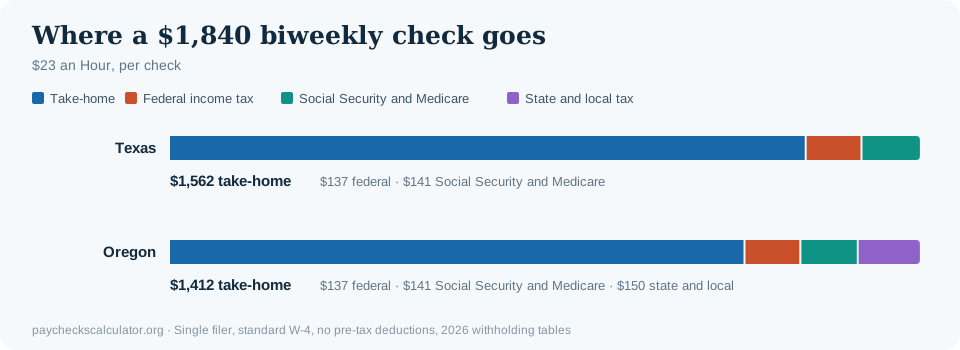
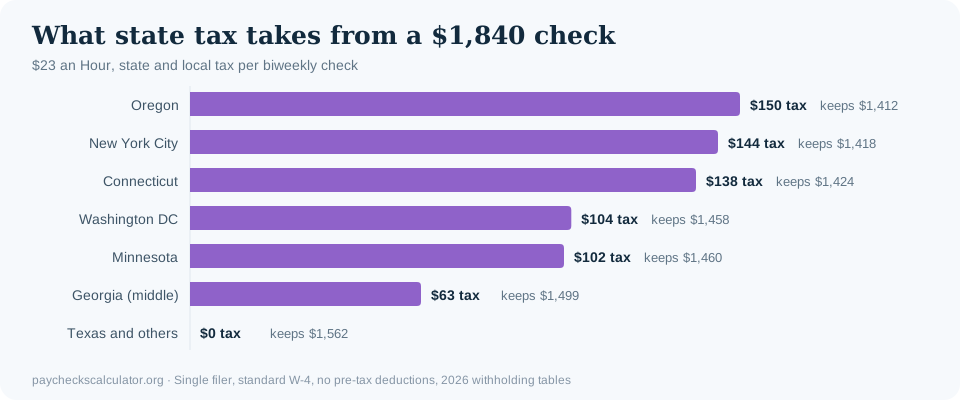
$23 an hour is how much biweekly? $1,840 before taxes and about $1,562 after taxes for a single filer in Texas, on a standard 80-hour pay period. The same check is $1,562 in 7 other places with no state tax at this pay, about $1,499 in a typical state, and $1,412 in Oregon, the lowest of the 52 locations we calculate.
Updated November 5, 2026 · 2026 IRS and state withholding tables
1
Your pay details at $23 an hour
Adjust the fields; results update instantly.
Pay frequency
2
Estimated take-home pay at $23 an hour
2026 source-backed withholding methods.
NET PAY · BIWEEKLY$1,562.29$40,619 per year
Take-home 85%Taxes 15%Deductions 0%
Gross pay$1,840.00
Federal income tax−$136.95
Social Security−$114.08
Medicare−$26.68
Texas income tax−$0.00
Pre-tax deductions−$0.00
ⓘ
No individual state income tax on wages.
Figures assume a single filer, standard W-4 and no pre-tax deductions. Change any field to match your pay stub.
PER CHECK
$23 an Hour Is How Much Biweekly? Where the $1,840 Goes
Federal income tax of $137 and payroll taxes of $141 are within a few dollars of each other at this wage. On a joint W-4 federal withholding falls to $60, which is most of the $77 gain in the married column.
Per biweekly check
Single
Married filing jointly
Head of household
Gross pay
$1,840.00
$1,840.00
$1,840.00
Federal income tax
−$136.95
−$60.15
−$95.72
Social Security (6.2%)
−$114.08
−$114.08
−$114.08
Medicare (1.45%)
−$26.68
−$26.68
−$26.68
Take-home
$1,562.29
$1,639.09
$1,603.52
Effective tax rate
15.1%
10.9%
12.9%
Tax on your next dollar
19.65%
17.65%
19.65%
No-income-tax state, standard W-4 with Step 2 unchecked, no pre-tax deductions, 2026 withholding tables. The next-dollar rate is the federal bracket plus 7.65% for Social Security and Medicare; state tax adds to both rates.
EVERY PAY PERIOD
$23 an Hour After Taxes: Per Month, Week, Day and Hour
$23 an hour after taxes is about $3,385 a month, $781 a week and $19.53 an hour for a single filer with no state income tax.
Per
Before taxes
After taxes
Year
$47,840
$40,619
Month (average)
$3,987
$3,385
Twice a month
$1,993
$1,692
Every two weeks
$1,840
$1,562
Week
$920
$781
Day (8 hours)
$184
$156
Hour
$23.00
$19.53
Annual take-home divided by the period, based on 2,080 paid hours a year. A monthly average, not what lands in a two-check month.
A 35-Hour Week at $23 an Hour: What the Check Becomes
Not every full-time job schedules 40 hours. At 35 hours a week a biweekly check covers 70 hours: $1,610 gross and $1,377 after taxes in Texas, or $41,860 a year before tax. Those 10 missing hours cost $230 of gross pay, but your check only falls by $185.
A 32-hour week drops the check to $1,472 gross and $1,267 take-home. Hours can affect more than pay. Under the Affordable Care Act, large employers treat 30 hours a week as full time, so a schedule below that line can change whether you are offered health coverage. At 30 hours a week your check would be $1,193.
Head of Household With One Child at $23 an Hour
A single parent filing as head of household starts at $1,604 a check, $41 above a single filer. Claiming one child under 17 in Step 3 of the W-4 takes $2,200 a year off withholding, about $85 a check.
At this wage that nearly wipes out federal withholding. $96 becomes $11, and take-home rises to $1,688. Social Security and Medicare stay at $141, because the credit only reduces income tax. With two children withholding reaches zero, and any credit left over waits for your tax return instead of arriving in your check.
Oregon Is Still the Low Point at $23 an Hour, by Just $6
Oregon leaves $1,412 a check and New York City leaves $1,418. That thin margin does not last: by $25 an hour the two have swapped places. Connecticut is close behind at $1,424, and the middle of the list is Georgia at $1,499.
The national median wage is $24.51 an hour, according to the Bureau of Labor Statistics. Reaching it from $23 would add $121 of gross pay and about $97 of take-home to each check in Texas.
BENCHMARKS
Is $23 an Hour a Good Wage?
$23 an hour is below the national median of $50,980, so more than half of U.S. jobs pay more, though it clears the 25th percentile of $37,590. Where you live changes the answer too: this pay leaves $1,562 a check in Texas and $1,412 in Oregon, about $3,900 a year apart.
Benchmark
Per year
Per hour
$23 an hour compared
25th percentile, all U.S. jobs
$37,590
$18.07
+$10,250 a year
Median, all U.S. jobs
$50,980
$24.51
−$3,140 a year
Median, full-time workers
$64,064
$30.80
−$16,224 a year
75th percentile, all U.S. jobs
$80,520
$38.71
−$32,680 a year
Jobs with a median wage close to this pay include Computer, Automated Teller, and Office Machine Repairers ($22.99), Outdoor Power Equipment and Other Small Engine Mechanics ($23.02), Bus Drivers, School ($23.04) and Welding, Soldering, and Brazing Machine Setters, Operators, and Tenders ($23.04).
$23 an Hour Is $18,660 Under the 22% Line: What a 401(k) Does to Your Check
A single filer would need to contribute $7,590 a year, 15.9% of pay, to reach the $40,250 Saver's Credit limit. Head of household filers have a higher limit of $60,375, so a single parent at this wage can already qualify for the 10% credit on up to $2,000 of contributions.
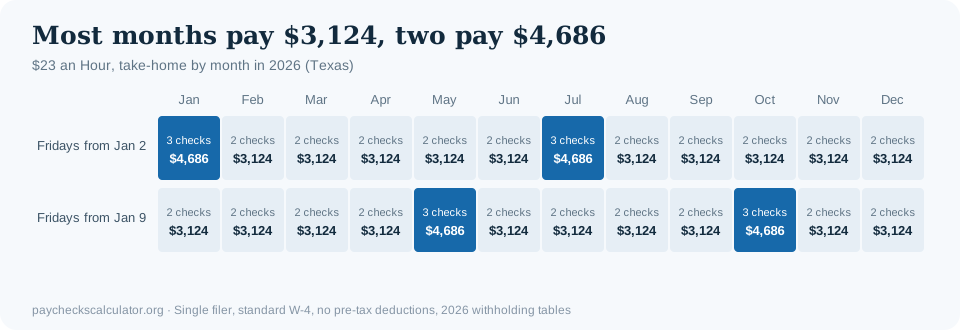
A full schedule deposits $3,124 in most months and $4,686 in two of them, averaging $3,385. On the 35-hour schedule those figures become $2,754 and $4,131, so a job with fewer hours needs its budget set well below the full-time number.
RENT
How Much Rent Can You Afford on $23 an Hour?
HUD counts a household as cost burdened when housing, including utilities, takes more than 30% of its income. On $23 an hour that line is $1,196 a month before tax, which is 38% of what a two-check month deposits in Texas. Setting your limit from take-home gives a lower, safer number.
What $23 an Hour Really Pays After Health Insurance and a 401(k)
Workers paid an average of $1,672 a year for single health coverage and $7,471 for family coverage in 2026, according to KFF. Premiums taken through a cafeteria plan and traditional 401(k) contributions both lower the tax on your check, so your take-home falls by less than the amount that comes out.