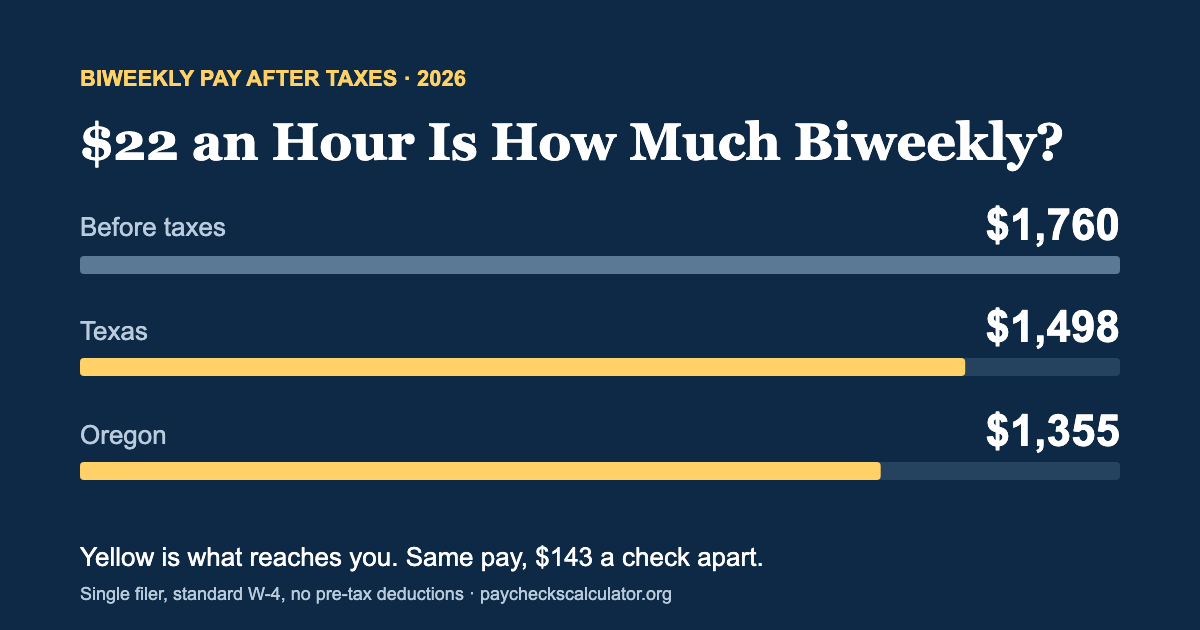
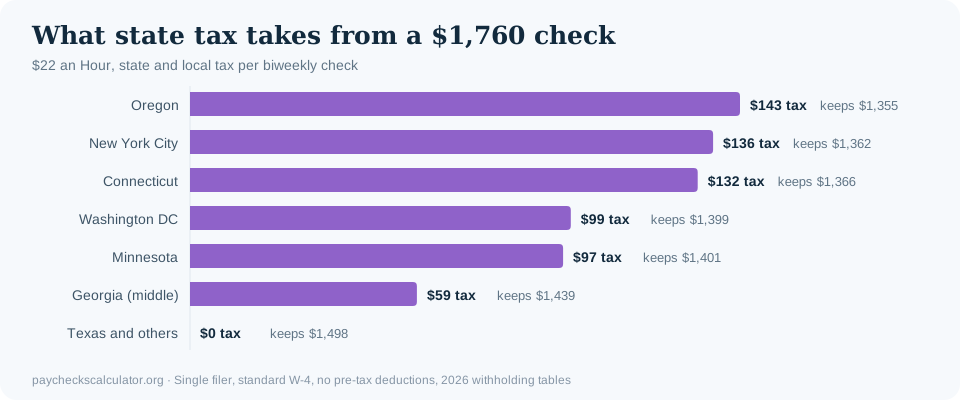
$22 an hour is how much biweekly? $1,760 before taxes and about $1,498 after taxes for a single filer in Texas, on a standard 80-hour pay period. The same check is $1,498 in 7 other places with no state tax at this pay, about $1,439 in a typical state, and $1,355 in Oregon, the lowest of the 52 locations we calculate.
Updated November 5, 2026 · 2026 IRS and state withholding tables
1
Your pay details at $22 an hour
Adjust the fields; results update instantly.
Pay frequency
2
Estimated take-home pay at $22 an hour
2026 source-backed withholding methods.
NET PAY · BIWEEKLY$1,498.01$38,948 per year
Take-home 85%Taxes 15%Deductions 0%
Gross pay$1,760.00
Federal income tax−$127.35
Social Security−$109.12
Medicare−$25.52
Texas income tax−$0.00
Pre-tax deductions−$0.00
ⓘ
No individual state income tax on wages.
Figures assume a single filer, standard W-4 and no pre-tax deductions. Change any field to match your pay stub.
PER CHECK
$22 an Hour Is How Much Biweekly? Where the $1,760 Goes
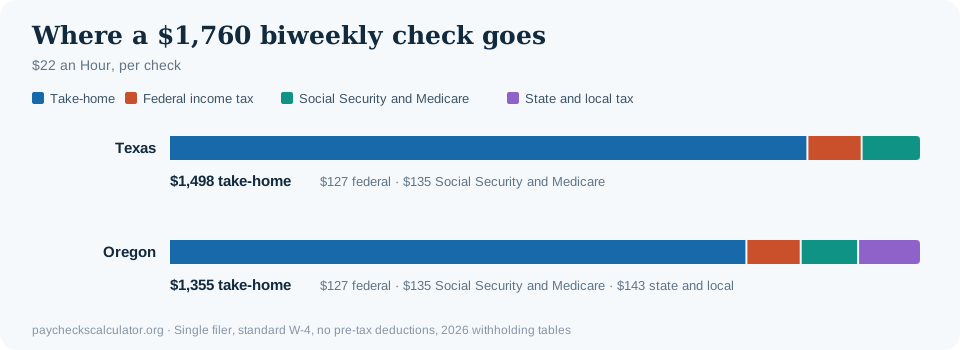
On a full 80 hours, Social Security and Medicare take $135, slightly more than the $127 of federal income tax. Both shrink when hours fall. A joint W-4 adds $75 and head of household adds $41.
Per biweekly check
Single
Married filing jointly
Head of household
Gross pay
$1,760.00
$1,760.00
$1,760.00
Federal income tax
−$127.35
−$52.15
−$86.12
Social Security (6.2%)
−$109.12
−$109.12
−$109.12
Medicare (1.45%)
−$25.52
−$25.52
−$25.52
Take-home
$1,498.01
$1,573.21
$1,539.24
Effective tax rate
14.9%
10.6%
12.5%
Tax on your next dollar
19.65%
17.65%
19.65%
No-income-tax state, standard W-4 with Step 2 unchecked, no pre-tax deductions, 2026 withholding tables. The next-dollar rate is the federal bracket plus 7.65% for Social Security and Medicare; state tax adds to both rates.
EVERY PAY PERIOD
$22 an Hour After Taxes: Per Month, Week, Day and Hour
$22 an hour after taxes is about $3,246 a month, $749 a week and $18.73 an hour for a single filer with no state income tax.
Per
Before taxes
After taxes
Year
$45,760
$38,948
Month (average)
$3,813
$3,246
Twice a month
$1,907
$1,623
Every two weeks
$1,760
$1,498
Week
$880
$749
Day (8 hours)
$176
$150
Hour
$22.00
$18.73
Annual take-home divided by the period, based on 2,080 paid hours a year. A monthly average, not what lands in a two-check month.
One Missed Shift at $22 an Hour Costs $141, Not $176
An unpaid 8-hour shift removes $176 of gross pay, but your check only falls by $141, because federal tax, Social Security and Medicare all shrink with it. Payroll treats each check as if you earned that amount all year, so a short check also lands in a lighter withholding calculation.
Where this bites is the monthly budget. If both checks in a month come up one shift short, the month brings in $2,714 rather than $2,996. With hours that move around, it is safer to build fixed bills on your low-hours check than on the 80-hour figure. Paid time off is different: those hours count as regular pay, so the check stays at $1,760 gross.
Overtime at $22 an Hour Looks Over-Taxed, but It Isn't
Eight overtime hours at $33.00 add $264 to your gross, and your check rises by $212, so you keep about 80% of it. That is the same 12% federal rate plus Social Security and Medicare that applies to your last regular dollar, not a special overtime tax.
You would need more than 24 overtime hours in one pay period before any of that check is withheld at 22%. Even then, the extra amount is withholding rather than your final bill. What you owe is settled on your tax return.
The federal overtime deduction helps later, not on the check. It covers the premium half of FLSA overtime, which is $11.00 an hour at this wage, up to $12,500 a year for a single filer through 2028. It is claimed on your return, so your employer's withholding does not change unless you adjust your W-4.
What a $1 Raise Is Worth at $22 an Hour
A $1 raise adds $80 of gross pay to an 80-hour check. In Texas, $64 of that reaches you, or about $1,671 a year. In Oregon you keep $58 because the state's rate applies as well.
Full-time pay of $45,760 also has $20,740 of room before the 22% withholding line, so raises stay in the same tax range for a long time. A salaried job at $45,760 pays the same $1,760 gross check, but it does not move with your schedule, which is worth weighing if your hours change from week to week.
BENCHMARKS
Is $22 an Hour a Good Wage?
$22 an hour is below the national median of $50,980, so more than half of U.S. jobs pay more, though it clears the 25th percentile of $37,590. Where you live changes the answer too: this pay leaves $1,498 a check in Texas and $1,355 in Oregon, about $3,718 a year apart.
Benchmark
Per year
Per hour
$22 an hour compared
25th percentile, all U.S. jobs
$37,590
$18.07
+$8,170 a year
Median, all U.S. jobs
$50,980
$24.51
−$5,220 a year
Median, full-time workers
$64,064
$30.80
−$18,304 a year
75th percentile, all U.S. jobs
$80,520
$38.71
−$34,760 a year
Jobs with a median wage close to this pay include Pharmacy Technicians ($22.00), Extruding, Forming, Pressing, and Compacting Machine Setters, Operators, and Tenders ($22.00), Printing Press Operators ($22.01) and Medical Assistants ($21.97).
$22 an Hour Is $20,740 Under the 22% Line: What a 401(k) Does to Your Check
Full-time pay of $45,760 has $20,740 of room before the 22% line, so a 401(k) here saves 12 cents on the dollar. A percentage contribution also moves with your hours: 5% is $88 on a full check and less on a short one.
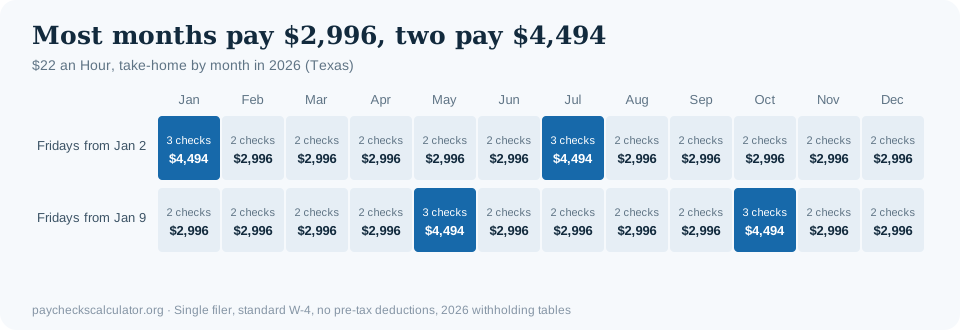
Monthly totals depend on your hours as well as the calendar. At a full 80 hours, ten months deposit $2,996 and two deposit $4,494, against an average of $3,246. Thirty percent of gross pay for rent would be $1,144, or 38% of a two-check month, and 42% if both checks come up a shift short.
RENT
How Much Rent Can You Afford on $22 an Hour?
HUD counts a household as cost burdened when housing, including utilities, takes more than 30% of its income. On $22 an hour that line is $1,144 a month before tax, which is 38% of what a two-check month deposits in Texas. Setting your limit from take-home gives a lower, safer number.
What $22 an Hour Really Pays After Health Insurance and a 401(k)
Workers paid an average of $1,672 a year for single health coverage and $7,471 for family coverage in 2026, according to KFF. Premiums taken through a cafeteria plan and traditional 401(k) contributions both lower the tax on your check, so your take-home falls by less than the amount that comes out.
Each row below is one pay period, withheld as if every check that year looked the same. That is why the short rows lose less than their gross and the long row keeps less of its extra pay.
$1,498 in Texas, about $1,439 in a typical state and $1,355 in Oregon, for a single filer with no pre-tax deductions.
How much is $22 an hour biweekly before taxes?
$1,760.00. An 80-hour pay period at $22 an hour is $1,760.00 gross, and 26 of those checks add up to $45,760 a year.
Why is my real paycheck on $22 an hour smaller than this?
Workplace deductions. A 5% 401(k) plus $150 a check for benefits brings $1,498 down to $1,300 in Texas.
How much is $22 an hour biweekly with overtime?
With 8 overtime hours in the pay period, gross pay is $2,024 and take-home is about $1,710 in Texas for a single filer. That compares with $1,498 on a regular 80-hour check.
Is $22 an hour above the U.S. median wage?
No. The Bureau of Labor Statistics puts the national median hourly wage at $24.51 (May 2025), about $2.51 above $22. Full time, $22 an hour comes to $45,760 a year.