$61,000 a Year Is How Much an Hour — 2026 Paycheck Calculator
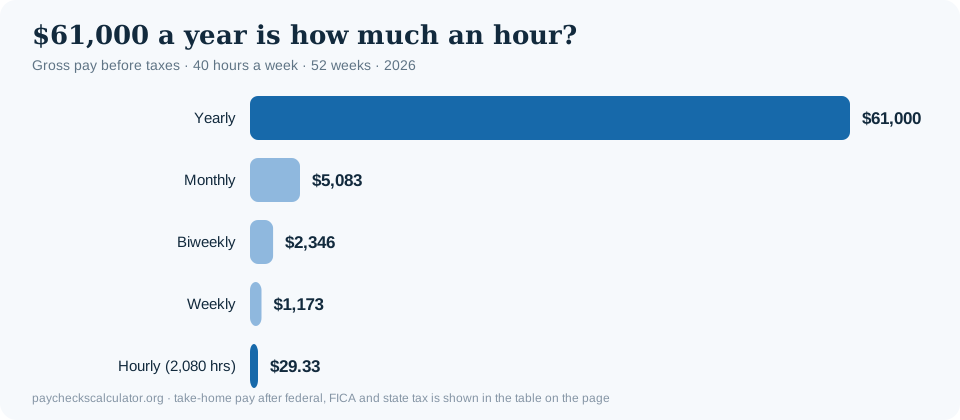
$61,000 a year is how much an hour? $29.33 an hour at 40 hours a week for 52 weeks (2,080 hours), or $33.52 an hour on a 35-hour week. Per pay period that is $5,083 a month, $2,346 biweekly or $1,173 a week before taxes.
1
Your pay details on $61,000 a year
Adjust the fields; results update instantly.
Pay frequency
2
Estimated take-home pay on $61,000 a year
2026 source-backed withholding methods.
NET PAY · BIWEEKLY$1,745.23$45,376 per year
Take-home 74%Taxes 14%Deductions 11%
Gross pay$2,346.15
Federal income tax−$165.62
Social Security−$136.16
Medicare−$31.84
Texas income tax−$0.00
Pre-tax deductions−$267.31
ⓘ
No individual state income tax on wages. Assumes a current federal W-4 with Step 2 unchecked and no credits. Address-specific local taxes are included only from the rate you enter; fixed local fees and employer-specific rules remain excluded.
After taxes, $61k a year is closer to $51,194 in a no-income-tax state like Texas and $46,131 in New York City. Enter your state, filing status and deductions above to see your own net paycheck.
2026 IRS MethodAll 50 StatesFree to Use
PAY BREAKDOWN
$61,000 a Year Is How Much an Hour, a Month, and Biweekly?
$61,000 a year converted to hourly, weekly, biweekly and monthly gross pay.
The math behind “$61,000 a year is how much an hour”: a full-time year is 40 hours × 52 weeks = 2,080 hours, so $61,000 ÷ 2,080 = $29.33 an hour. If you only count the roughly 2,000 hours most people actually work after holidays and vacation, $61k a year is about $30.50 an hour. Here is the same salary split across common pay schedules before any taxes or deductions:
Hourly (40 hrs/wk, 2,080 hrs): $29.33
Hourly (35 hrs/wk, 1,820 hrs): $33.52
Weekly (52×/yr): $1,173
Biweekly (26×/yr): $2,346
Semimonthly (24×/yr): $2,542
Monthly (12×/yr): $5,083
These are gross amounts. Your take-home depends on your state, filing status and deductions — the calculator above gives a state-specific net estimate, and the table below shows $61,000 a year after tax in every supported state. Earning a little less? $60,000 a year is how much an hour — $0.48 an hour less than $61,000. Expecting a raise? $62,000 a year is how much an hour — $0.48 an hour more, or $38 per biweekly check.
JOBS AT THIS SALARY
What Jobs Pay About $61,000 a Year?
These occupations have a national median salary closest to $61,000 a year, according to the BLS Occupational Employment and Wage Statistics survey (May 2025).The median is the midpoint — half of workers in the job earn more, half earn less.
Occupation
Median annual
Median hourly
U.S. jobs
Heating, Air Conditioning, and Refrigeration Mechanics and Installers
The largest of these is Carpenters — about 670K jobs nationwide with a median wage of $60,580 a year — and together the 7 occupations listed employ roughly 1.8M people, with median pay between $60,550 and $61,160.
Where $61,000 a year sits among U.S. salaries
$61,000 a year is above the national median of $50,980 (BLS May 2025) — about 120% of a typical salary — but below the 75th percentile of $80,520. More than half of American workers earn less than this, and it is the range where a single filer's marginal federal rate moves from 12% to 22%, so each additional dollar of raise is taxed noticeably harder than at lower salaries. Weighted by employment, about 62% of the 143.6M U.S. jobs in the 451 occupations we track have a median salary below $61,000.
MARGINAL TAX
A Raise on $61,000 a Year: How Much of It You Actually Keep
On $61,000 a year a single filer with a standard W-4 pays about $5,140 in federal income tax and $4,667 in Social Security and Medicare before any state tax. Because the U.S. system is marginal, a raise is taxed at your top rate, not your average rate — so the next dollar is worth less than the average dollar you already earn.
Run through the 2026 withholding tables in a no-income-tax state, a $1,000 raise on $61,000 adds about $804 to annual take-home (80%), and a $5,000 raise adds roughly $4,018 — $155per biweekly paycheck. Add your state’s income tax on top of that. Federal withholding follows IRS Publication 15-T; Social Security (6.2%) applies up to the $184,500 wage base and Medicare (1.45%) to every dollar. Our methodology page lists the tables.
TAKE-HOME PAY BY STATE
How Much Is $61,000 a Year After Taxes in Each State? (2026)
Here is what $61,000 a year takes home after taxes in every supported state for 2026 — from $51,194 in Florida down to $46,131 in New York City. Calculated for a single filer, standard W-4, biweekly pay frequency, no pre-tax deductions. Sorted highest to lowest.
Single filer · standard W-4 · biweekly pay · no pre-tax deductions · 2026 federal and state withholding tables. Actual paychecks vary based on filing status, allowances, and deductions.
FREQUENTLY ASKED QUESTIONS
$61,000 a Year — Frequently Asked Questions
$61,000 a year is how much an hour?+
$61,000 a year is $29.33 an hour if you work 40 hours a week for 52 weeks (2,080 hours). At 35 hours a week it is $33.52 an hour. These are gross figures before federal income tax, Social Security, Medicare and state tax.
$61k a year is how much an hour after taxes?+
After taxes, $61k a year is roughly $22.00–$24.93 an hour, because a single filer with a standard W-4 keeps about 75%–85% of gross depending on the state. Federal income tax, 6.2% Social Security and 1.45% Medicare come out of every check; the state table on this page shows the exact after-tax figure for all 38 supported states.
$61k a year is how much biweekly?+
$61,000 a year with 26 biweekly pay periods is $2,346 per paycheck before taxes. Net pay after taxes will be lower — enter your state and deductions in the calculator for an exact estimate.
$61,000 a year is how much a month?+
$61,000 a year equals $5,083 a month in gross pay ($61,000 ÷ 12). Set the calculator's pay frequency to monthly to see your net monthly take-home.
What federal tax bracket is $61,000 in for 2026?+
For 2026, a $61,000 single-filer salary falls in the 22% federal income tax bracket. The U.S. uses a marginal rate system, so only income above each bracket threshold is taxed at that rate.
Is $61,000 a good salary?+
Whether $61,000 a year is a good salary depends on your location, household size and cost of living. Compare the after-tax figures for different states on this page.
How much of a $1,000 raise do I keep at $61,000?+
About $804, or 80%, in a state with no income tax. A $5,000 raise would add roughly $4,018 a year — $155 per biweekly paycheck.
How much house can I afford on $61,000 a year?+
A common guideline caps total housing costs at 28% of gross income — about $1,423 a month on $61,000. Depending on rates and your down payment, that supports a mortgage in the $152,500–$213,500 range.
Is $61,000 a good salary?+
$61,000 is above the U.S. median annual wage of $50,980 (BLS May 2025). Whether it feels good depends on your state — the table above shows the after-tax difference, which can exceed $4,880 a year between the highest- and lowest-tax states.
RELATED CALCULATORS
How Much an Hour Is $60,000 or $62,000 a Year — and Other Paycheck Calculators