Publication 505, Tax Withholding and Estimated Tax, is the IRS guide to paying your 2026 tax during the year instead of all at once in April. This page sums up what each chapter covers, which of its worksheets you actually need, and the 2026 rules it sets out.
How withholding from wages, pensions, annuities and other payments works, and how to change it with Forms W-4, W-4P, W-4R and W-4V
2
Estimated Tax for 2026
Who must pay estimated tax, how to figure it, when it is due, the annualized method and the underpayment penalty
If you only have wages, chapter 1 is all you need, and the practical step is usually a new W-4. For a paycheck-level view of what is already being withheld, see how much tax is taken from a paycheck. Chapter 2 is for income with no withholding: self-employment, rentals, investments, and the 2026 Estimated Tax Worksheet.
WORKSHEETS
Publication 505 Worksheets: Which Ones You Need
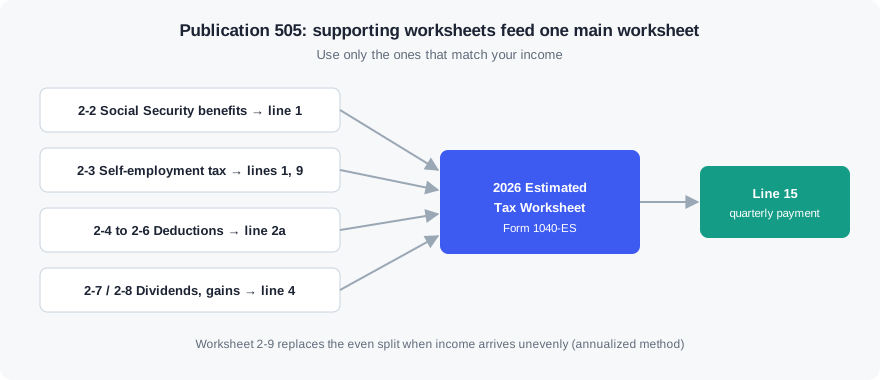
Each supporting worksheet is named for the Estimated Tax Worksheet line it feeds.
The main 2026 Estimated Tax Worksheet is short because the hard parts are pushed into supporting worksheets. Each one is named for the line it feeds. You only need the ones that match your situation.
Worksheet
What it figures
You need it if
1-4
Tax Computation Worksheets for 2026
Tax on $100,000 or more when checking withholding
2-2
Line 1: estimated taxable Social Security and railroad retirement benefits
You receive Social Security or RRB benefits
2-3
Lines 1 and 9: estimated self-employment tax and deduction
You have self-employment income
2-4
Line 2a: standard deduction
You are 65+, blind, or can be claimed as a dependent
2-5
Line 2a: expected charitable contribution deduction
You give to charity
2-6
Line 2a: overall limitation on itemized deductions
You itemize at high income
2-7
Line 4: Qualified Dividends and Capital Gain Tax Worksheet
You have qualified dividends or long-term gains
2-8
Line 4: Foreign Earned Income Tax Worksheet
You exclude foreign earned income or housing
2-9
2026 Annualized Estimated Tax Worksheet
Your income arrives unevenly through the year
2-10
Annualized line 12: Qualified Dividends and Capital Gain Tax Worksheet
Annualizing, with dividends or gains
2-11
Annualized line 12: Foreign Earned Income Tax Worksheet
The safe harbors set the minimum you must prepay to avoid a penalty, not what you owe. If you pay last year's tax in four installments while your income doubles, you avoid the penalty but still owe the difference when you file.
For 2026 the estimated tax worksheet also has a line for the new deductions reported on Schedule 1-A, such as qualified tips and overtime pay. If those apply, the no tax on overtime guide explains the overtime part.
HOW TO USE IT
How to Use Publication 505 in Four Steps
Decide whether chapter 2 applies. If you have only wages and your withholding is close, adjust your W-4 in chapter 1 and stop.
Pull the supporting worksheets you need. Use the table above: 2-3 for self-employment, 2-7 for dividends and gains, 2-2 for Social Security.
Fill out the Estimated Tax Worksheet. Line 12c gives the minimum to prepay; line 15 gives each quarterly payment.
Pay by each due date. If income is lumpy, switch to the annualized method in Worksheet 2-9 to lower the early installments.
FREQUENTLY ASKED QUESTIONS
Publication 505 FAQ
What is IRS Publication 505?+
Publication 505, Tax Withholding and Estimated Tax, is the IRS guide to paying tax during the year. Chapter 1 covers withholding from wages, pensions and other payments. Chapter 2 covers estimated tax: who must pay, how much, when, and the penalty for paying too little.
Is Publication 505 for 2026 available?+
Yes. The IRS has published Publication 505 (2026), labelled "For use in 2026", on IRS.gov. It is meant for planning 2026 withholding and estimated payments, not for filing your 2025 return.
What is Worksheet 2-7 in Publication 505?+
It is the estimated-tax version of the Qualified Dividends and Capital Gain Tax Worksheet. It feeds line 4 of the 2026 Estimated Tax Worksheet so that qualified dividends and long-term gains are taxed at 0%, 15% or 20% rather than at ordinary rates.
What is the difference between Publication 505 and Form 1040-ES?+
Form 1040-ES is the short package: the worksheet, the 2026 rate schedules, the due dates and the payment vouchers. Publication 505 is the long explanation behind it, with the supporting worksheets for Social Security benefits, self-employment tax, capital gains, foreign income and the annualized method.
Does Publication 505 explain the underpayment penalty?+
Yes. Chapter 2 explains the underpayment penalty and when it applies. The penalty itself is figured on Form 2210 when you file, as interest on each quarter's shortfall.
How do I avoid an estimated tax penalty?+
Prepay, through withholding and estimated payments, at least the smaller of 90% of your 2026 tax or 100% of your 2025 tax (110% if 2025 AGI was over $150,000, or $75,000 married filing separately). You also owe no penalty if the balance due after withholding is under $1,000.
SOURCES
Where this comes from
Chapter titles and worksheet numbers are from the table of contents of Publication 505 (2026). The safe-harbor percentages, the $1,000 threshold and the due dates also appear in the 2026 Form 1040-ES.
Disclaimer: a summary for planning, not tax advice or a substitute for the publication itself.