The Tax Computation Worksheet is how Form 1040 figures tax on taxable income of $100,000 or more. Find your filing status and income row, multiply by the rate, subtract the amount shown, and the result is your tax. All four sections for 2026 are below.
IRS Revenue Procedure 2025-32Sections A–DMatches the 2026 rate schedules
HOW IT WORKS
How the Tax Computation Worksheet Works
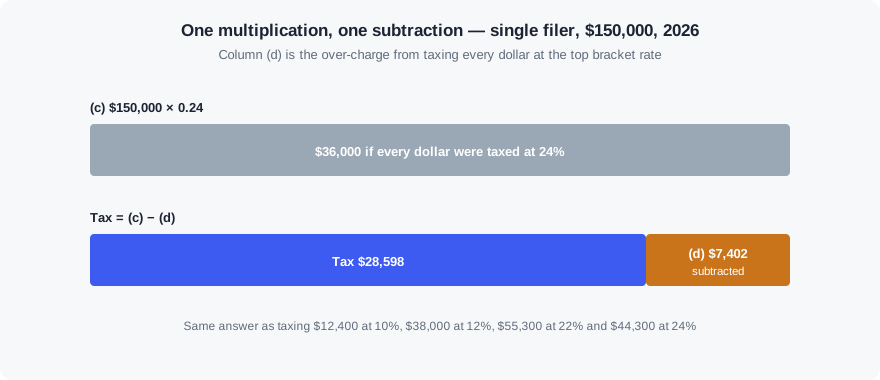
Column (d) removes the over-charge from taxing every dollar at the top bracket rate.
Each row has five columns. Column (a) is your taxable income. Column (b) is the rate for the bracket that income falls in. Column (c) multiplies the two. Column (d) is a fixed subtraction amount, and your tax is (c) minus (d).
The subtraction is what makes one multiplication work for a progressive schedule. Multiplying all of your income by your top rate over-charges the dollars that belong in lower brackets. Column (d) is exactly that over-charge, worked out in advance for each bracket.
Use it when the amount being taxed is $100,000 or more. Below that, the Tax Table in the 1040 instructions applies. The test is applied to whatever amount you are taxing, so on the Qualified Dividends and Capital Gain Tax Worksheet line 22 might use the Tax Table while line 24 uses this worksheet.
SECTION A
Section A: Single
Taxable income (a)
Multiplication amount (b)
Subtraction amount (d)
Tax
At least $100,000 but not over $105,700
× 0.22 (22%)
$5,288.00
(a) × (b) − $5,288.00
Over $105,700 but not over $201,775
× 0.24 (24%)
$7,402.00
(a) × (b) − $7,402.00
Over $201,775 but not over $256,225
× 0.32 (32%)
$23,544.00
(a) × (b) − $23,544.00
Over $256,225 but not over $640,600
× 0.35 (35%)
$31,230.75
(a) × (b) − $31,230.75
Over $640,600
× 0.37 (37%)
$44,042.75
(a) × (b) − $44,042.75
SECTION B
Section B: Married filing jointly or qualifying surviving spouse
Taxable income (a)
Multiplication amount (b)
Subtraction amount (d)
Tax
At least $100,000 but not over $100,800
× 0.12 (12%)
$496.00
(a) × (b) − $496.00
Over $100,800 but not over $211,400
× 0.22 (22%)
$10,576.00
(a) × (b) − $10,576.00
Over $211,400 but not over $403,550
× 0.24 (24%)
$14,804.00
(a) × (b) − $14,804.00
Over $403,550 but not over $512,450
× 0.32 (32%)
$47,088.00
(a) × (b) − $47,088.00
Over $512,450 but not over $768,700
× 0.35 (35%)
$62,461.50
(a) × (b) − $62,461.50
Over $768,700
× 0.37 (37%)
$77,835.50
(a) × (b) − $77,835.50
SECTION C
Section C: Married filing separately
Taxable income (a)
Multiplication amount (b)
Subtraction amount (d)
Tax
At least $100,000 but not over $105,700
× 0.22 (22%)
$5,288.00
(a) × (b) − $5,288.00
Over $105,700 but not over $201,775
× 0.24 (24%)
$7,402.00
(a) × (b) − $7,402.00
Over $201,775 but not over $256,225
× 0.32 (32%)
$23,544.00
(a) × (b) − $23,544.00
Over $256,225 but not over $384,350
× 0.35 (35%)
$31,230.75
(a) × (b) − $31,230.75
Over $384,350
× 0.37 (37%)
$38,917.75
(a) × (b) − $38,917.75
SECTION D
Section D: Head of household
Taxable income (a)
Multiplication amount (b)
Subtraction amount (d)
Tax
At least $100,000 but not over $105,700
× 0.22 (22%)
$7,099.00
(a) × (b) − $7,099.00
Over $105,700 but not over $201,750
× 0.24 (24%)
$9,213.00
(a) × (b) − $9,213.00
Over $201,750 but not over $256,200
× 0.32 (32%)
$25,353.00
(a) × (b) − $25,353.00
Over $256,200 but not over $640,600
× 0.35 (35%)
$33,039.00
(a) × (b) − $33,039.00
Over $640,600
× 0.37 (37%)
$45,851.00
(a) × (b) − $45,851.00
WORKED EXAMPLE
2026 Tax Computation Worksheet Example
A single filer has $150,000 of taxable income on Form 1040 line 15. That falls in the row from $105,700 to $201,775 in Section A.
Column
Step
Amount
(a)
Taxable income
$150,000.00
(b)
Multiplication amount
× 0.24
(c)
(a) × (b)
$36,000.00
(d)
Subtraction amount
$7,402.00
Tax
(c) − (d)
$28,598.00
Working through the brackets one at a time gives the same $28,598.00. A married couple filing jointly with $250,000 of taxable income uses Section B: $250,000 × 0.24 − $14,804.00 = $45,196.00.
WHERE IT FITS
Where the Worksheet Fits on Your Return
Form 1040 line 16, when you have no qualified dividends or capital gain
Qualified Dividends and Capital Gain Tax Worksheet, lines 22 and 24
Schedule D Tax Worksheet, for its ordinary-tax lines
Publication 505 Worksheet 1-4, when estimating 2026 withholding
The 2026 brackets start at $12,400 (12%) for single filers and $24,800 for joint filers, so every row on this worksheet is already in the 22% bracket or above.
FREQUENTLY ASKED QUESTIONS
Tax Computation Worksheet FAQ
What is the Tax Computation Worksheet?+
It is the table in the Form 1040 instructions you use instead of the Tax Table when taxable income is $100,000 or more. It restates the bracket schedule as one step: multiply your taxable income by your top bracket rate, then subtract a fixed amount for your bracket.
When do I use the Tax Computation Worksheet instead of the Tax Table?+
When the amount you are taxing is $100,000 or more. That applies to Form 1040 line 15, and also to lines 22 and 24 of the Qualified Dividends and Capital Gain Tax Worksheet, which each tax a separate amount and can land on different tables.
Where does the subtraction amount come from?+
It removes the over-charge from taxing your whole income at the top rate. Each bracket's subtraction amount equals the bracket floor times its rate, minus the tax owed on income up to that floor. For 2026 single filers in the 24% bracket it is $7,402.00.
Is the 2026 Tax Computation Worksheet out yet?+
The IRS prints it in the 2026 Form 1040 instructions, released around the end of the year. The figures here come from the 2026 rate schedules in IRS Revenue Procedure 2025-32, which are the same schedules printed in the 2026 Form 1040-ES and Publication 505 Worksheet 1-4, so the result matches the official worksheet.
Does the Tax Computation Worksheet give the same answer as the tax brackets?+
Yes, to the cent. It is the bracket schedule in a different format. The Tax Table, by contrast, works in $50 income steps and taxes the midpoint, so for incomes under $100,000 the table and an exact bracket calculation can differ by a few dollars.
Do I use this worksheet if I have qualified dividends?+
Indirectly. You first run the Qualified Dividends and Capital Gain Tax Worksheet. Its lines 22 and 24 tell you to figure tax on certain amounts, and for any amount of $100,000 or more you use this worksheet to do it.
SOURCES
Where these figures come from
Rates and bracket floors are the 2026 schedules in IRS Revenue Procedure 2025-32 §3.01, the same figures printed as the 2026 Tax Rate Schedules in Form 1040-ES. The subtraction amounts are derived from them. The worksheet layout follows the Form 1040 instructions.
Disclaimer: a planning reference, not tax advice. Check your figures against the 2026 Form 1040 instructions when they are released.