2026 FORM 1040-ES

2026 Estimated Tax Worksheet, Line by Line

The Estimated Tax Worksheet in Form 1040-ES works out whether you need to pay quarterly estimated tax for 2026, and how much each payment should be. It runs 15 numbered lines: estimate the year's tax, find the smallest amount that avoids a penalty, subtract withholding, and divide by four.

2026 Form 1040-ESAll 15 lines2026 due dates

WHO PAYS

Who Needs to Fill Out the 2026 Estimated Tax Worksheet

Estimated tax is how income without withholding gets taxed during the year: self-employment profit, rental income, interest, dividends, capital gains, alimony from older divorce agreements. You generally must pay it for 2026 when both of these are true:

  • You expect to owe at least $1,000 after withholding and refundable credits
  • Withholding and credits will cover less than 90% of 2026 tax or 100% of 2025 tax, whichever is smaller

You owe nothing for 2026 if you were a US citizen or resident all of 2025 and had no tax liability for that full year. The worksheet tests both conditions for you on lines 14a and 14b.

LINE BY LINE

The 2026 Estimated Tax Worksheet, Every Line

Lines 1–11c estimate your 2026 tax from the top down, the same order as Form 1040. Lines 12a–12c set the minimum you have to prepay. Lines 13–15 subtract withholding and give you the quarterly figure.

LineWhat it asksHow to fill it in
1Adjusted gross income you expect for the yearWages, business profit, interest, dividends and gains, minus adjustments such as half of self-employment tax.
2aDeductionsYour standard deduction or estimated itemized deductions. Non-itemizers can add up to $1,000 ($2,000 joint) of cash charitable gifts.
2bQualified business income deductionUsually 20% of qualified business income, limited by taxable income.
2cSchedule 1-A deductionsThe new deductions reported on Schedule 1-A, such as qualified tips and overtime pay.
2dAdd lines 2a, 2b and 2cTotal deductions.
3Line 1 − line 2dEstimated taxable income.
4Tax on line 3The 2026 Tax Rate Schedules. With qualified dividends or a net capital gain, use Publication 505 Worksheet 2-7 instead.
5Alternative minimum taxFrom Form 6251, if it applies.
6Line 4 + line 5, plus other taxes that go in Form 1040 line 16Income tax before credits.
7CreditsChild tax credit and other nonrefundable credits. Not withholding.
8Line 6 − line 7, not below 0Income tax after credits.
9Self-employment tax15.3% on 92.35% of net self-employment profit, with Social Security capped at the wage base.
10Other taxesAdditional Medicare tax, net investment income tax, household employment taxes and similar.
11aAdd lines 8 through 10Total tax before refundable credits.
11bRefundable creditsEarned income credit, additional child tax credit, net premium tax credit and others.
11cTotal 2026 estimated taxLine 11a − line 11b, not below 0.
12a90% of line 11c66⅔% if you are a farmer or fisherman.
12bRequired payment based on last year's tax100% of the tax on your 2025 return, or 110% if 2025 AGI was over $150,000 ($75,000 married filing separately).
12cSmaller of line 12a or line 12bYour required annual payment: what you must prepay to avoid a penalty.
13WithholdingIncome tax withheld and expected to be withheld during 2026.
14aLine 12c − line 13If zero or less, stop: you don't need to make estimated payments.
14bLine 11c − line 13If less than $1,000, stop: you don't need to make estimated payments.
15Quarterly paymentIf your first payment is due April 15, 2026: ¼ of line 14a, minus any 2025 overpayment applied.

Line 4 is where most mistakes happen. Taxing qualified dividends and long-term gains at ordinary rates overstates your estimate. Run them through the Qualified Dividends and Capital Gain Tax Worksheet, which Publication 505 reprints as Worksheet 2-7 for estimated tax. For self-employment tax on line 9, the self-employment tax calculator gives the figure for your profit.

WORKED EXAMPLE

2026 Estimated Tax Worksheet Example: a Freelancer

A single freelancer expects $80,000 of net profit in 2026, has no other income and no withholding, and owed $12,000on last year's return with AGI under $150,000.

LineWhat it isAmount
1Expected AGI (profit − ½ SE tax)$74,348
2aStandard deduction, single$16,100
2bQBI deduction$11,650
2dTotal deductions$27,750
3Taxable income$46,599
4Tax from the rate schedule$5,344
8Tax after credits (none)$5,344
9Self-employment tax$11,304
11cTotal 2026 estimated tax$16,647
12a90% of line 11c$14,983
12b100% of 2025 tax$12,000
12cRequired annual payment$12,000
13Withholding$0
14aLine 12c − line 13$12,000
14bLine 11c − line 13$16,647
15Each quarterly payment$3,000

The estimated 2026 tax is $16,647, and 90% of that is $14,983. Last year's $12,000 is smaller, so it becomes the required payment: $3,000 a quarter. That avoids the penalty, but about $4,647 will still be due in April 2027, so it is worth setting aside.

Self-employment tax is 15.3% of 92.35% of profit, with Social Security capped at the $184,500 2026 wage base. The QBI deduction is taken as 20% of qualified business income, limited to 20% of taxable income before the deduction.

DUE DATES

2026 Estimated Tax Due Dates

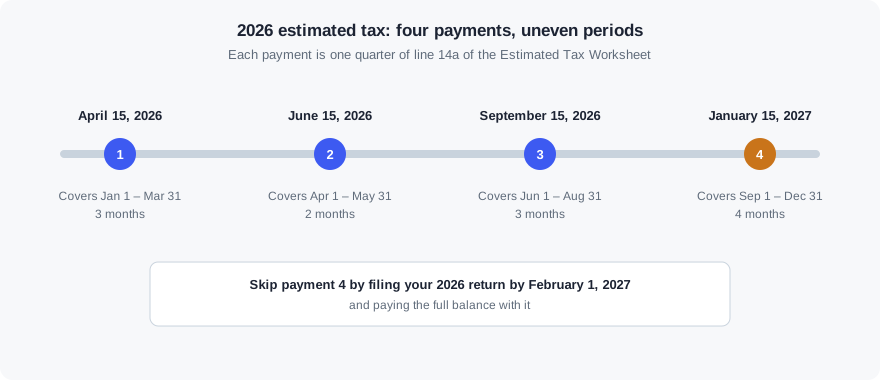
2026 estimated tax due dates: April 15, June 15 and September 15, 2026, and January 15, 2027
The four payment periods are uneven: three, two, three and four months.
PaymentDueCovers income earned
1stApril 15, 2026January 1 – March 31
2ndJune 15, 2026April 1 – May 31
3rdSeptember 15, 2026June 1 – August 31
4thJanuary 15, 2027September 1 – December 31

You can skip the January payment if you file your 2026 return by February 1, 2027and pay the whole balance with it. Paying late or too little triggers an underpayment penalty, figured on Form 2210, which works like interest on each quarter's shortfall. If your income arrives unevenly, the annualized method in Publication 505 (Worksheet 2-9) can lower the early payments.

FREQUENTLY ASKED QUESTIONS

2026 Estimated Tax Worksheet FAQ

Do I have to make 2026 estimated tax payments?+

Run lines 14a and 14b and the worksheet answers it. If line 14a is zero or less, or line 14b is under $1,000, you don't need to pay. Otherwise you do, unless you owed no tax at all for a full 12-month 2025.

What are the 2026 estimated tax due dates?+

April 15, June 15 and September 15, 2026, and January 15, 2027. You can skip the January payment if you file your 2026 return by February 1, 2027 and pay the full balance with it.

What is the 110% rule?+

If your 2025 adjusted gross income was more than $150,000 ($75,000 if married filing separately in 2026), the prior-year safe harbor on line 12b is 110% of your 2025 tax instead of 100%. It does not apply if at least two-thirds of your gross income comes from farming or fishing.

Which is better, paying 90% of this year's tax or 100% of last year's?+

Whichever is smaller is all you need to prepay to avoid a penalty, which is why line 12c takes the smaller. Last year's tax is fixed and known, so it is the safer target when your income is rising. You still owe any remaining balance when you file.

How do I figure line 4 if I have qualified dividends or capital gains?+

Don't use the rate schedules directly. Run your projected taxable income, qualified dividends and long-term gain through Publication 505 Worksheet 2-7, which follows the same 25 steps as the Form 1040 worksheet, and enter its result on line 4.

Can I raise my withholding instead of paying estimated tax?+

Yes. If you also have a job, a new Form W-4 asking your employer to withhold more can cover the tax on your other income. Withholding counts as paid evenly through the year no matter when it happens, which estimated payments don't.

SOURCES

Where these figures come from

Line wording, the safe-harbor percentages and the due dates follow the 2026 Form 1040-ES. Tax rates and the standard deduction are from IRS Revenue Procedure 2025-32. Worksheet numbers refer to Publication 505 (2026).

Disclaimer: a planning guide, not tax advice. The example ignores state tax, the self-employed health insurance deduction and retirement contributions.

Reviewed by: Paycheck Calculator Editorial Team

Rules current for tax year 2026

2026 TAX WORKSHEETS

Related 2026 tax worksheets