What is the capital gains tax rate 2026 investors pay? Long-term gains are taxed at 0%, 15% or 20%, depending on your taxable income. A single filer pays 0% on gains that fit under $49,450 of taxable income and 15% up to $545,500. Short-term gains are taxed as ordinary income. Enter your figures to see how your gain splits across the brackets.
1
Your income and gains
Use taxable amounts, after deductions. Results update instantly.
2
Federal tax on your gains
2026 rates · Single
CAPITAL GAINS TAX$3,000.0015.0% of your gains · total taxable income $80,000
At 0% 0%At 15% 100%At 20% 0%
Long-term gain taxed at 0%$0.00
Long-term gain taxed at 15%$20,000.00
Long-term gain taxed at 20%$0.00
Tax on long-term gain$3,000.00
Tax on short-term gain (ordinary rates)$0.00
Total federal income tax$10,912.00
Every capital gains tax rate 2026 threshold here comes from IRS Revenue Procedure 2025-32 §3.03. The calculator stacks the gain on top of your other taxable income, exactly as the Form 1040 capital gain worksheet does.
Capital Gains Tax Rate 2026 Brackets for Long-Term Gains
The ranges are total taxable income, after the standard or itemized deduction, not the size of the gain. Your gain is taxed at the rate for the range it falls in once your other income is counted first.
Filing status
0% rate
15% rate
20% rate
Single
Up to $49,450
$49,450 – $545,500
Over $545,500
Married filing jointly
Up to $98,900
$98,900 – $613,700
Over $613,700
Married filing separately
Up to $49,450
$49,450 – $306,850
Over $306,850
Head of household
Up to $66,200
$66,200 – $579,600
Over $579,600
Estates and trusts
Up to $3,300
$3,300 – $16,250
Over $16,250
Qualified dividends use the same three rates and the same thresholds. Married couples filing jointly get exactly twice the single 0% limit, but the 15% limit is not doubled: $613,700 versus $545,500.
SHORT-TERM GAINS
Short-Term Capital Gains Tax Rate 2026
A gain on an asset held one year or less is short-term and is taxed at your ordinary income tax rate, the same as wages. For 2026 that means seven brackets from 10% to 37%.
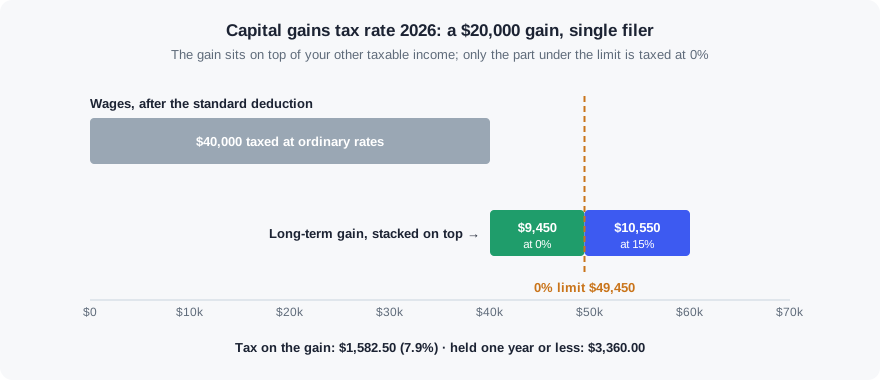
Wages fill the brackets first, so only the part of the gain below the 0% limit escapes tax.
A single filer has $40,000 of taxable income from wages and sells stock held for three years at a $20,000 profit. Total taxable income is $60,000.
Step
Amount
Room left under the $49,450 0% limit
$9,450.00
Gain taxed at 0%
$9,450.00
Gain taxed at 15%
$10,550.00
Tax on the gain
$1,582.50
That is 7.9% of the gain. Had the stock been sold after eleven months, the same $20,000 would be a short-term gain taxed at ordinary rates: $3,360.00, or $1,777.50 more.
SPECIAL RATES
Other Capital Gains Rates: 25%, 28% and the 3.8% Surtax
28% maximum on collectibles (art, coins, precious metals) and the taxable part of qualified small business stock gains
25% maximum on unrecaptured Section 1250 gain, the depreciation taken on real estate you sell
3.8% net investment income tax above $200,000 of modified AGI (single), $250,000 (joint) or $125,000 (separate)
Gains in these categories are worked through the Schedule D Tax Worksheet rather than the Qualified Dividends and Capital Gain Tax Worksheet. The 3.8% surtax is added on Form 8960, so the top federal rate on a long-term gain is 23.8%.
STATE TAXES
State Capital Gains Taxes in 2026
Most states tax capital gains as ordinary income at their regular rates, with no separate long-term rate. 9 states have no tax on wage income: Alaska, Florida, Nevada, New Hampshire, South Dakota, Tennessee, Texas, Washington, Wyoming. All but Washington also leave capital gains untaxed; Washington levies its own tax on large long-term gains (see the Washington Department of Revenue).
Combined rate = 20% federal + 3.8% net investment income tax + the state's top rate, before any state exclusion. A few states exclude part of long-term gains; check your state's rules before relying on the combined figure.
FREQUENTLY ASKED QUESTIONS
Capital Gains Tax Rate 2026 FAQ
What is the capital gains tax rate for 2026?+
Long-term gains (assets held more than a year) are taxed at 0%, 15% or 20% depending on taxable income. For single filers the 0% rate covers taxable income up to $49,450 and 15% runs to $545,500; for joint filers the limits are $98,900 and $613,700. Short-term gains are taxed at ordinary rates from 10% to 37%.
Is the 0% bracket based on my gain or my total income?+
On total taxable income, including the gain. Ordinary income fills the brackets first and the long-term gain sits on top. Only the part of the gain that lands below $49,450 (single) is taxed at 0%.
How long do I have to hold an asset for the lower rate?+
More than one year. An asset sold one year or less after you bought it produces a short-term gain, taxed like wages. The holding period starts the day after you acquire the asset.
Do capital gains push my other income into a higher bracket?+
No. Long-term gains are stacked on top of ordinary income, so your wages are taxed the same with or without the gain. A large gain can, however, raise adjusted gross income and affect credits, Medicare premiums and the 3.8% net investment income tax.
What is the 3.8% net investment income tax?+
A surtax on investment income for people with modified AGI above $200,000 (single or head of household), $250,000 (married filing jointly) or $125,000 (married filing separately). These thresholds are fixed in law and do not rise with inflation, so it can push the top federal rate on gains to 23.8%.
Which states have no capital gains tax?+
States with no tax on wage income generally do not tax capital gains either: Alaska, Florida, Nevada, New Hampshire, South Dakota, Tennessee, Texas, Wyoming. Washington is the exception: it has no wage income tax but does tax large long-term capital gains.
SOURCES
Where these figures come from
The 0% and 15% limits and the ordinary brackets are from IRS Revenue Procedure 2025-32 §3.01 and §3.03. The 25% and 28% maximum rates and the net investment income tax thresholds are set in Internal Revenue Code §1(h) and §1411 and are not adjusted for inflation. State rates are the top rates in our state paycheck calculators.
Disclaimer: a planning reference, not tax advice. Rates are for tax year 2026, the return you file in 2027.