This net pay calculator turns your gross salary into net pay: what lands in your account after federal income tax, Social Security, Medicare, state tax and pre-tax deductions. Enter your salary, pay frequency and state, and every line of the gross-to-net calculation is shown per paycheck.
1
Your pay details
Adjust the fields; results update instantly.
Pay frequency
2
Estimated take-home pay
2026 source-backed withholding methods.
NET PAY · BIWEEKLY$1,938.08$50,390 per year
Take-home 84%Taxes 16%Deductions 0%
Gross pay$2,307.69
Federal income tax−$193.08
Social Security−$143.08
Medicare−$33.46
Texas income tax−$0.00
Pre-tax deductions−$0.00
ⓘ
No individual state income tax on wages.
Federal withholding follows the 2026IRS percentage method in Publication 15-T, and state tax uses each state's own 2026 withholding formula. Add your 401(k) percentage and other pre-tax deductions to match your pay stub. Paid by the hour? Use the hourly paycheck calculator.
IRS Pub. 15-T (2026)All 50 states + DCFree to Use
THE FORMULA
How to Calculate Net Pay
Net pay = gross pay − pre-tax deductions − taxes − after-tax deductions. Payroll works it out in this order, because pre-tax deductions change how much income tax is owed:
Gross pay for the period: annual salary ÷ number of paychecks, or hours × hourly rate plus overtime.
Pre-tax deductions: traditional 401(k) or 403(b), health, dental and vision premiums, HSA and FSA contributions.
Federal income tax, from your W-4 and the IRS withholding tables.
FICA: Social Security at 6.2% up to the $184,500 wage base, and Medicare at 1.45%, plus 0.9% on wages over $200,000.
State and local income tax, where it applies. Nine states have no wage income tax.
After-tax deductions: Roth 401(k), union dues, garnishments, charitable payroll gifts.
WORKED EXAMPLE
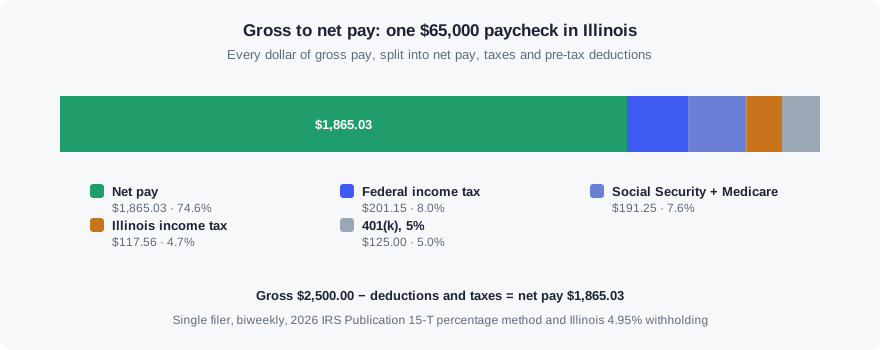
Gross to Net Pay: a $65,000 Salary in Illinois
A single filer paid biweekly (26 paychecks a year), contributing 5% to a 401(k). One paycheck:
Where each dollar of a $65,000 Illinois paycheck goes, gross to net.
Line
Per paycheck
Per year
Gross pay
$2,500.00
$65,000
401(k), 5%
−$125.00
−$3,250
Federal income tax
−$201.15
−$5,230
Social Security (6.2%)
−$155.00
−$4,030
Medicare (1.45%)
−$36.25
−$943
Illinois income tax (4.95%)
−$117.56
−$3,057
Net pay
$1,865.03
$48,491
Taxes take $13,259, or 20.4% of gross pay, and net pay is 74.6% of gross. The 401(k) contribution is not lost money, but it is not in the paycheck either, which is why net pay is lower than "after-tax" pay.
NET PAY BY SALARY
2026 Net Pay by Salary and State
Annual net pay for a single filer with no pre-tax deductions, and the biweekly paycheck in brackets. Texas has no state income tax; the other three show how much state tax changes the answer.
Your W-4. Claiming dependents in Step 3 lowers withholding; extra withholding in Step 4(c) raises it. A big refund means net pay was lower than it needed to be.
Pre-tax benefits. Moving money into an HSA or traditional 401(k) costs less than the contribution, because it is taken out before income tax.
Where you live. State tax ranges from nothing to more than 10% at high incomes, and some cities add their own.
The Social Security wage base. Earn over $184,500 and the 6.2% stops for the rest of the year, so late-year paychecks get bigger.
Bonuses. Supplemental pay is often withheld at a flat 22% federal rate, so a bonus check nets less than a regular one of the same size. See the gross-up calculator.
FREQUENTLY ASKED QUESTIONS
Net Pay Calculator FAQ
What is net pay?+
Net pay is the amount you actually receive after everything is taken out of your gross pay: federal income tax, Social Security, Medicare, state and local income tax, and deductions such as 401(k) contributions and health insurance premiums. It is the figure on the "net pay" line of your pay stub and the amount deposited in your bank account.
How do I calculate net pay from gross pay?+
Start with gross pay for the period. Subtract pre-tax deductions (traditional 401(k), health insurance, HSA), then federal income tax withholding, Social Security at 6.2%, Medicare at 1.45%, and state and local income tax. Finally subtract after-tax deductions such as Roth 401(k) contributions or union dues. What is left is net pay.
What is the difference between gross pay and net pay?+
Gross pay is what you earn before anything is taken out: your salary divided by the number of paychecks, or your hourly rate times hours worked. Net pay is what is left after taxes and deductions. A single filer earning $60,000 in Texas grosses $2,307.69 every two weeks and nets about $1,938.08.
What percentage of gross pay is net pay?+
For most people, 70% to 85%. Without retirement contributions, a single filer on $50,000 keeps about 85% in Texas and 81% in California. The share falls as income rises, because more of each dollar lands in higher federal and state brackets.
Is net pay the same as take-home pay?+
Yes. Net pay, take-home pay and after-tax pay all mean the amount you receive after taxes and deductions. Strictly, "after-tax pay" sometimes leaves out non-tax deductions like insurance premiums, but on a pay stub net pay and take-home pay are the same number.
Why is my net pay different from this calculator?+
The calculator uses the 2026 IRS percentage method and each state's published withholding formula, with the deductions you enter. Differences usually come from items it can't see: health, dental and vision premiums, extra withholding or credits on your W-4, local taxes, wage garnishments, or a supplemental rate applied to a bonus in that paycheck.
Does net pay include 401(k) contributions?+
No. Contributions are taken out of gross pay before you are paid, so they lower net pay. A traditional 401(k) contribution also lowers your federal and most state income tax, so net pay drops by less than the amount you save. It does not lower Social Security or Medicare.
How much is net pay on a $60,000 salary?+
For a single filer with no pre-tax deductions, about $50,390 a year in Texas, $47,638 in California and $47,455 in New York. Paid biweekly, that is $1,938.08, $1,832.24 and $1,825.19 per paycheck.
Disclaimer:withholding is an estimate of the tax you will owe, not the final amount. Your actual net pay depends on your employer's payroll setup and the deductions on your pay stub.