2026 QUARTERLY ESTIMATED TAX

Estimated Tax Calculator 2026

Self-employed, freelancing on the side or earning income nobody withholds tax from? This estimated tax calculator works out your 2026 federal tax, applies the IRS safe harbor and tells you how much to pay each quarter, or whether you need to pay at all.

2026 Estimated Tax Calculator
Your quarterly estimated tax payment
Pay each quarter
$3,000.00
$12,000 for the year, based on 100% of last year's tax
Self-employment tax (15.3% of 92.35% of profit)$11,303.64
Adjusted gross income$74,348.18
Standard deduction− $16,100.00
Qualified business income deduction− $11,649.64
Taxable income$46,598.54
Federal income tax$5,343.83
Total 2026 federal tax$16,647.47
90% of 2026 tax$14,982.72
100% of 2025 tax$12,000.00
Required annual payment (smaller of the two)$12,000.00
Owed at filing if you pay only the safe harbor$4,647.47
1st payment — due April 15, 2026$3,000.00
2nd payment — due June 15, 2026$3,000.00
3rd payment — due September 15, 2026$3,000.00
4th payment — due January 15, 2027$3,000.00

Federal only. Assumes the standard deduction and ordinary income; qualified dividends and long-term gains are taxed at lower rates, so run them through the capital gains calculator. The QBI deduction is simplified and ignores the wage and property limits that apply at higher incomes. Most states have their own estimated payments.

It follows the Form 1040-ES Estimated Tax Worksheet: income tax at the 2026rates, self-employment tax, then the smaller of 90% of this year's tax or 100%/110% of last year's. Rates and standard deductions are from IRS Revenue Procedure 2025-32. The next payment is due January 15, 2027.

IRS Revenue Procedure 2025-32Form 1040-ES methodFree to Use

HOW IT WORKS

How the Estimated Tax Calculator Figures Your Payment

  1. Self-employment tax. 15.3% on 92.35% of net profit: 12.4% Social Security up to the $184,500 wage base (W-2 wages count first) and 2.9% Medicare with no cap.
  2. Adjusted gross income. Profit, wages and other income, minus half of the self-employment tax.
  3. Taxable income. AGI minus the 2026 standard deduction and, if you choose, the 20% qualified business income deduction.
  4. Income tax. The 2026 rate schedule for your filing status, minus credits such as the child tax credit.
  5. Required annual payment. The smaller of 90% of the total tax or 100% of your 2025 tax (110% if 2025 AGI was over $150,000).
  6. Quarterly payment. The required payment minus withholding, divided by four. If the result is zero, or you would owe less than $1,000 at filing, no payments are needed.

To work it by hand, line by line, use the 2026 Estimated Tax Worksheet. The rules behind it are in IRS Publication 505.
QUICK REFERENCE

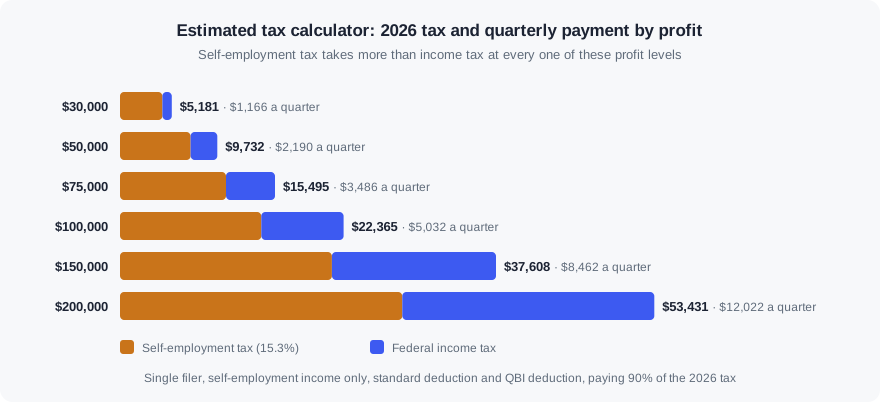
2026 Estimated Tax by Self-Employment Income

A single filer whose only income is self-employment profit, with the standard deduction and the QBI deduction, paying 90% of the 2026tax. Paying 100% of last year's tax instead may be lower.

Estimated tax calculator chart: 2026 federal tax on $75,000 of self-employment profit is $15,495, or $3,486 a quarter, split into self-employment tax and income tax
2026 self-employment tax and income tax by net profit, with the quarterly payment.
Net profitSE taxIncome taxTotal 2026 taxQuarterly payment
$30,000$4,239$942$5,181 (17.3%)$1,166
$50,000$7,065$2,667$9,732 (19.5%)$2,190
$75,000$10,597$4,898$15,495 (20.7%)$3,486
$100,000$14,130$8,235$22,365 (22.4%)$5,032
$150,000$21,194$16,413$37,608 (25.1%)$8,462
$200,000$28,234$25,196$53,431 (26.7%)$12,022

For the self-employment tax piece on its own, use the self-employment tax calculator.

DEADLINES

2026 Estimated Tax Due Dates

PaymentDue dateIncome earned
1stApril 15, 2026January 1 – March 31
2ndJune 15, 2026April 1 – May 31
3rdSeptember 15, 2026June 1 – August 31
4thJanuary 15, 2027September 1 – December 31

The quarters are not equal: the second covers two months and the fourth covers four. If a due date falls on a weekend or federal holiday, it moves to the next business day. Missed the September payment? Pay it now: the penalty is charged daily, so a late payment costs less than none.

WORKED EXAMPLES

Estimated Tax Examples

Full-time freelancer, single, $80,000 profit, $12,000 of tax last year. The 2026 bill is $16,647.47: $11,303.64 of self-employment tax and $5,343.83 of income tax. 90% of that is $14,982.72, but last year's $12,000 is smaller, so the required payment is $12,000.00: $3,000.00 a quarter. The remaining $4,647.47 is due in April 2027, penalty-free.

Married couple with a side business. $95,000 of wages with $7,600 withheld, plus $25,000 of 1099 profit, and $9,000 of tax last year. Total 2026 tax is $12,802.83. The safe harbor is $9,000.00; after withholding that leaves $1,400.00, or $350.00 a quarter. Raising W-4 withholding by the same amount would do the job without quarterly payments.

Employee with a little interest income. $70,000 of wages, $6,800 withheld and $3,000 of interest. The tax is $7,230.00, so withholding leaves $430.00 to pay at filing: under $1,000, so no estimated payments are needed.

LOWER OR AVOID THE PAYMENTS

Ways to Pay Less Each Quarter

  • Use last year's tax. If income is rising, 100% (or 110%) of last year's tax is a fixed, smaller target than 90% of this year's.
  • Withhold more from a W-2 job. Extra withholding on a new W-4 counts as paid evenly through the year.
  • Fund a SEP-IRA or solo 401(k). Contributions cut AGI and the income tax, though not the self-employment tax.
  • Deduct health insurance premiums. Self-employed health insurance is an above-the-line deduction.
  • Annualize uneven income. If most of your income arrives late in the year, Form 2210 Schedule AI lets the earlier payments be smaller.
  • Apply last year's refund. An overpayment applied to 2026 counts toward the first quarter.

FREQUENTLY ASKED QUESTIONS

Estimated Tax FAQ

How do I calculate my 2026 estimated tax?+

Project your 2026 income, subtract the standard deduction ($16,100 single, $32,200 married filing jointly) and figure the income tax on what is left. Add self-employment tax of 15.3% on 92.35% of your net profit. Your required payment is the smaller of 90% of that total or 100% of last year's tax (110% if last year's AGI was over $150,000). Subtract withholding and divide by four.

Who has to pay estimated taxes?+

Anyone who expects to owe $1,000 or more when they file, after withholding and refundable credits. That usually means freelancers, 1099 contractors, small-business owners, landlords, retirees with untaxed distributions and anyone with large investment income. You don't need to pay if you owed no tax for a full 12-month 2025.

When are 2026 estimated tax payments due?+

April 15, 2026, June 15, 2026, September 15, 2026, January 15 and 2027. The January payment can be skipped if you file your 2026 return by February 1, 2027 and pay the whole balance with it.

What is the safe harbor for estimated taxes?+

You avoid the underpayment penalty if your withholding and estimated payments add up to at least the smaller of 90% of this year's tax or 100% of last year's. If last year's AGI was over $150,000 ($75,000 married filing separately), the prior-year figure is 110%. Paying the safe harbor only avoids the penalty; any balance is still due when you file.

How much should I set aside from 1099 income for taxes?+

For most freelancers, 20% to 30% of net profit covers federal income tax and self-employment tax. In the quick-reference table, a single filer with $75,000 of profit owes $15,495, about 21% of profit. Add your state's income tax on top.

What happens if I don't pay estimated taxes?+

The IRS charges an underpayment penalty, figured on Form 2210 like interest: the short-term federal rate plus 3 percentage points, on each late quarter's shortfall, for the days it was late. It is not a flat fine, so paying a missed quarter as soon as possible stops it growing.

Can I pay all of my estimated tax at once?+

Yes, by the first due date. Paying it all in January of the following year is too late for the earlier quarters, because each quarter's payment is due by its own date. If your income comes unevenly, the annualized income method on Form 2210 Schedule AI can lower the earlier payments.

I have a job and a side business. Do I still need to pay quarterly?+

Not if you raise your W-4 withholding enough to cover the extra tax. Withholding counts as paid evenly through the year, even if you increase it in November, which makes it the easiest way to catch up on a shortfall late in the year.

How do I make an estimated tax payment?+

Online through IRS Direct Pay, your IRS online account or EFTPS, by debit or credit card through an approved processor, or by mailing a check with a Form 1040-ES voucher. Choose the payment type "estimated tax" and the correct tax year.

SOURCES

Where these figures come from

2026 rate schedules and standard deductions are from IRS Revenue Procedure 2025-32. The safe harbor, $1,000 test and due dates follow the 2026 Form 1040-ES instructions and IRS Publication 505. The $184,500 Social Security wage base is the SSA's 2026 figure.

Disclaimer: an estimate, not tax advice. It assumes the standard deduction, taxes all income at ordinary rates, simplifies the QBI deduction and leaves out the alternative minimum tax, the net investment income tax, refundable credits and state tax.

Reviewed by: Paycheck Calculator Editorial Team

Rates current for tax year 2026

2026 TAX WORKSHEETS

Related 2026 tax worksheets and rates