How Many Pay Periods in a Year? Weekly, Biweekly, Semimonthly and Monthly
How many pay periods in a year depends on how often you are paid: 52 weekly, 26 biweekly, 24 semimonthly and 12 monthly. Weekly and biweekly schedules sometimes pick up one extra period, giving 53 or 27 paychecks that year. A $60,000 salary works out to $1,153.85 per weekly check or $2,307.69 per biweekly check.
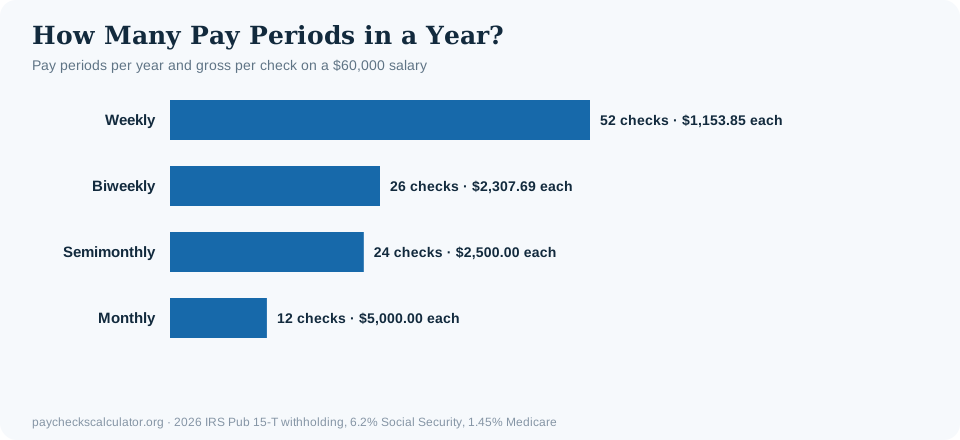
- Weekly 52 · biweekly 26 · semimonthly 24 · monthly 12.
- A pay period is the work span a check covers; payday is when it is paid.
- 27-paycheck biweekly years ahead for Friday payrolls: 2027, 2032, 2038.
- Annual pay and annual tax do not depend on the count, only check size does.
- Divide salary by pay periods for gross per check; multiply a check by periods for annual pay.
How Many Pay Periods in a Year for Each Pay Schedule
US employers use four standard schedules. The count of pay periods per year follows directly from how the schedule is defined, and it is the same count the IRS uses in the withholding tables of Publication 15-T.
| Schedule | Pay periods per year | How paydays fall | Occasional extra |
|---|---|---|---|
| Weekly | 52 | Every week, same weekday | 53 |
| Biweekly | 26 | Every other week, same weekday | 27 |
| Semimonthly | 24 | Twice a month on fixed dates (e.g. 15th and last day) | None |
| Monthly | 12 | Once a month on a fixed date | None |
Biweekly is the most common schedule in the US private sector, followed by weekly. Semimonthly is popular for salaried office staff, and monthly pay is more common outside the US than inside it; several states restrict how often an employer may pay monthly.
What Is a Pay Period?
A pay periodis the block of days your employer tallies work for before paying you. On a weekly schedule that might be Sunday through Saturday; on a semimonthly schedule, the 1st through the 15th and the 16th through month-end. Your pay stub shows it as "period start" and "period end" or as a date range.
The pay period is not the same as payday. Payroll needs time to collect timesheets and run calculations, so most employers pay a few days to a week after the period closes. Someone whose period ends Saturday might be paid the following Friday. That lag is why your first paycheck at a new job can take two or three weeks to arrive.
For overtime purposes, the Fair Labor Standards Act uses a different unit again: the workweek, a fixed seven-day span that the employer sets. A biweekly pay period holds exactly two workweeks; a semimonthly one does not, which matters for hourly workers.
Pay Per Check on a $60,000 Salary
Dividing the same salary by more pay periods makes each check smaller. Annual take-home stays the same because withholding scales with the count.
| Schedule | Pay periods | Gross per check | Federal tax | Social Security + Medicare | Take-home per check |
|---|---|---|---|---|---|
| Weekly | 52 | $1,153.85 | $96.54 | $88.27 | $969.04 |
| Biweekly | 26 | $2,307.69 | $193.08 | $176.54 | $1,938.08 |
| Semimonthly | 24 | $2,500.00 | $209.17 | $191.25 | $2,099.58 |
| Monthly | 12 | $5,000.00 | $418.33 | $382.50 | $4,199.17 |
Every row multiplies back to $50,390.00 of take-home pay for the year. In a state with income tax, each check would be lower by the state withholding; the state paycheck calculators handle that for every state.
When There Are 27 or 53 Pay Periods in a Year
A calendar year is 365 days, which is 52 weeks plus one day (two in a leap year). Those spare days add up. Every so often a weekly schedule fits 53 paydays into one year, and a biweekly schedule fits 27.
| Schedule | Years with an extra paycheck |
|---|---|
| Weekly, paid Fridays | 2027, 2032, 2038 |
| Biweekly, first 2026 payday Jan 2 | 2027, 2038 |
| Biweekly, first 2026 payday Jan 9 | 2032 |
In a 27-pay year, the January 2 cohort's first payday falls on January 1, 2027, a bank holiday, so many employers pay on December 31, 2026 instead. That moves the check into the earlier tax year and leaves 2027 with 26 paychecks. Ask payroll which way your employer handles it.
Using Pay Periods in Paycheck Math
Annual pay = gross per check × pay periods per year
Monthly pay = gross per check × pay periods ÷ 12
The count shows up in more places than you might expect: annualizing a check for a loan application, converting an hourly rate (2,080 hours ÷ 26 = 80 hours per biweekly period), setting a 401(k) contribution to hit the annual limit, or spreading an extra W-4 withholding amount across the remaining checks of the year. Using 24 when you are actually paid 26 times is the most common slip, and it misstates annual income by about 8%.
How to Tell Which Pay Schedule You Are On
- Find two recent pay stubs and note the pay dates.
- Seven days apart means weekly (52); fourteen days apart means biweekly (26).
- The same two dates every month (for example, the 15th and the 30th) means semimonthly (24).
- One date a month means monthly (12).
If you are still unsure, the pay period dates printed on the stub settle it. For a side-by-side of the two schedules that cause the most confusion, read semimonthly vs biweekly pay. Once you know how many pay periods in a year you have, the paycheck calculators for each schedule will show your exact take-home pay.
COMMON QUESTIONS
Frequently Asked Questions
How many pay periods are in a year?+
It depends on the schedule: 52 for weekly pay, 26 for biweekly, 24 for semimonthly and 12 for monthly. Weekly and biweekly schedules occasionally have one extra pay period (53 or 27) when the calendar year contains an extra payday.
What is a pay period?+
A pay period is the stretch of days an employer counts work for before issuing a paycheck, such as one week or the 1st through the 15th. The payday is the date the money is paid, which is often a few days to a week after the period ends.
How many pay periods are in a year if paid biweekly?+
Twenty-six in most years. A year has 52 weeks plus one or two extra days, so roughly every 11 years a biweekly schedule fits 27 paydays into one calendar year.
Are there 24 or 26 pay periods in a year?+
Both exist. Twenty-four is semimonthly (twice a month on set dates); twenty-six is biweekly (every two weeks). Check your pay stub or offer letter: if paydays fall on the same weekday, you are biweekly; if they fall on the same dates, you are semimonthly.
How many weeks are in a pay period?+
One for weekly pay and two for biweekly. Semimonthly periods are about 2.17 weeks on average but vary from 13 to 16 days, and monthly periods average about 4.33 weeks.
Does the number of pay periods change how much tax I pay?+
No. Withholding tables convert each check to an annual figure using the pay-period count, so the yearly total is the same on any schedule. What can drift is a 27th or 53rd paycheck year, where per-check withholding assumes the usual count and the extra check adds income.
Sources and How We Checked the Numbers
Every dollar figure in this article is produced by the same 2026 payroll engine that runs our calculators: the IRS percentage method from Publication 15-T for federal withholding, the 2026 Social Security wage base, and the state rules documented on our methodology page. Rates and limits were checked against these primary sources:
- IRS Publication 15-T, Federal Income Tax Withholding Methods, Table 3 (payroll periods)
- U.S. Department of Labor, State Payday Requirements
- U.S. Bureau of Labor Statistics, How frequently do private businesses pay workers?
- 29 CFR 778.105, Determining the workweek
Disclaimer:examples are estimates for a single W-4 with no adjustments unless stated otherwise. Your employer's payroll system, benefit elections and year-to-date wages determine your actual paycheck.