How to Read a Pay Stub: Every Line, Abbreviation and YTD Figure
To read a pay stub, follow the money from top to bottom: gross pay (what you earned), minus pre-tax deductions (401(k), health premiums), minus taxes (FIT, Social Security/OASDI, Medicare, state), minus post-tax deductions, equals net pay, the deposit. On the example stub below, $2,307.69 of gross pay becomes $1,680.57 of net pay.
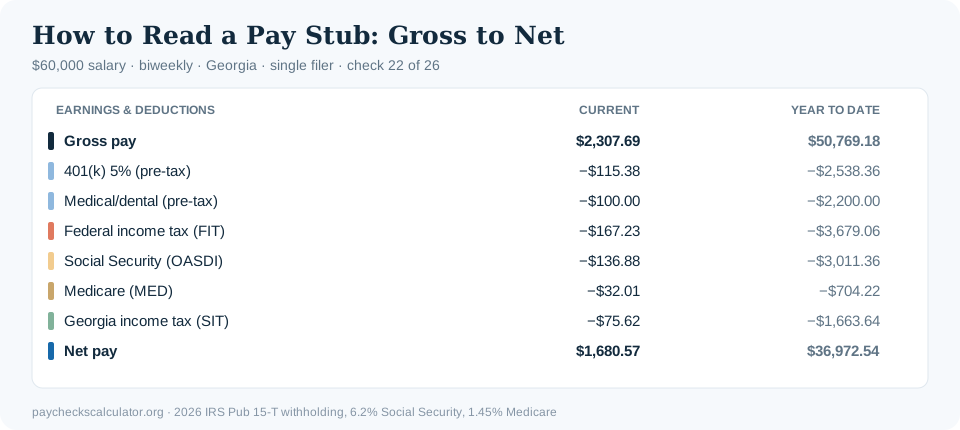
- Gross − pre-tax deductions − taxes − post-tax deductions = net pay.
- FIT = federal income tax; OASDI = Social Security; MED = Medicare.
- Current column is this check; YTD column is January 1 to date.
- 401(k) lowers income-tax wages, not Social Security or Medicare wages.
- Check rate, hours, deductions and YTD every period.
How to Read a Pay Stub: The Five Sections
Pay stubs look different from one payroll provider to the next, but nearly all of them have the same five blocks. Find them first and the rest of the stub falls into place.
- Header: employer, employee name and ID, pay period start and end, pay date, and sometimes filing status from your W-4.
- Earnings: each type of pay (regular, overtime, holiday, bonus) with hours, rate and amount. Their total is gross pay.
- Pre-tax deductions: traditional 401(k), health, dental and vision premiums, HSA and FSA contributions.
- Taxes: FIT, Social Security and Medicare, followed by any state, city or disability withholding.
- Post-tax deductions and net pay: Roth 401(k), union dues, garnishments, then the amount deposited.
Many stubs also list employer contributions (401(k) match, employer health premium) and paid-time-off balances. Those are informational; they do not change your net pay.
Example Pay Stub, Line by Line
Here is a biweekly stub for a single filer in Georgia on a $60,000.00 salary, contributing 5% to a traditional 401(k) and paying $100.00 per check for pre-tax health coverage. It is the 22nd paycheck of 2026, so the YTD column covers 22 pay periods.
| Line | Current | Year to date |
|---|---|---|
| Regular salary (80 h) | $2,307.69 | $50,769.18 |
| Gross pay | $2,307.69 | $50,769.18 |
| 401(k) 5% (pre-tax) | −$115.38 | −$2,538.36 |
| Medical/dental (pre-tax) | −$100.00 | −$2,200.00 |
| Federal income tax (FIT) | −$167.23 | −$3,679.06 |
| Social Security (OASDI) | −$136.88 | −$3,011.36 |
| Medicare (MED) | −$32.01 | −$704.22 |
| Georgia income tax (SIT) | −$75.62 | −$1,663.64 |
| Net pay | $1,680.57 | $36,972.54 |
Reading it: gross pay is $2,307.69, which is $60,000.00 ÷ 26. Pre-tax deductions take $215.38. Taxes take $411.74 in total. Nothing is deducted after tax, so net pay is $1,680.57, about 73% of gross. Of the $627.12 difference, $115.38 is your own retirement savings rather than a cost.
Common Pay Stub Abbreviations
| Abbreviation | Meaning |
|---|---|
| FIT, FWT, Fed W/H | Federal income tax withholding |
| OASDI, SS, FICA-SS | Social Security (6.2%) |
| MED, MEDI, FICA-MED | Medicare (1.45%, plus 0.9% over $200,000) |
| SIT, SWT, ST | State income tax |
| LIT, LOC, CITY | Local or city income tax |
| SDI, FLI, PFML | State disability or paid family leave insurance |
| 401K, 401K-R / ROTH | Traditional or Roth 401(k) deferral |
| MED/DEN/VIS, SEC125 | Pre-tax health, dental, vision premiums |
| REG, OT, HOL, PTO | Regular, overtime, holiday and paid-time-off hours |
| YTD | Year to date |
FIT is the line people ask about most. Our page on what FIT means on a paycheck explains how it is calculated and how a new W-4 changes it.
Reading the Year-to-Date Column
The YTD column is the most useful part of a pay stub and the most overlooked. It answers questions a single check cannot:
- What have I earned this year? YTD gross, which lenders use to verify income.
- Will my W-2 match? YTD taxable wages and taxes become W-2 boxes 1 through 6 and 16 to 17.
- Am I on track for my 401(k) goal? YTD deferrals versus the 2026 limit of $24,500.
- Has Social Security stopped? High earners see YTD OASDI freeze at $11,439 once wages pass $184,500.
To project annual income from the YTD column, divide YTD gross by paychecks received and multiply by your pay periods per year; the method is in how to calculate annual income.
Why a Pay Stub Can Show Three Different Taxable Wages
Pre-tax deductions do not all reduce the same taxes, so some stubs print separate wage bases:
| Wage base | Reduced by 401(k)? | Reduced by health premium? | Example, this check |
|---|---|---|---|
| Federal taxable wages | Yes | Yes | $2,092.31 |
| Social Security wages | No | Yes | $2,207.69 |
| Medicare wages | No | Yes | $2,207.69 |
This is also why W-2 box 1 is usually lower than boxes 3 and 5. For a fuller list of which deductions come out before tax, see pre-tax vs post-tax deductions.
What to Check on Every Pay Stub
- Hours and rate. Do regular and overtime hours match your timesheet? Is the rate current after a raise?
- Deductions. Do benefit amounts match what you elected at enrollment?
- Tax setup. Is the right state listed after a move or a remote-work change?
- Net pay. Does it match the deposit in your bank account?
- YTD continuity. Does each YTD figure equal last stub's YTD plus this check?
Once you know how to read a pay stub, the layout stops looking like a wall of codes: it is one subtraction from gross to net, shown twice, once for this check and once for the year.
COMMON QUESTIONS
Frequently Asked Questions
How do I read my pay stub?+
Work from top to bottom. Gross pay is what you earned before anything came out. Below it are pre-tax deductions (such as 401(k) and health premiums), then the tax lines (FIT, OASDI, MED, plus any state or city tax), then post-tax deductions. Net pay at the bottom is what was deposited. Each line has a current-period column and a year-to-date column.
What does YTD mean on a pay stub?+
Year to date: the running total of each line from January 1 through the current pay date. YTD gross is the figure lenders use to verify income, and YTD tax totals will match your W-2 if nothing changes before year-end.
What is OASDI on my pay stub?+
OASDI stands for Old-Age, Survivors and Disability Insurance, the formal name for Social Security. It is 6.2% of wages up to the annual wage base ($184,500 in 2026). Medicare usually appears on the next line as MED or Medicare at 1.45%.
What does FIT mean on a pay stub?+
FIT is federal income tax withholding. It is calculated from your W-4 and the IRS percentage method in Publication 15-T, and it is the one tax line you can change by filing a new W-4 with your employer.
Why is my taxable wage different from my gross pay?+
Pre-tax deductions come out first. A traditional 401(k) lowers federal and most state taxable wages but not Social Security or Medicare wages. Section 125 health premiums lower all of them. That is why a stub may show three different wage bases.
How long should I keep pay stubs?+
At least until you have checked them against your W-2 in January. Many people keep a year of stubs, plus the last stub of each year, for loan applications and to resolve disputes. Employers must keep payroll records for at least three years under the FLSA.
Sources and How We Checked the Numbers
Every dollar figure in this article is produced by the same 2026 payroll engine that runs our calculators: the IRS percentage method from Publication 15-T for federal withholding, the 2026 Social Security wage base, and the state rules documented on our methodology page. Rates and limits were checked against these primary sources:
- IRS Publication 15-T, Federal Income Tax Withholding Methods
- IRS Topic No. 751, Social Security and Medicare Withholding Rates
- Georgia Department of Revenue, 2026 Employer's Tax Guide
- U.S. Department of Labor, Recordkeeping requirements under the FLSA (Fact Sheet #21)
Disclaimer:examples are estimates for a single W-4 with no adjustments unless stated otherwise. Your employer's payroll system, benefit elections and year-to-date wages determine your actual paycheck.