Exempt vs Non-Exempt Employee: Salary Tests, Overtime and 2026 Thresholds
Exempt vs non-exempt employee status decides whether you are owed overtime. A non-exempt employee must be paid 1.5× for hours over 40 a week. An exempt employee is not, but only if they are paid a fixed salary of at least $684 a week ($35,568 a year) under federal law and their main duties are executive, administrative or professional. California, New York and several other states set higher salary floors for 2026.
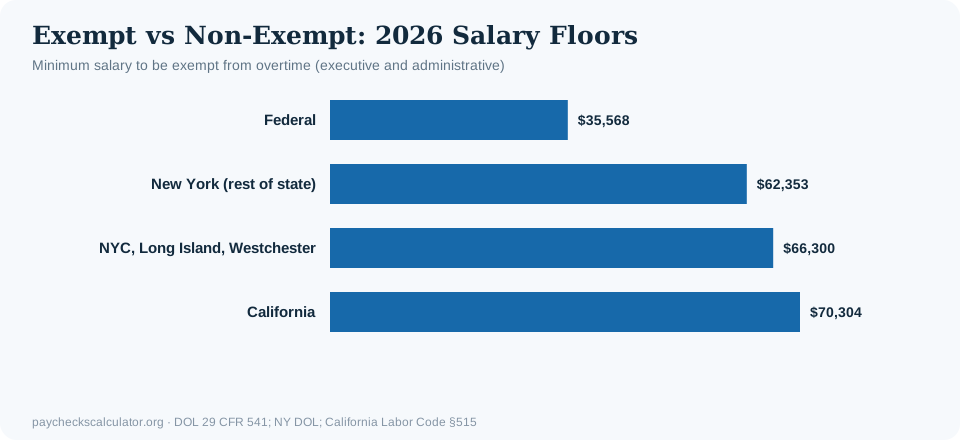
- Three tests for exemption: salary basis, salary level, duties.
- Federal salary level: $684/week ($35,568); HCE: $107,432.
- State floors can be much higher: California $70,304 in 2026.
- Salaried does not mean exempt; job title does not decide it.
- Misclassification can mean up to two years of back overtime (three if willful).
Exempt vs Non-Exempt Employee: What the Terms Mean
"Exempt" is short for exempt from the overtime and minimum-wage provisions of the Fair Labor Standards Act (FLSA). Every employee is non-exempt by default. An employer may treat someone as exempt only if the job meets one of the exemptions in 29 CFR Part 541, and the burden of proving it falls on the employer.
| Non-exempt | Exempt | |
|---|---|---|
| Overtime after 40 hours | Yes, 1.5× the regular rate | No |
| Minimum wage protection | Yes, for every hour | Covered by the salary floor |
| How pay is set | Usually hourly; can be salaried | Fixed salary (with narrow exceptions) |
| Hours tracked | Required | Not required for pay purposes |
| Pay docked for partial days | Yes, for hours not worked | Generally no |
The Three Tests for Exempt Status
For the white-collar exemptions (executive, administrative and professional) all three tests must be met:
- Salary basis: paid a predetermined, fixed salary that is not reduced because of the quality or quantity of work. Deductions are allowed only in limited cases, such as full-day absences for personal reasons.
- Salary level: paid at least the threshold, currently $684 a week federally, or more under state law.
- Duties:primary duties match the exemption's definition. Title and job description do not decide it; what the person actually does does.
2026 Exempt Salary Thresholds
In November 2024 a federal court in Texas vacated the Department of Labor's 2024 overtime rule, which would have raised the federal threshold to $1,128 a week. The DOL kept enforcing the 2019 levels and formally restored them in May 2026. States may set higher floors, and where they do, the higher figure applies.
| Jurisdiction | Weekly | Annual |
|---|---|---|
| Federal (FLSA standard salary level) | $684.00 | $35,568.00 |
| Federal highly compensated employee | — | $107,432.00 |
| New York outside NYC, Long Island, Westchester | $1,199.10 | $62,353.20 |
| New York City, Long Island, Westchester | $1,275.00 | $66,300.00 |
| California (2 × state minimum wage × 2,080) | $1,352.00 | $70,304.00 |
Washington, Colorado and a few other states also set thresholds above the federal level, and some of them adjust every January. Check your state labor department before relying on the federal figure.
The Duties Tests in Plain English
- Executive: primary duty is managing the business or a department, regularly directing at least two full-time employees, with real input into hiring and firing.
- Administrative: office or non-manual work tied to management or general business operations, with discretion and independent judgment on significant matters. HR, finance and compliance roles often qualify; clerical and data-entry roles do not.
- Learned professional: work requiring advanced knowledge in science or learning, normally acquired through prolonged specialized study, such as accountants, engineers, registered nurses and pharmacists.
- Creative professional: work requiring invention, imagination or originality in an artistic or creative field.
- Computer employee: systems analysts, programmers and software engineers, paid the salary level or at least $27.63 an hour.
- Outside sales:primary duty is making sales away from the employer's place of business; no salary test.
Blue-collar workers who perform work involving repetitive operations with their hands, along with police, firefighters, paramedics and similar first responders, are not exempt under these rules regardless of pay.
Exempt vs Non-Exempt: What It Means for Your Paycheck
Classification matters most when hours run long. Compare the same $45,000 job at 50 hours a week under each status:
| Exempt (salaried) | Non-exempt | |
|---|---|---|
| Base pay | $45,000 | $21.63/hour × 2,080 = $45,000 |
| Overtime pay | $0 | $16,862 |
| Annual gross | $45,000 | $61,862 |
| Effective hourly rate | $17.31 | $23.79 |
At 50 hours, the non-exempt worker earns $16,862 more. In weeks under 40 hours, the exempt worker is ahead, because the salary is guaranteed. Neither status changes how your pay is taxed, and only non-exempt overtime qualifies for the new federal overtime deduction. To price your own overtime, use the overtime calculator or read how to calculate overtime pay.
Misclassification and Back Pay
Misclassifying a non-exempt employee as exempt is one of the most common wage-and-hour violations. An employee can recover unpaid overtime for two years, or three if the violation was willful, plus an equal amount in liquidated damages. Several states allow longer look-back periods. If you think you are misclassified, keep a record of hours worked and contact the Wage and Hour Division or your state labor department.
For Employers: Getting Classification Right
Review each exempt role against the salary level and the duties test, not the title, and re-check every January when state thresholds change. Track hours for every non-exempt employee, including salaried non-exempt staff, and fold nondiscretionary bonuses into the regular rate for overtime. Payroll software can apply the overtime rules automatically once each employee's classification is set correctly.
The exempt vs non exempt employee distinction comes down to pay and duties, and the line moves with state law. Run the numbers both ways before accepting or offering a salaried role that will routinely exceed 40 hours.
COMMON QUESTIONS
Frequently Asked Questions
What is the difference between exempt and non-exempt employees?+
Non-exempt employees are covered by the Fair Labor Standards Act's minimum wage and overtime rules and earn time and a half for every hour beyond 40 in a workweek. Exempt employees meet specific salary and job-duties tests and are not owed federal overtime, no matter how many hours they work.
What is the 2026 salary threshold for exempt employees?+
Under federal law, $684 a week ($35,568 a year) for the executive, administrative and professional exemptions, and $107,432 in total annual compensation for highly compensated employees. A 2024 rule that would have raised these amounts was vacated in court, and the Department of Labor formally restored the 2019 levels in 2026. Several states set higher thresholds.
Can a salaried employee be non-exempt?+
Yes. Being paid a salary satisfies only one of the tests. A salaried employee who earns below the threshold, or whose duties do not meet an exemption, is non-exempt and must be paid overtime for hours over 40.
Can an hourly employee be exempt?+
Usually not, because most exemptions require a salary. The main exceptions are computer professionals paid at least $27.63 an hour, outside sales employees, and licensed doctors, lawyers and teachers, who have no salary requirement.
Is it better to be exempt or non-exempt?+
It depends on hours. Exempt roles usually pay a steady salary, often with more flexibility, while non-exempt roles pay for every overtime hour. If you regularly work well over 40 hours, a non-exempt job at the same base pay can earn noticeably more.
Can my employer change me from exempt to non-exempt?+
Yes, as long as the change is applied going forward and pay remains at least minimum wage for all hours. Employers often reclassify when a salary threshold rises or after an audit. Back pay may be owed if an employee was misclassified in the past.
Sources and How We Checked the Numbers
Every dollar figure in this article is produced by the same 2026 payroll engine that runs our calculators: the IRS percentage method from Publication 15-T for federal withholding, the 2026 Social Security wage base, and the state rules documented on our methodology page. Rates and limits were checked against these primary sources:
- U.S. Department of Labor, Earnings thresholds for the FLSA Part 541 exemptions
- DOL Fact Sheet #17A, Exemption for Executive, Administrative, Professional, Computer and Outside Sales Employees
- 29 CFR Part 541, Defining and delimiting the exemptions
- California Labor Commissioner, Exemptions from overtime
- New York State Department of Labor, Minimum wage and exempt salary thresholds
Disclaimer:examples are estimates for a single W-4 with no adjustments unless stated otherwise. Your employer's payroll system, benefit elections and year-to-date wages determine your actual paycheck.