What Is Taxable Income? How to Calculate It for 2026
Taxable income is the amount the IRS applies tax rates to: your total income, minus adjustments such as HSA or traditional IRA contributions, minus the standard deduction ($16,100 single, $32,200 married filing jointly for 2026) or your itemized deductions. A single filer on a $60,000 salary who puts $3,000 in a 401(k) and pays health premiums pre-tax ends up with $39,500 of taxable income and about $4,492 of federal income tax.
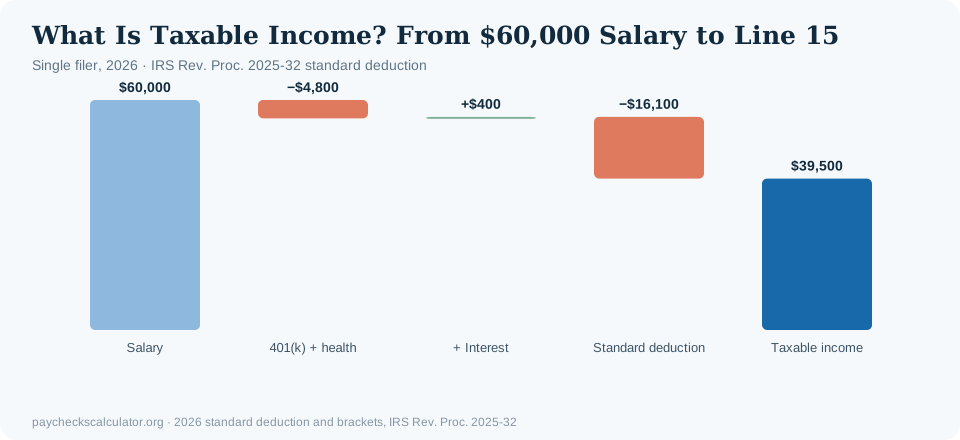
- Taxable income = gross income − adjustments − standard or itemized deduction.
- 2026 standard deduction: $16,100 single, $32,200 joint, $24,150 head of household.
- Pre-tax 401(k), HSA and Section 125 health premiums never reach gross income.
- Tax brackets apply to taxable income, not salary.
- Taxable income sits on Form 1040, line 15.
What Is Taxable Income?
Taxable income is the figure that federal income tax rates are applied to. It is always smaller than what you earned, sometimes by a lot, because the tax code lets you exclude some income outright and subtract deductions from the rest. When people say they are "in the 22% bracket," the bracket refers to taxable income, not salary.
Three terms sit on the path from paycheck to tax bill, and they are easy to mix up. Gross income is everything you received that the law does not exclude. Adjusted gross income (AGI)is gross income after a short list of "above-the-line" adjustments. Taxable income is AGI after the standard or itemized deduction and a few others. Each step is a line on Form 1040.
The Taxable Income Formula
AGI − standard or itemized deduction − QBI deduction = taxable income
On the current Form 1040, total income is line 9, AGI is line 11, deductions run from line 12 to line 14 (line 13 now also carries the new overtime, tip, car-loan interest and senior deductions from Schedule 1-A), and taxable income is line 15. Line numbers can shift when the IRS redesigns the form, so check the label. Tax is then computed from line 15 using the tax tables, the Tax Computation Worksheet for incomes of $100,000 or more, or the qualified dividends worksheet when you have long-term gains or qualified dividends.
How to Calculate Taxable Income: A $60,000 Worked Example
Take a single filer earning a $60,000 salary in 2026 who contributes 5% to a traditional 401(k), pays $150 a month in health premiums through a pre-tax cafeteria plan, earns $400 of savings interest, and takes the standard deduction.
| Step | Amount | Where it comes from |
|---|---|---|
| Salary | $60,000 | Offer letter |
| − Traditional 401(k) (5%) | −$3,000 | Excluded from W-2 box 1 |
| − Pre-tax health premiums | −$1,800 | Section 125 plan, excluded from box 1 |
| = W-2 box 1 wages | $55,200 | Form 1040 line 1a |
| + Savings interest | $400 | Form 1099-INT |
| = Total income / AGI | $55,600 | Lines 9 and 11 (no adjustments here) |
| − Standard deduction | −$16,100 | Line 12 |
| = Taxable income | $39,500 | Line 15 |
| Federal income tax | $4,492.00 | 10% of the first $12,400, 12% of the rest |
Notice how far taxable income is from salary: $60,000 of pay produces $39,500 of taxable income. The tax of $4,492.00 is about 7.49% of salary, even though this filer's top bracket is 12%. A married couple filing jointly on $110,000 of wages would subtract $32,200 and have $77,800 of taxable income, for $8,840.00 of tax.
Taxable vs Non-Taxable Income
IRS Publication 525 is the full list. The short version: income is taxable unless a specific rule excludes it.
| Income | Federal treatment |
|---|---|
| Wages, salary, tips, bonuses, commission | Taxable |
| Self-employment and 1099 income | Taxable (profit after expenses) |
| Interest and ordinary dividends | Taxable |
| Qualified dividends and long-term gains | Taxable at 0%, 15% or 20% |
| Unemployment compensation | Taxable |
| Social Security benefits | Up to 85% taxable, depending on other income |
| Gifts and inheritances received | Not taxable to you |
| Child support | Not taxable |
| Employer-paid health insurance | Not taxable |
| Municipal bond interest | Not taxable federally |
| Qualified Roth IRA and HSA withdrawals | Not taxable |
If you freelance on the side, the profit counts even when no form arrives; our guide to what a 1099 form is explains the reporting thresholds.
The 2026 Standard Deduction
Most filers take the standard deduction because it is larger than their itemized deductions would be. For 2026 the IRS set it at:
| Filing status | Standard deduction |
|---|---|
| Single or married filing separately | $16,100 |
| Married filing jointly | $32,200 |
| Head of household | $24,150 |
You itemize instead when mortgage interest, state and local taxes (capped, with a higher limit under the 2025 tax law), charitable gifts and large medical expenses add up to more than these amounts. Itemizing is an either-or choice; you cannot take both.
How Tax Brackets Apply to Taxable Income
Brackets are marginal. Each rate applies only to the slice of taxable income inside its band, so moving into a higher bracket never makes your whole income taxed at the higher rate.
| Rate | Single | Married filing jointly |
|---|---|---|
| 10% | $0 – $12,400 | $0 – $24,800 |
| 12% | $12,400 – $50,400 | $24,800 – $100,800 |
| 22% | $50,400 – $105,700 | $100,800 – $211,400 |
| 24% | $105,700 – $201,775 | $211,400 – $403,550 |
| 32% | $201,775 – $256,225 | $403,550 – $512,450 |
| 35% | $256,225 – $640,600 | $512,450 – $768,700 |
| 37% | Over $640,600 | Over $768,700 |
Legitimate Ways to Lower Taxable Income
- Traditional 401(k) or 403(b): contributions come out of wages before federal tax.
- HSA: payroll or direct contributions are excluded or deductible if you have a qualifying high-deductible plan.
- Traditional IRA: deductible within income limits if you or a spouse has a workplace plan.
- Pre-tax benefits: health, dental, vision premiums and dependent care FSA through a cafeteria plan.
- Self-employed: business expenses, half of self-employment tax, and the qualified business income deduction.
- Overtime and tips (2025–2028): new federal deductions for qualified overtime premium and tips; see no tax on overtime.
To see how a pre-tax contribution changes each paycheck rather than the annual return, try the 401(k) paycheck impact calculator. Knowing what taxable income is, and which line of the return it lives on, makes every other tax number easier to check.
COMMON QUESTIONS
Frequently Asked Questions
What is taxable income in simple terms?+
Taxable income is the part of your income the IRS actually applies tax rates to. You start with all your income, subtract certain adjustments such as traditional IRA or HSA contributions to reach adjusted gross income, then subtract the standard deduction or your itemized deductions. Whatever is left is taxable income.
Is taxable income the same as gross income?+
No. Gross income is everything you received that is not specifically excluded. Taxable income is gross income minus adjustments and deductions. For a single filer in 2026 the gap is at least the $16,100 standard deduction, and more if you contribute pre-tax to a 401(k), HSA or traditional IRA.
What is the 2026 standard deduction?+
$16,100 for single filers and married people filing separately, $32,200 for married couples filing jointly, and $24,150 for heads of household, under IRS Revenue Procedure 2025-32. People 65 or older or blind get an additional amount, and the One Big Beautiful Bill Act added a separate senior deduction for 2025 through 2028.
What income is not taxable?+
Common examples are gifts and inheritances you receive, life insurance death benefits, child support, qualified Roth IRA withdrawals, qualified HSA withdrawals for medical expenses, most employer-paid health insurance, and municipal bond interest for federal purposes. Some Social Security benefits are also excluded, depending on your other income.
Is taxable income before or after 401(k) contributions?+
After traditional 401(k) contributions. Pre-tax deferrals are left out of box 1 of your W-2, so they never enter gross income for federal tax. Roth 401(k) deferrals go in after tax, so they leave taxable income unchanged. Neither type reduces Social Security or Medicare wages.
How do I find my taxable income on my tax return?+
On Form 1040 it is line 15, labelled taxable income. It equals adjusted gross income on line 11 minus the deductions on lines 12 through 14. If you have not filed yet, your final pay stub of the year gives a starting point: year-to-date federal taxable wages.
Sources and How We Checked the Numbers
Every dollar figure in this article is produced by the same 2026 payroll engine that runs our calculators: the IRS percentage method from Publication 15-T for federal withholding, the 2026 Social Security wage base, and the state rules documented on our methodology page. Rates and limits were checked against these primary sources:
- IRS Revenue Procedure 2025-32 (2026 tax rate tables and standard deduction)
- IRS Publication 525, Taxable and Nontaxable Income
- IRS Publication 17, Your Federal Income Tax
- IRS, About Form 1040
Disclaimer:examples are estimates for a single W-4 with no adjustments unless stated otherwise. Your employer's payroll system, benefit elections and year-to-date wages determine your actual paycheck.